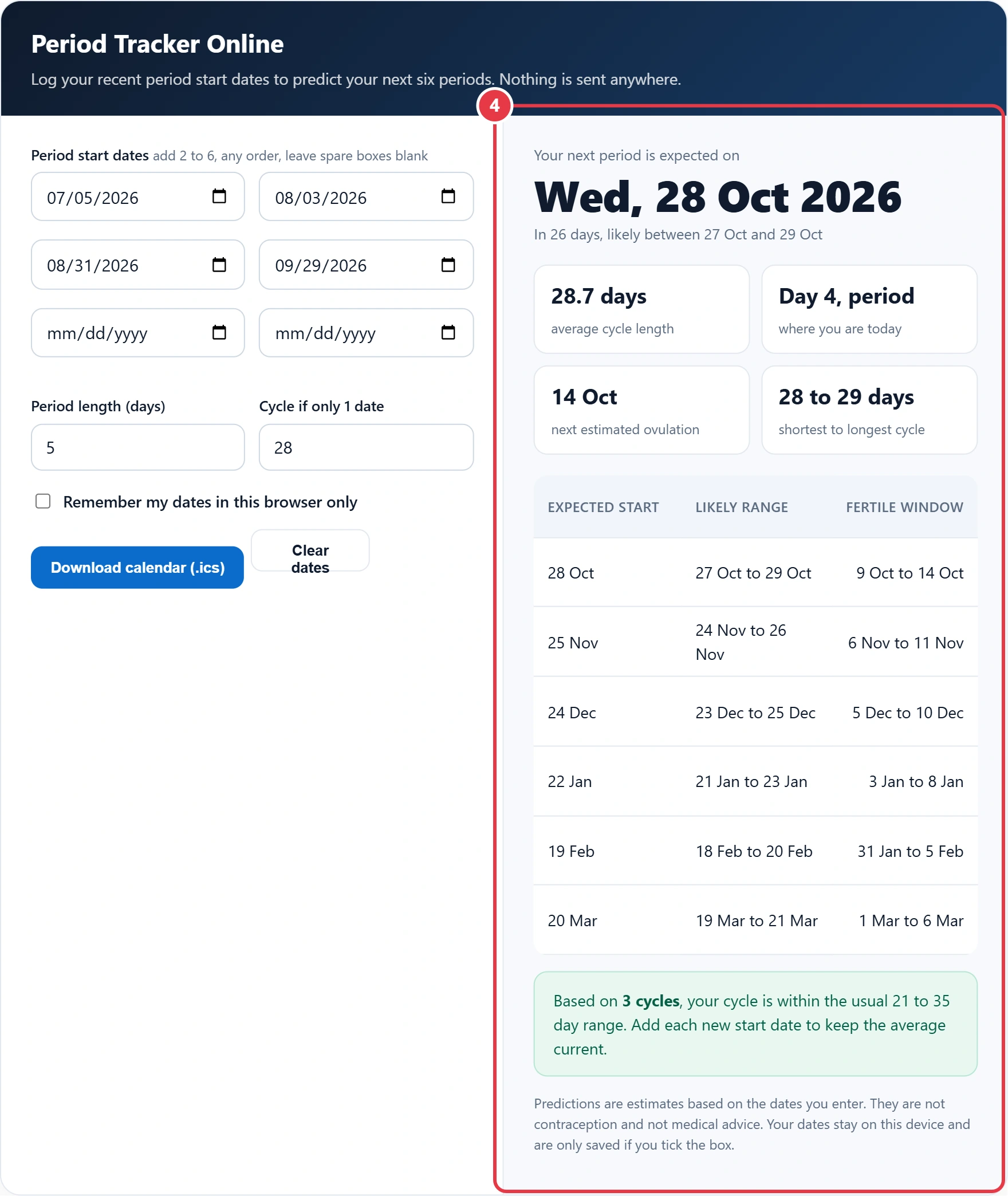
Log your recent period start dates to predict your next six periods. Nothing is sent anywhere.
| Expected start | Likely range | Fertile window |
|---|
Predictions are estimates based on the dates you enter. They are not contraception and not medical advice. Your dates stay on this device and are only saved if you tick the box.
This period tracker online lets anyone who has periods log their recent start dates and see when the next six are likely to arrive, with no app to install and no account. It works out your own average cycle and how much it varies, then checks it against the NHS guide to periods so you know whether your pattern sits in the usual range. You also get your cycle day today, your next likely ovulation and a calendar file you can add to your phone.
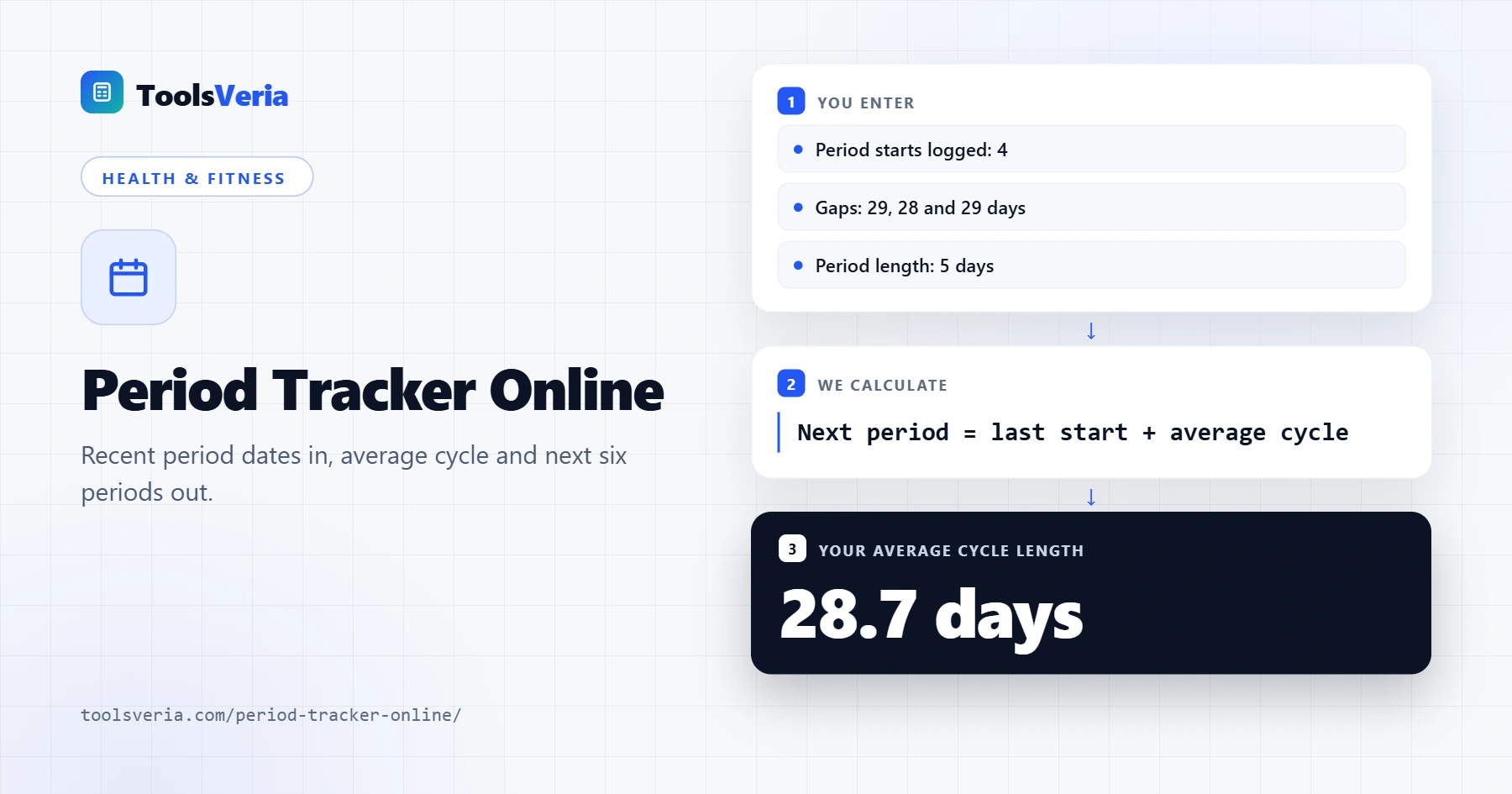
Quick answer: A period tracker online predicts your next period by adding your average cycle length to the first day of your last period. If your last three cycles were 29, 28 and 29 days, your average is 28.7 days, so your next period is due about 29 days after the last one began.
In This Guide
What Is a Period Tracker?
A period tracker is a record of the days your periods start, used to predict when the next ones will come. The maths is simple: average cycle = total days between your logged start dates ÷ number of cycles, and next period = last start date + average cycle. A cycle runs from the first day of one period to the day before the next.
Most online period calculators ask for one date and assume the same cycle every month. That gives a single, overly precise day. This tool uses up to six real dates, so the average reflects your body rather than a textbook 28 days, and it turns the gap between your shortest and longest cycle into a likely range. Ovulation is estimated at 14 days before each expected period, with the fertile window covering the 5 days before it.
How to Use the Period Tracker Online
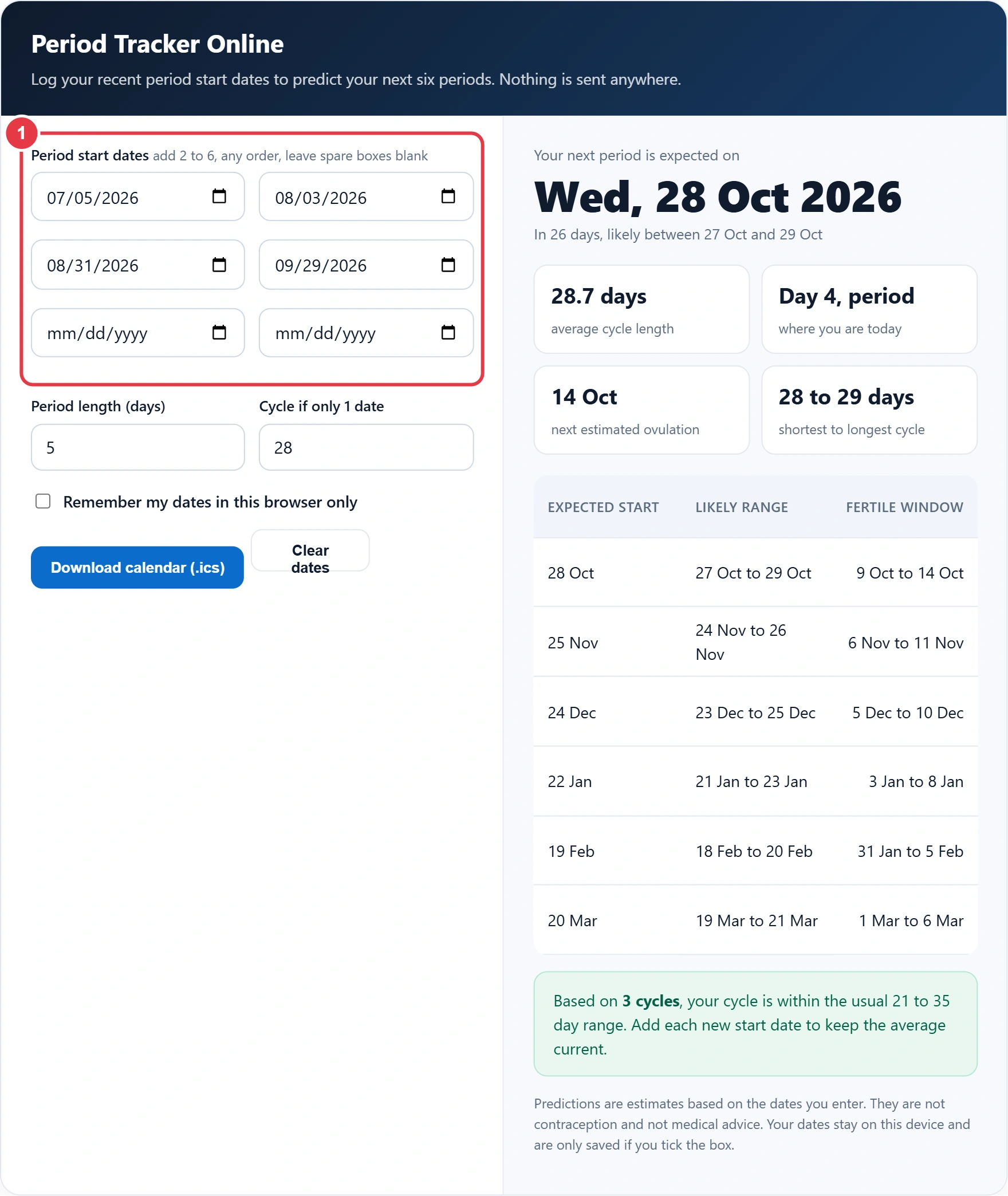
Step 1: Add Your Period Start Dates
Enter the first day of bleeding for your recent periods, from a diary, an old app or your phone calendar. Two dates give one cycle, and four to six give a much better average. Order does not matter, because the tracker sorts them for you.
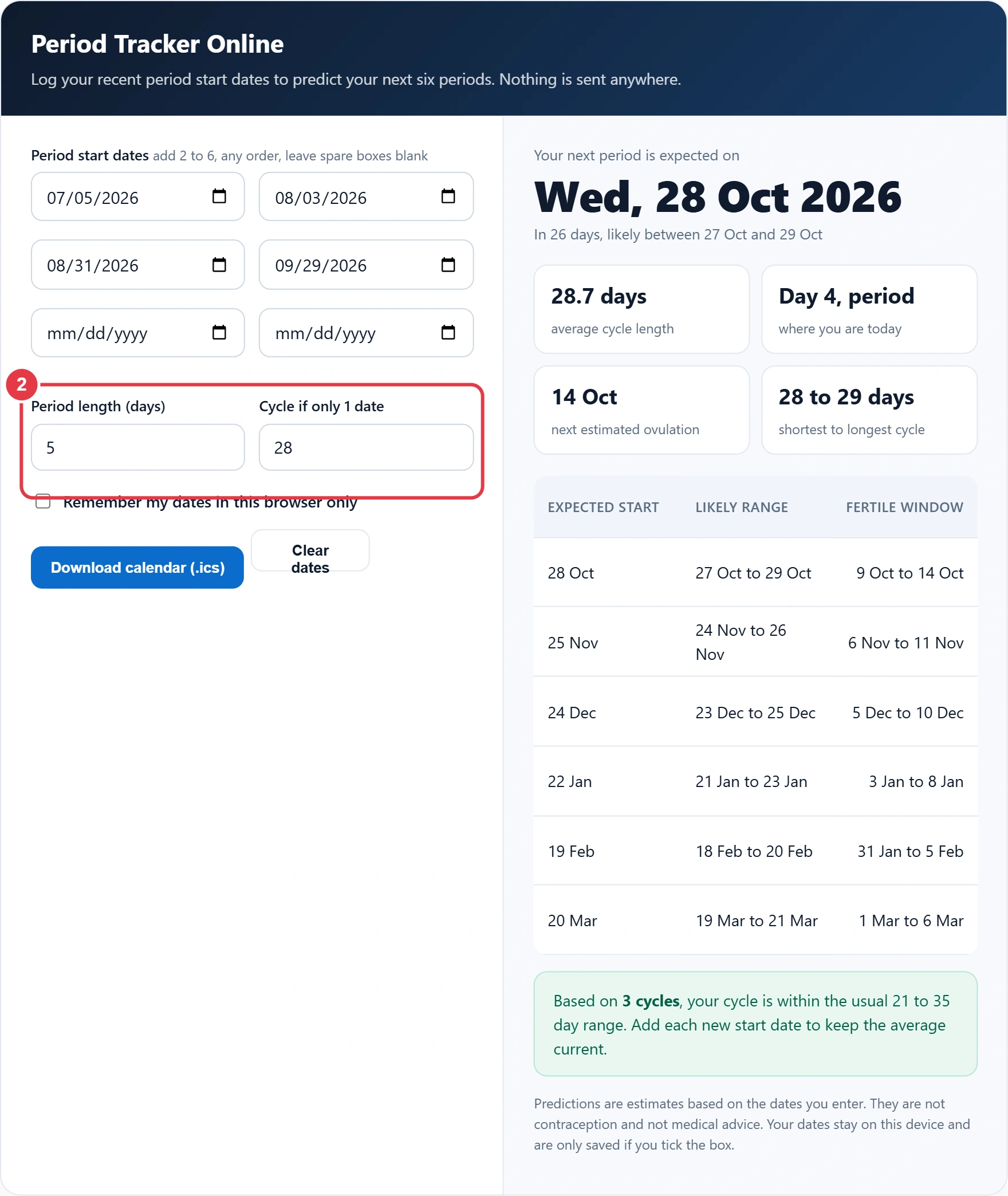
Step 2: Set Your Period Length
Enter how many days you usually bleed so the tracker can label the period part of your cycle. If you only know one start date, the second box sets the cycle length used until you add another, with 28 days as the starting point.
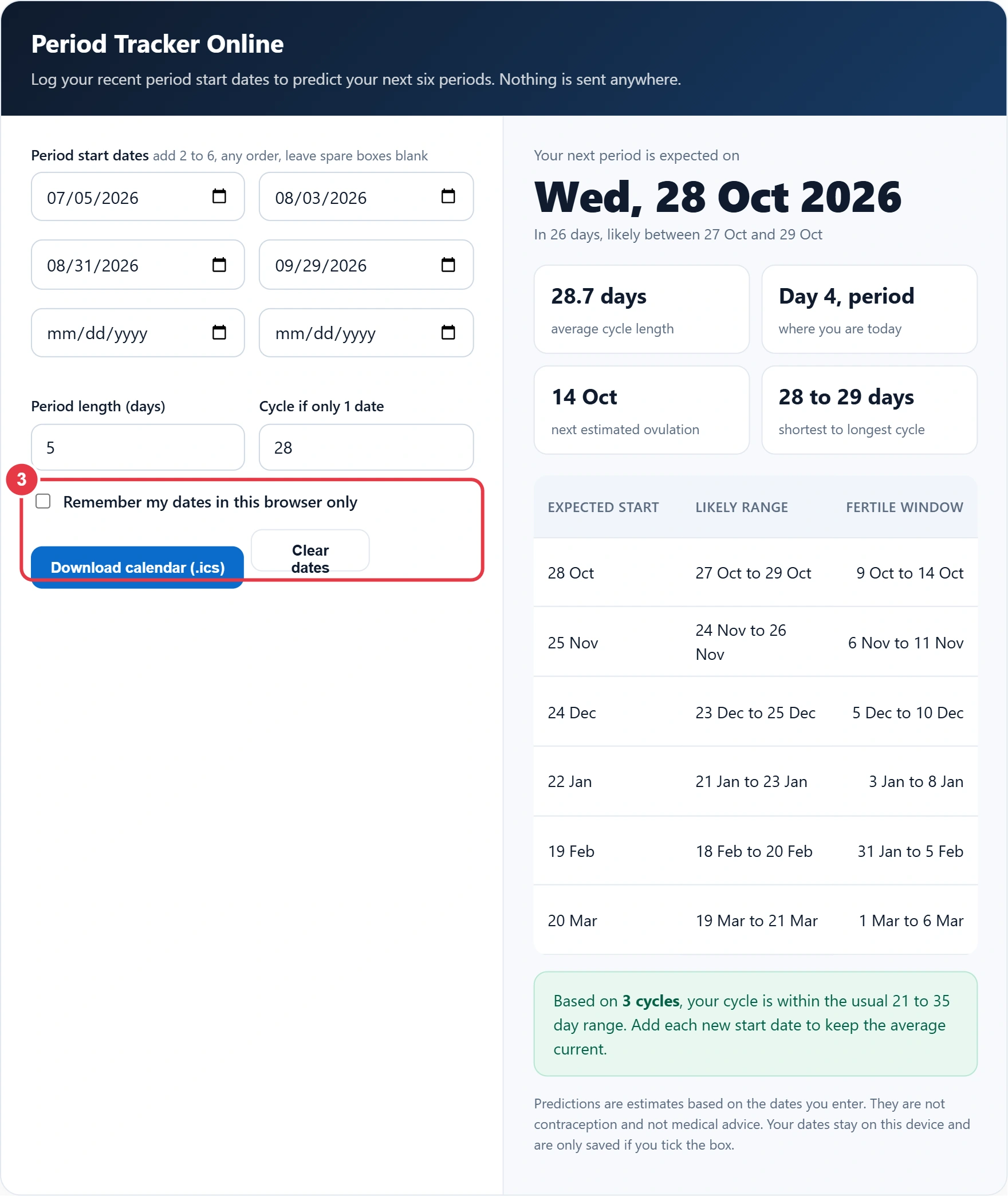
Step 3: Save or Download
Tick the box to keep your dates in this browser, so they are waiting next month. They are stored only on your device and never sent to Tools Veria. The download button creates a calendar file with your next six expected periods, which opens in Google Calendar, Apple Calendar or Outlook.
Step 4: Read Your Forecast
The headline shows your next expected period and a likely range. The tiles give your average cycle, your cycle day and phase today, your next likely ovulation and your shortest to longest cycle. The table looks six periods ahead, each with a range and a fertile window.
When Is My Next Period Due?
Your next period is due one average cycle after the first day of your last period, so with a 28 day cycle it starts 28 days later, and with a 32 day cycle 32 days later. Expect a day or two either side even if you are very regular.
Take Chloe, whose last four periods began on 6 July, 4 August, 31 August and 29 September 2026. The period tracker online finds cycles of 29, 27 and 29 days, an average of 28.3 days. Her next period is expected on Tuesday 27 October, most likely between 26 and 28 October, because her cycles vary by two days. Her estimated ovulation falls around 13 October, with a fertile window from 8 to 13 October. If she is hoping to conceive, the ovulation calculator looks at those fertile days in more detail, including the best days and a pregnancy test date.
What Is a Normal Menstrual Cycle?
| Measure | Usual range (NHS) |
|---|---|
| Cycle length | 21 to 35 days, around 28 on average |
| Period length | 2 to 7 days, usually about 5 |
| Blood loss per period | About 20 to 90 ml (1 to 5 tablespoons) |
| Ovulation | Around 10 to 16 days before the next period |
| Average age periods start | Around 12 |
| Average age of menopause in the UK | 51 |
Cycles often shift a few days with stress, illness, travel, weight change, breastfeeding or hormonal contraception, and they are often less regular in the first years after periods start and in the years before menopause. The NHS guidance on missed or late periods lists the common causes, and if a late period could mean pregnancy, the pregnancy week by week calculator uses the same last period date to show how far along you would be.
- See a GP if you have missed 3 periods in a row and are not pregnant.
- See a GP if your periods are very heavy or suddenly change pattern.
- See a GP if you bleed between periods or after sex, or after the menopause.
- See a GP if your periods have not started by the age of 15.
Predictions from this period tracker online are estimates for information only and are not medical advice. Calendar predictions are not a reliable form of contraception, so speak to a GP, pharmacist or sexual health clinic if you want to avoid pregnancy.
Period Tracker Online Terms Explained
These terms explain what the period tracker online measures, helping you understand your cycle, your predicted dates and the fertile window it estimates for you.
- Menstrual cycle
- The recurring sequence of hormonal changes that prepares the body for a possible pregnancy, counted from the first day of bleeding to the day before the next period. Its length naturally varies between people and from one month to the next.
- Ovulation
- The release of a mature egg from an ovary, which the tracker places 14 days before each expected period. Because the stage after ovulation is fairly stable, most differences in cycle length come from the stage that precedes it.
- Fertile window
- The days in each cycle when sex could lead to pregnancy, covering the 5 days before ovulation as well as ovulation day. Sperm can survive inside the body for several days, which is why the window opens before the egg is released.
- Luteal phase
- The part of the cycle from ovulation until the next period starts, when the corpus luteum produces progesterone to support a possible pregnancy. Its fairly consistent length is the reason ovulation can be estimated by counting back from the next period.
- Cycle variability
- The spread between your shortest and longest recent cycles. The tracker uses it to show a likely range of dates rather than a single day, since a wider spread means less certainty about exactly when the next period will begin.
</>Embed this calculator on your website
Add the free Period Tracker Online to your own site or blog. Copy the code below and paste it into an HTML block. It resizes itself and works on phones.
How we checked this tool: the Tools Veria Editorial Team built this tool by hand, checked it against the official rules or published standards where they apply, and tested it against worked examples. Results are estimates for planning, not personal financial or tax advice. Read our editorial policy and disclaimer, or report an error.
Frequently Asked Questions
How does a period tracker predict my next period?
It averages the gaps between your logged period start dates and adds that average to your most recent start date. With cycles of 29, 28 and 29 days, the average is 28.7 days, so the next period is due about 29 days later.
How many periods do I need to log?
Two start dates give one cycle and a basic prediction. Four to six dates give a far more reliable average and a realistic range, because a single short or long month has less effect on the result.
Is my period data private?
Yes. Everything is calculated in your browser and nothing is sent to Tools Veria or anyone else. Your dates are only kept if you tick the save box, and then only in this browser on this device.
What is a normal cycle length?
The NHS says most cycles are around 28 days, and anything from 21 to 35 days is normal. Periods usually last 2 to 7 days, with about 5 days being typical.
Why is my period late?
Common reasons include pregnancy, stress, sudden weight change, intense exercise, hormonal contraception, breastfeeding and approaching menopause. If you could be pregnant, take a test, and see a GP if you miss 3 periods in a row.
Can a period tracker tell me when I am fertile?
It can estimate your fertile window, the 5 days before ovulation plus ovulation day, using your average cycle. It is only an estimate, so do not use it as contraception, and ovulation tests give more precise timing.