
Aisha works in London and needs a video call with her colleague Marcus in New York and a client, Jun, in Sydney. Everyone “knows” New York is five hours behind London, yet for one week this autumn it is only four. Learning how to convert time zones through UTC, and checking the date as well as the place, is what stops a meeting invite landing at 2am for someone.
This guide is for remote teams, travellers, students on overseas courses and anyone booking calls across borders. It sets out a three step method that works for every zone, the daylight saving dates that catch people out in 2026 and 2027, half hour and 45 minute zones, and a worked meeting time that suits three continents.
Quick answer: To convert a time between zones, find each place’s UTC offset on that exact date, subtract the source offset to get UTC, then add the target offset. For example, 21:00 in London on 28 October 2026 (UTC+0) is 21:00 UTC, which is 17:00 in New York (UTC-4) and 08:00 the next day in Sydney (UTC+11).
In This Guide
What is UTC and why convert through it?
Coordinated Universal Time, or UTC, is the world’s reference clock, and every time zone is defined as an offset from it, such as UTC+1 for Paris in winter or UTC-5 for New York in winter. Converting through UTC means you only ever need one number per place, instead of memorising the gap between every pair of cities.
Greenwich Mean Time and UTC show the same clock time, so London in winter is UTC+0. In summer the UK switches to British Summer Time, UTC+1. Computers and phones store zones by name in the IANA time zone database, using identifiers such as Europe/London and America/New_York, which carry each region’s daylight saving history and rules.
How to convert time zones in three steps
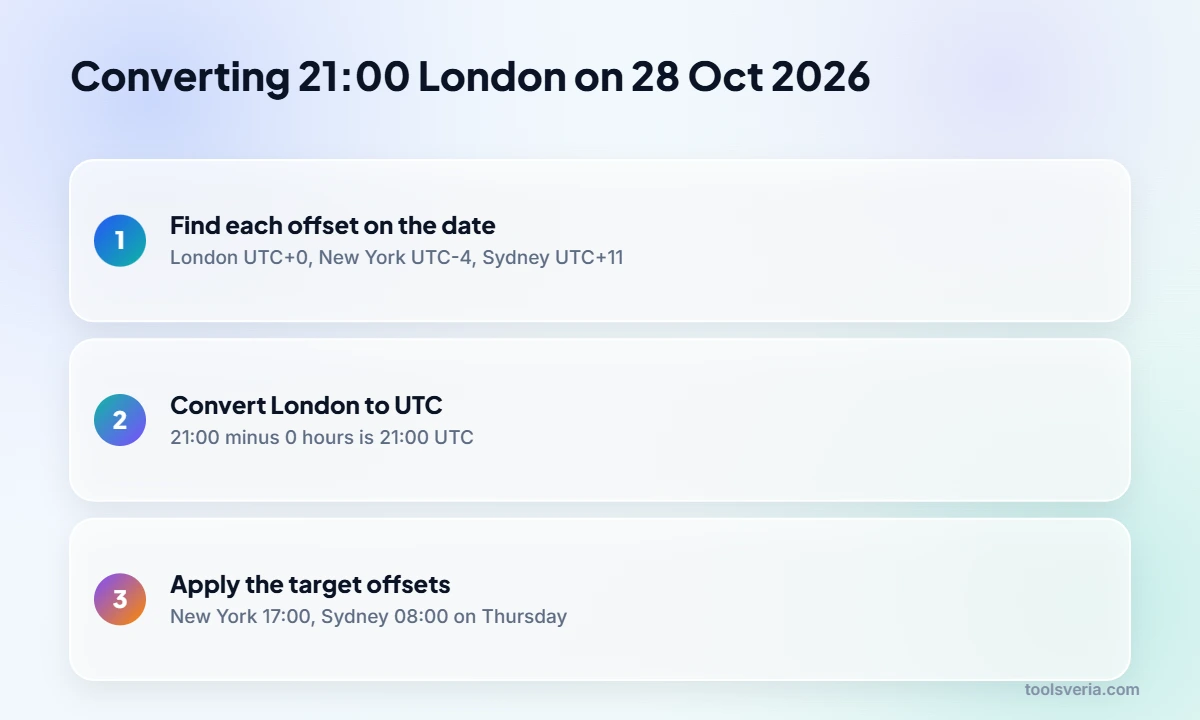
Converting a time between zones takes three steps: look up both offsets for the date, convert the source time to UTC, then convert UTC to the target zone. Aisha is planning the call for Wednesday 28 October 2026.
- Find the offsets on 28 October 2026. London has just returned to GMT, UTC+0. New York is still on daylight time, UTC-4. Sydney is on summer time, UTC+11.
- Convert London to UTC by subtracting its offset. A proposed 21:00 in London minus 0 is 21:00 UTC.
- Add each target offset. New York: 21:00 minus 4 hours is 17:00. Sydney: 21:00 plus 11 hours is 32:00, which rolls past midnight to 08:00 on Thursday 29 October.
That slot works for everyone: the end of Aisha’s evening, late afternoon for Marcus and breakfast time for Jun. The date roll in step 3 is the part people forget. Whenever the result goes above 24:00 or below 00:00, change the date as well as the hour, and say both in the invite.

When do the clocks change in 2026 and 2027?
The UK and EU clocks go back on the last Sunday in October and forward on the last Sunday in March, while the US and Canada change on the first Sunday in November and the second Sunday in March. The UK dates are listed on the GOV.UK clock change page. Because the regions use different rules, the usual gap between them shifts for a few weeks each year.
| Region | Clocks go forward | Clocks go back |
|---|---|---|
| UK and EU, 2026 | Sunday 29 March | Sunday 25 October |
| US and Canada, 2026 | Sunday 8 March | Sunday 1 November |
| Sydney and Melbourne, 2026 | Sunday 4 October | Sunday 5 April |
| UK and EU, 2027 | Sunday 28 March | Sunday 31 October |
| US and Canada, 2027 | Sunday 14 March | Sunday 7 November |
Between 25 October and 1 November 2026, London is on GMT while New York is still on daylight time, so New York is four hours behind instead of five. The same thing happens in spring, from 8 March to 29 March 2026 and from 14 March to 28 March 2027. Southern hemisphere zones move in the opposite direction, so London and Sydney can be 9, 10 or 11 hours apart depending on the month.
UTC offsets for major cities
The table shows standard and summer offsets for common business locations, with the IANA identifier your calendar or phone uses behind the scenes.
| City | IANA zone | Standard offset | Summer offset |
|---|---|---|---|
| London | Europe/London | UTC+0 | UTC+1 |
| Paris, Berlin, Madrid | Europe/Paris | UTC+1 | UTC+2 |
| New York | America/New_York | UTC-5 | UTC-4 |
| Los Angeles | America/Los_Angeles | UTC-8 | UTC-7 |
| Phoenix | America/Phoenix | UTC-7 | No change |
| Dubai | Asia/Dubai | UTC+4 | No change |
| Mumbai, Delhi | Asia/Kolkata | UTC+5:30 | No change |
| Tokyo | Asia/Tokyo | UTC+9 | No change |
| Sydney | Australia/Sydney | UTC+10 | UTC+11 |

How do you handle half hour time zones?
Half hour and 45 minute zones convert in exactly the same way; you just add or subtract minutes as well as hours. India uses UTC+5:30 all year. If Aisha’s 21:00 London call on 28 October included a colleague in Delhi, 21:00 UTC plus 5 hours 30 minutes would be 02:30 on Thursday, clearly too late.
Nepal sits at UTC+5:45, and Adelaide in South Australia uses UTC+9:30 in winter and UTC+10:30 in summer. These zones are the main reason mental arithmetic fails, so use the time zone converter whenever more than two places are involved.
Time zones for flights and spreadsheets
Flight times are always printed in local time at each airport, which makes durations look odd. A flight leaving London at 10:00 BST and landing in New York at 13:00 EDT seems to take three hours. Convert both to UTC, 09:00 and 17:00, and the real flying time is 8 hours. The time duration calculator works out the gap once both times share a zone.
In spreadsheets, a time is a fraction of a day, so one hour is 1/24. A London time in A2 becomes New York winter time with =A2-5/24. That fixed offset ignores daylight saving, though, so either store everything in UTC or keep a column with the correct offset for each date. Systems that log events usually record Unix timestamps, which are always UTC, and the Unix timestamp converter turns them into readable local times.
Key points
- Convert the source time to UTC, then apply the target offset for that date.
- UK clocks go back on 25 October 2026, but US clocks wait until 1 November 2026.
- During those gap weeks, New York is four hours behind London rather than five.
- India uses UTC+5:30 and Nepal UTC+5:45, so minutes matter as well as hours.
- Always change the date when a converted time passes midnight.
Key Time Zone Terms Explained
These terms appear in calendars, flight tickets and converters, and each one matters when you work out how to convert time zones correctly.
- Coordinated Universal Time
- The world reference clock, written UTC, from which every zone is measured as an offset. Converting through UTC means 21:00 UTC becomes 17:00 in New York at UTC-4 in late October 2026.
- UTC offset
- The hours and minutes a zone sits ahead of or behind UTC on a given date, such as UTC+11 for Sydney in summer or UTC+5:30 for India, which keeps the same offset all year.
- Daylight saving time
- Moving clocks forward an hour in summer. The UK changes on the last Sundays of March and October, the US on the second Sunday in March and the first Sunday in November.
- British Summer Time
- The UK’s summer clock, UTC+1, used from the last Sunday in March to the last Sunday in October. In 2026 it ends on 25 October, when London returns to GMT.
- IANA time zone database
- The shared list of zone identifiers such as Europe/London and America/New_York, with each region’s daylight saving rules, that phones, calendars and web browsers rely on to convert times automatically, even across clock changes.
Frequently Asked Questions
Is GMT the same as UTC?
For everyday scheduling, yes: both show the same clock time. UTC is the precise atomic time standard, while GMT is the UK’s winter time zone name. In summer the UK moves to BST, which is UTC+1, so London stops matching UTC.
Why is New York only four hours behind London some weeks?
Because the UK and US change clocks on different Sundays. In 2026 the UK goes back on 25 October and the US on 1 November, so for that week London is UTC+0 and New York UTC-4.
Should I write EST or ET in a meeting invite?
Write ET or name the city. EST strictly means the winter offset, UTC-5, and is wrong in summer when New York uses EDT, UTC-4. Saying “17:00 New York time” avoids the confusion entirely.
My calendar invite shows the wrong time for a colleague abroad. Why?
Usually the event was created with a fixed offset or the wrong zone instead of a named zone such as Europe/London. Set the event’s time zone explicitly, and check that the device’s own zone is set to update automatically.
Which places do not use daylight saving time?
Many, including India, Japan, China, the United Arab Emirates and most of Arizona. Their UTC offset stays the same all year, so their gap with London or New York changes when those cities switch clocks.
How do I find a meeting time that suits London, New York and Sydney?
Look for the evening in London, which gives afternoon in New York and morning in Sydney. On 28 October 2026, 21:00 London is 17:00 New York and 08:00 Thursday in Sydney.
Aisha’s invite now reads “Wednesday 28 October, 21:00 London, 17:00 New York, Thursday 08:00 Sydney”, and nobody is woken at 2am. Knowing how to convert time zones through UTC, and checking each place’s offset on the actual date, is what makes that possible. Figures checked October 2026.