A time zone converter with automatic daylight saving: one time in, the same moment in every city out.
| Place | Local time | UTC offset |
|---|
Uses your browser's built in IANA time zone database through Intl.DateTimeFormat, so daylight saving changes are applied for the date you choose. Nothing is sent anywhere.
This free time zone converter shows what a chosen date and time in one place will be anywhere else in the world, for remote teams, travellers, students on overseas courses and anyone booking an international call. It uses the same IANA time zone database as phones and computers, with Coordinated Universal Time (UTC) as the reference, so daylight saving changes are handled automatically for the exact date you pick.
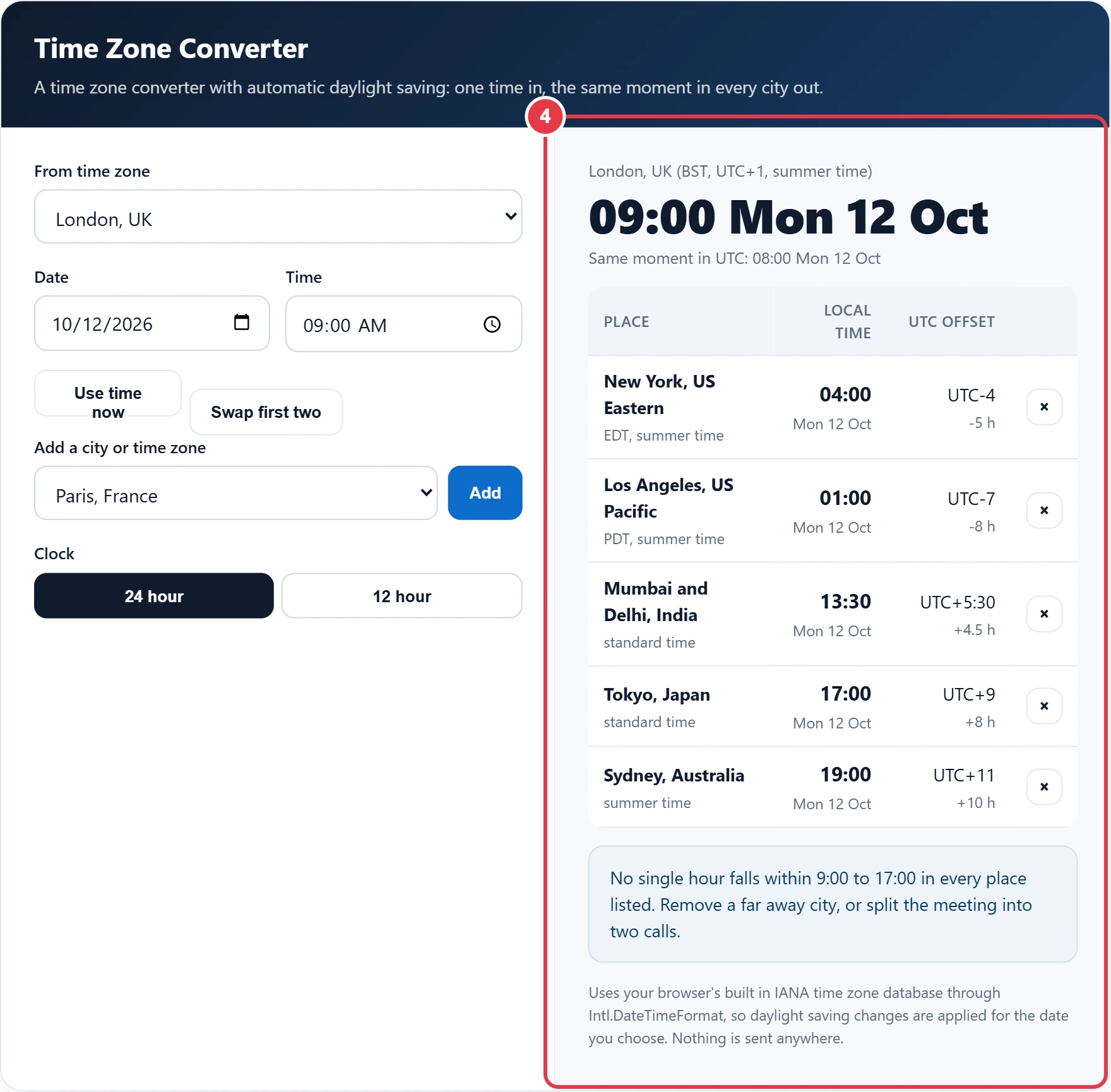
Quick answer: To convert a time between zones, change it to UTC by subtracting the source offset, then add the target offset. 09:00 in London on a summer date (UTC+1) is 08:00 UTC, which is 04:00 in New York (UTC-4). A time zone converter does this for any date, including daylight saving changes.

In This Guide
What Is a Time Zone Converter?
A time zone converter, sometimes called a world time converter, is a tool that translates a single moment from one local time to another, taking each place's UTC offset and daylight saving rules into account. It answers questions such as "what time is 3pm in London in Tokyo?" without mental arithmetic.
In plain words: UTC time = local time minus the local offset, and target time = UTC time plus the target offset. Offsets are not fixed. London is UTC+0 in winter and UTC+1 in summer, New York is UTC-5 or UTC-4, and India stays at UTC+5:30 all year. That is why this time zone calculator always asks for a date.
How to Use the Time Zone Converter
Step 1: Choose the Source Time Zone
Pick the city whose time you know, and the time zone converter treats it as the source. Popular cities are listed first, followed by every IANA zone your browser supports, such as Europe/Lisbon or Asia/Kathmandu.

Step 2: Set the Date and Time
Enter the meeting or event date and time, or press Use time now. Swap first two makes the first city in the list the new source, which is handy when a colleague abroad suggests a time in their own zone.

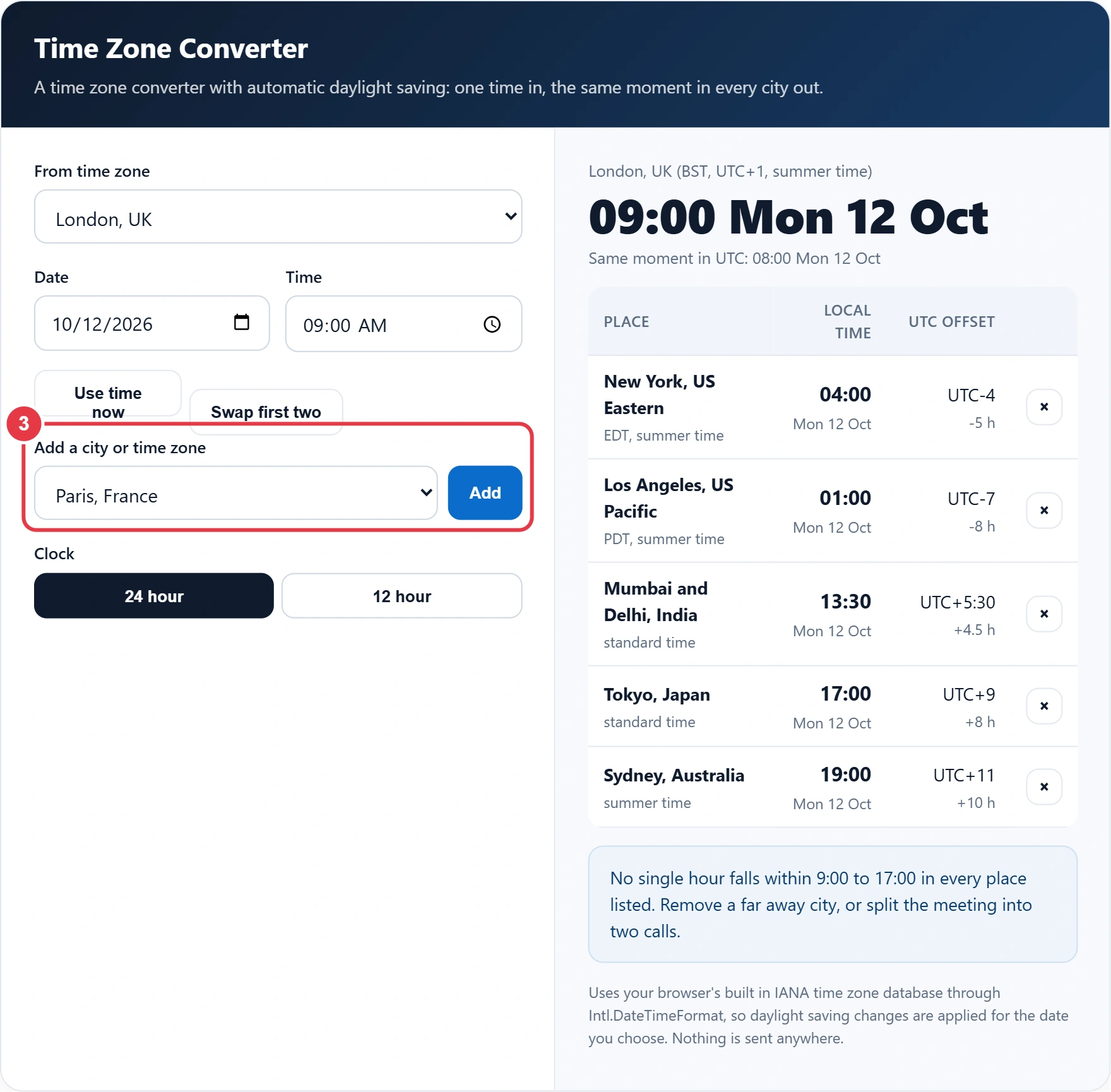
Step 3: Add the Cities to Compare
Choose a city and press Add. You can compare as many places as you like and remove any with the × button. Switch between the 24 hour and 12 hour clock to match how your invitees read times.
Step 4: Read the Results
Each row shows the local time and date, the abbreviation, whether summer time applies, the UTC offset and the gap from your source. In the time zone calculator results, a "+1 day" note warns you when the date changes. The green panel lists the hours that fall between 9:00 and 17:00 in every place, which is the easiest slot for a meeting.
World Time Zone Offsets in Winter and Summer
The table shows how far common cities sit from UTC in January and July 2027. Places with a change use daylight saving; in the southern hemisphere it runs the other way round.
| City | IANA zone | January 2027 | July 2027 |
|---|---|---|---|
| London | Europe/London | UTC+0 (GMT) | UTC+1 (BST) |
| Paris, Berlin | Europe/Paris | UTC+1 | UTC+2 |
| New York | America/New_York | UTC-5 | UTC-4 |
| Chicago | America/Chicago | UTC-6 | UTC-5 |
| Los Angeles | America/Los_Angeles | UTC-8 | UTC-7 |
| Dubai | Asia/Dubai | UTC+4 | UTC+4 |
| Karachi | Asia/Karachi | UTC+5 | UTC+5 |
| Mumbai, Delhi | Asia/Kolkata | UTC+5:30 | UTC+5:30 |
| Singapore | Asia/Singapore | UTC+8 | UTC+8 |
| Tokyo | Asia/Tokyo | UTC+9 | UTC+9 |
| Sydney | Australia/Sydney | UTC+11 | UTC+10 |
| Auckland | Pacific/Auckland | UTC+13 | UTC+12 |
Why Is the Time Difference Different Some Weeks?
The gap between two cities changes for a week or more each spring and autumn because countries change their clocks on different dates. The UK and EU change on the last Sunday of March and October, while the US changes on the second Sunday of March and the first Sunday of November.
UK clocks go back on 25 October 2026, as the GOV.UK clock change dates confirm, but US clocks do not go back until 1 November 2026. For that week, London is only 4 hours ahead of New York instead of the usual 5.
Worked example: Grace manages a team in Manchester and books a weekly 15:00 call with a client in New York. On Thursday 22 October 2026 the time zone converter shows 10:00 in New York. On Thursday 29 October it shows 11:00, because the UK has left summer time and the US has not. From 5 November the call is back at 10:00. Grace sets the invite in the client's time zone so both calendars stay right.
What Is the Difference Between GMT and UTC?
For everyday use, and in any time zone converter, GMT and UTC show the same time; the difference is that UTC is a scientific standard kept by atomic clocks, while GMT is the UK's winter time zone. In summer the UK moves to BST, which is UTC+1, so "GMT" on a summer invite is often a mistake.
Software stores times in UTC and converts them for display. If you work with server logs, the Unix timestamp converter turns those raw numbers into readable UTC dates, and the time duration calculator works out how long a flight or shift lasts once both ends are in the same zone. Offsets checked October 2026.
Key Time Zone Terms Explained
These terms explain the standards a time zone converter relies on and why the gap between two cities can change during the year.
- Coordinated Universal Time
- The world's reference time, kept by atomic clocks and written UTC. Every time zone is described as an offset from it, so London is one hour ahead of it in summer and New York is five hours behind it in winter.
- UTC offset
- The hours and minutes a place is ahead of or behind UTC. Most offsets are whole hours, but some are not: India uses UTC+5:30 and Nepal uses UTC+5:45, all year round.
- Daylight saving time
- Moving clocks forward one hour in summer. The UK changes on the last Sunday of March and October, the US on the second Sunday of March and first Sunday of November, so gaps shift briefly.
- IANA time zone database
- The public list of time zones and their clock change history, used by phones, computers and browsers. Zones are named by region and city, such as Europe/London or Asia/Tokyo.
- Greenwich Mean Time
- The UK's winter time zone, equal to UTC+0 for everyday use. In summer the UK switches to British Summer Time, UTC+1, so GMT is not the UK's local time all year.
</>Embed this calculator on your website
Add the free Time Zone Converter to your own site or blog. Copy the code below and paste it into an HTML block. It resizes itself and works on phones.
How we checked this tool: the Tools Veria Editorial Team built this tool by hand, checked it against the official rules or published standards where they apply, and tested it against worked examples. Results are estimates for planning, not personal financial or tax advice. Read our editorial policy and disclaimer, or report an error.
Frequently Asked Questions
Does the time zone converter handle daylight saving?
Yes. It uses the IANA time zone database built into your browser, which holds the clock change rules for every country. Pick any date, past or future, and each city's correct summer or winter offset is applied automatically.
Why should I use city names instead of EST or PST?
Abbreviations are ambiguous and often wrong. EST is only correct in winter; in summer New York uses EDT. Some abbreviations, such as CST, mean different zones in different countries. City based IANA zones such as America/New_York avoid both problems.
What happens to times that do not exist?
When clocks go forward, one hour is skipped. In the UK on 29 March 2026, times from 01:00 to 01:59 never happened. The converter moves such a time forward by an hour and shows a note so you can pick a real time instead.
Which countries do not use daylight saving?
Most of Asia, Africa and South America keep one offset all year, including India, Pakistan, the UAE, Japan, China, Singapore and Brazil. In the US, Hawaii and most of Arizona also stay on standard time all year.
How do I find a meeting time across time zones?
Add every participant's city and look at the green panel, which lists the hours that fall between 9:00 and 17:00 in all of them. If no hour works, remove the most distant city or rotate the meeting time between regions.
What is UTC+5:30?
It is a time zone 5 hours and 30 minutes ahead of UTC, used by India and Sri Lanka. Some zones use 30 or 45 minute offsets, such as Nepal at UTC+5:45, which is why the converter shows minutes in every offset.