Compare your current mortgage with a new deal, fees included.
| Current | New |
|---|
Uses standard repayment (amortising) maths with monthly payments and a fixed rate for the whole term. Real deals often fix for 2 to 5 years and then revert, so treat long term figures as a guide.
This mortgage refinance savings calculator shows homeowners in the UK, US or Europe whether switching to a new rate is worth it once fees are counted. It runs the same checks the MoneyHelper remortgaging guide suggests before you move: the new monthly payment, the months until the fees are recovered and the total interest saved.
Quick answer: A mortgage refinance savings calculator compares your current payment with a new rate using the standard repayment formula. The key test is the break even point, switching costs ÷ monthly saving: if you plan to keep the new deal for longer than that many months, refinancing pays off once fees are counted.
In This Guide
What Is Mortgage Refinancing?
Refinancing, called remortgaging in the UK, means replacing your current mortgage with a new loan for the same property, usually to get a lower interest rate. Each payment uses the standard repayment formula: payment = balance × r ÷ (1 − (1 + r)^−n), where r is the annual rate divided by 12 and n is the number of months.
The key test is the break even point: switching costs ÷ monthly saving. If you plan to stay in the home or keep the deal for longer than that many months, refinancing pays off.
How to Use the Mortgage Refinance Savings Calculator
Step 1: Enter Your Current Mortgage
Pick your currency, then add the outstanding balance, your current rate and the years left. Your latest annual statement shows all three.

Step 2: Enter the New Deal
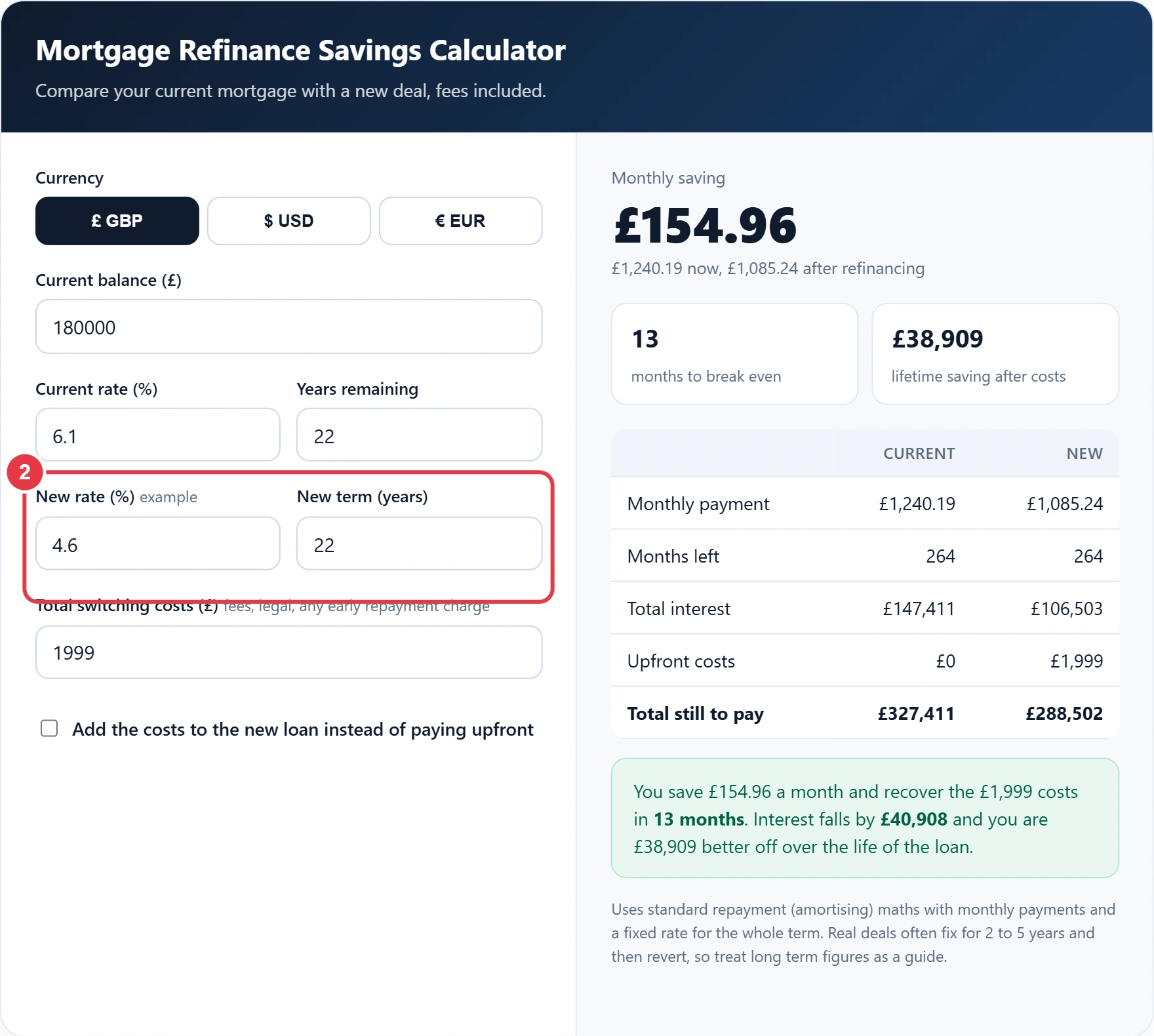
Type the rate you have been offered and the new term. The 4.6% default is only an example, so replace it with a real quote. Keeping the term the same gives a fair comparison, while stretching it lowers payments but can raise total interest.
Step 3: Add the Switching Costs
Include arrangement fees, valuation and legal costs, plus any early repayment charge on your current deal. Tick the box if the lender adds fees to the loan, and the loan calculator can show what borrowing those fees alone would cost you over the term.

Step 4: Read the Saving and Break Even Point
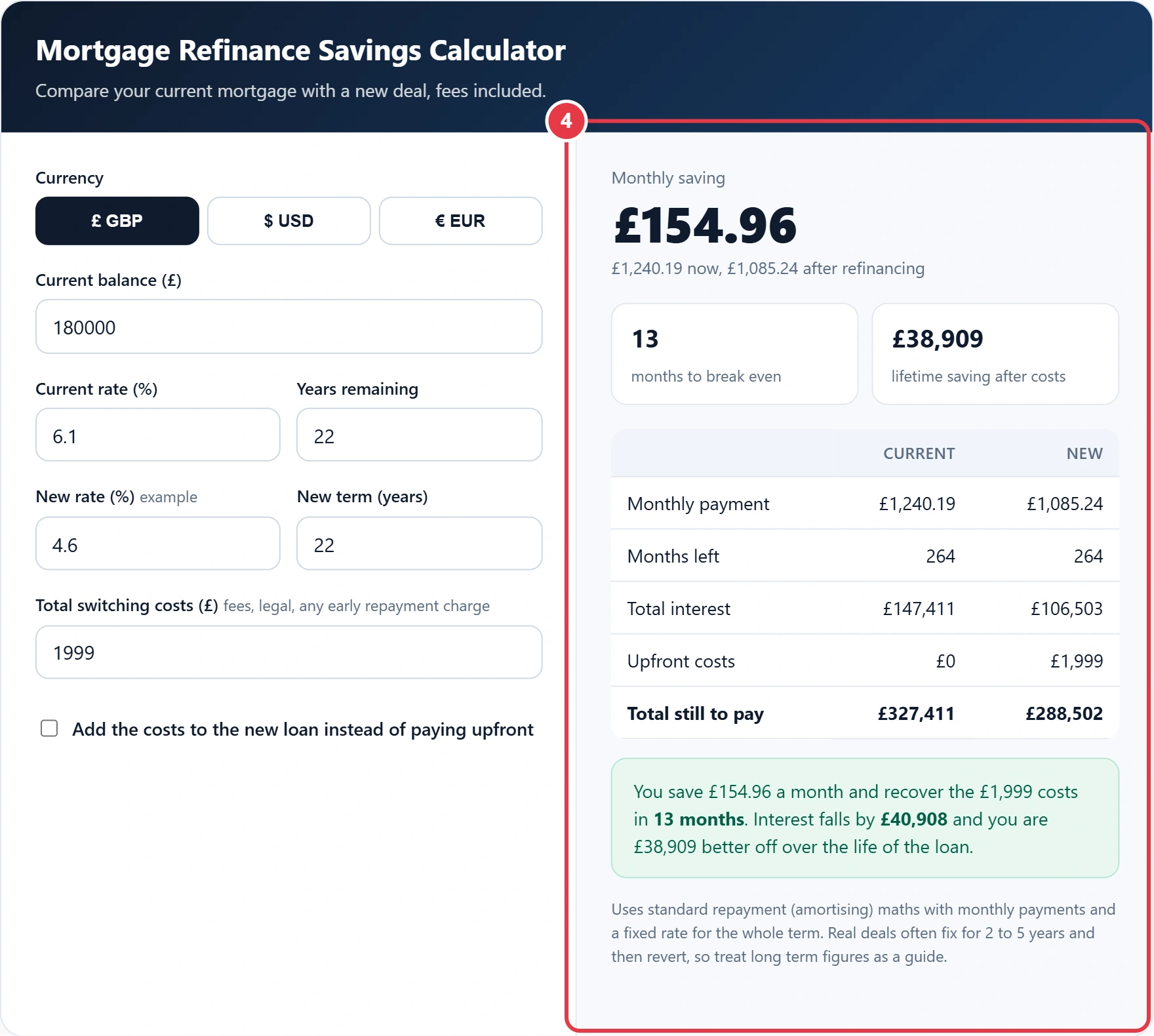
The results show both monthly payments, the months needed to recover your costs and the total still to pay on each loan. If you would rather keep your deal and pay it down faster, the mortgage overpayment calculator shows how much interest extra payments save.
Is It Worth Refinancing to Save 1%?
Usually yes, if you will keep the new loan beyond the break even point, which is often 12 to 24 months for a 1% to 1.5% cut on a six figure balance. Daniel owes £180,000 at 6.1% with 22 years left and is offered 4.6% with £1,999 of fees. His payment drops from £1,240.19 to £1,085.24, a saving of £154.96 a month, so he breaks even in 13 months.
| Scenario | Monthly saving | Break even |
|---|---|---|
| £180,000, 6.1% to 4.6%, 22 years, £1,999 fees | £154.96 | 13 months |
| $250,000, 5.5% to 4.25%, 25 years, $2,500 costs | $180.87 | 14 months |
| €120,000, 7.5% to 6%, 15 years, €3,000 costs | €99.79 | 31 months |
Over the full term Daniel pays £40,908 less interest, or £38,909 after fees. Stretching the new loan to 25 years would cut his payment further to £1,010.74, but the general rule described in the overview of refinancing holds: a longer term trades lower payments for more total interest.
Key Mortgage Refinance Terms Explained
These terms explain the costs and trade-offs behind the mortgage refinance savings calculator, helping you decide whether switching deals genuinely leaves you better off.
- Remortgaging
- The British term for moving an existing mortgage to a new deal, either with a different lender or a new product from the same one, while keeping the same property as security. Americans usually call the same process refinancing.
- Break even point
- The number of months after which the monthly savings from a cheaper rate have repaid the one off cost of switching. Leaving or switching again before that point means the move has cost more than it saved.
- Switching costs
- The total outlay needed to move to a new mortgage, including arrangement, valuation and legal fees plus any penalty for leaving the current deal early. Some lenders offer free legal work or cashback that offsets part of it.
- Fee added to the loan
- An option to roll arrangement fees into the new mortgage instead of paying them upfront. It avoids an immediate cash outlay, but interest is then charged on the fees for the whole term, raising the true cost.
- Term extension
- Lengthening the repayment period when refinancing, which lowers each monthly payment because the balance is spread over more months. The trade-off is that interest accrues for longer, so total borrowing costs usually rise.
- Closing costs
- The American name for the fees paid to complete a mortgage or refinance, such as lender charges, appraisal, title and recording fees. They play the same role in a break even calculation as UK switching costs.
</>Embed this calculator on your website
Add the free Mortgage Refinance Calculator to your own site or blog. Copy the code below and paste it into an HTML block. It resizes itself and works on phones.
How we checked this tool: the Tools Veria Editorial Team built this tool by hand, checked it against the official rules or published standards where they apply, and tested it against worked examples. Results are estimates for planning, not personal financial or tax advice. Read our editorial policy and disclaimer, or report an error.
Frequently Asked Questions
How do I calculate the break even point on a refinance?
Divide your total switching costs by the monthly saving. Fees of £1,999 and a saving of £154.96 a month give a break even point of 12.9, so you recover the costs in the 13th month.
Should I add the fees to my new mortgage?
Adding fees avoids an upfront payment but you pay interest on them for the whole term. £1,999 added to a 22 year loan at 4.6% costs about £1,183 in extra interest.
Does refinancing to a longer term save money?
It lowers the monthly payment but often increases total interest. Moving £180,000 from 22 to 25 years at 4.6% cuts the payment to £1,010.74 but adds about £16,720 of interest compared with 22 years.
What costs should I include when refinancing?
Include arrangement or product fees, valuation, legal or closing costs, broker fees and any early repayment charge on your current deal. Leaving one out makes the break even point look sooner than it is.
Is the monthly saving the same as the interest saved?
No. The monthly saving is the drop in each payment, while the interest saved is the difference in total interest over the remaining term, which is usually much larger.
Can I use this calculator for a remortgage in the UK?
Yes. Remortgaging is the UK name for refinancing, and the maths is identical. Use your outstanding balance, years remaining and the new product rate and fees from your lender or broker.