Use this one rep max calculator to turn any set of 1 to 12 reps into an estimated 1RM and a loading chart.
| % of 1RM | Load | Approx. reps |
|---|
Estimates for healthy adults with good technique, checked October 2026. Accuracy drops above 10 reps. This is not medical advice: speak to a GP or physiotherapist before maximal lifting if you have a heart condition, high blood pressure, an injury or are pregnant.
This one rep max calculator estimates the heaviest weight you could lift once, using a set you have already done, so lifters in the UK, US and anywhere else can plan training without testing a true maximum. It averages the four best known formulas from one repetition maximum research and turns the result into loads for every training zone, in kilograms or pounds.
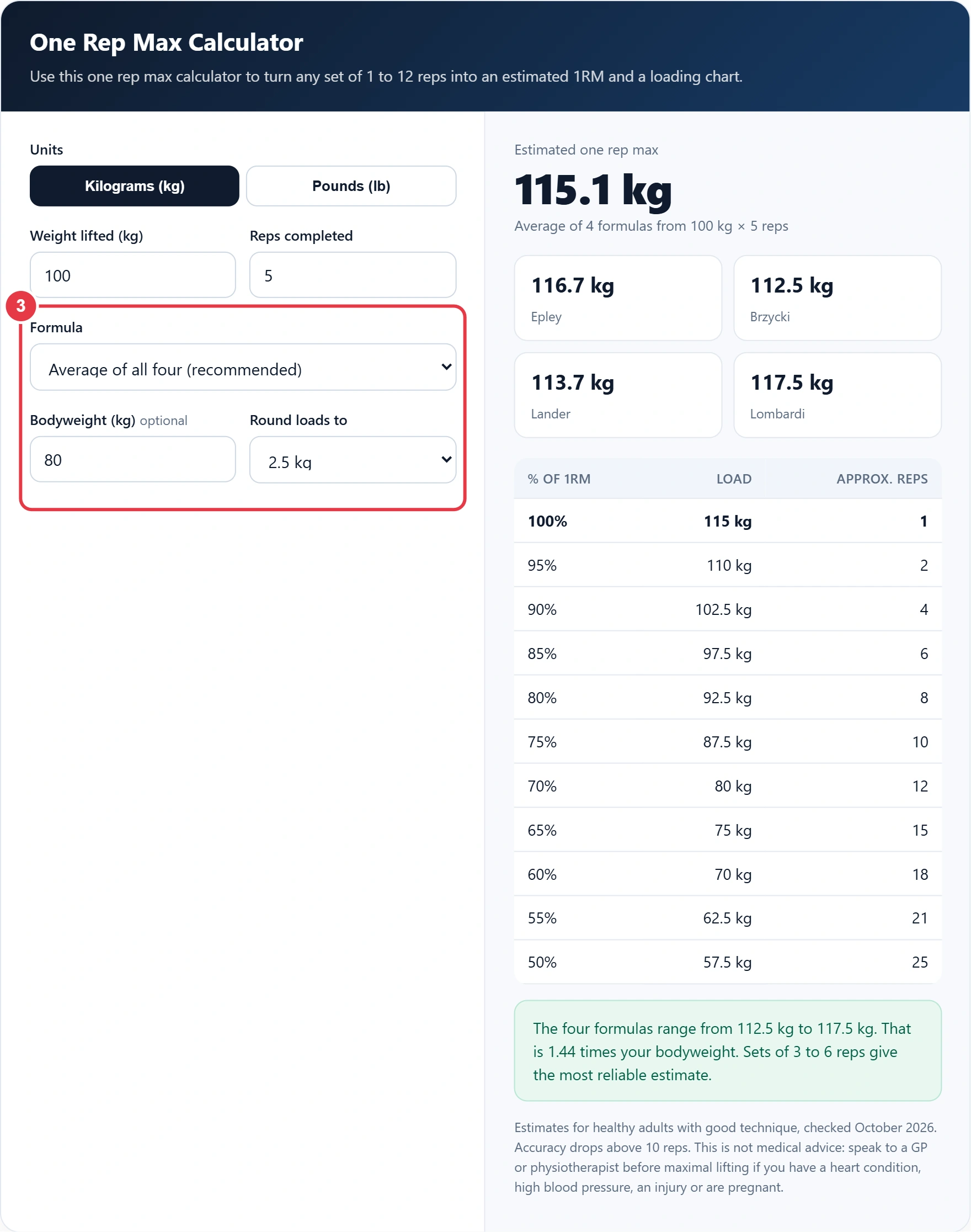
Quick answer: A one rep max calculator uses the Epley formula, weight × (1 + reps ÷ 30), or similar equations to predict your 1RM. Lifting 100 kg for 5 reps gives about 116.7 kg with Epley and 115.1 kg when four formulas are averaged. Sets of 3 to 6 reps give the most reliable estimate.

In This Guide
What Is a One Rep Max?
A one rep max (1RM) is the most weight you can lift for one complete repetition of an exercise with correct form. Coaches use it as the reference point for programming, because loads are prescribed as a percentage of 1RM: 80% of a 120 kg squat is 96 kg.
Testing a true maximum is tiring and carries more risk, so most people estimate it. The formulas assume each extra rep you can manage means the weight is a little further below your maximum. Epley adds one thirtieth of the weight per rep, Brzycki uses weight × 36 ÷ (37 − reps), Lander uses 100 × weight ÷ (101.3 − 2.67123 × reps) and Lombardi uses weight × reps to the power 0.1.
How to Use the One Rep Max Calculator
Step 1: Choose Kilograms or Pounds
Pick the unit your plates and bar are marked in. Switching converts the weights you have entered, using 1 lb = 0.45359237 kg, and changes the plate rounding options to match.

Step 2: Enter the Weight and Reps
Type the total weight lifted, including the bar, and the number of clean reps you completed. Use a recent hard set taken close to failure. A set of 3 to 6 reps works best; anything over 10 reps is flagged as a rough estimate.

Step 3: Pick a Formula and Rounding
Leave the formula on the average unless your coach uses a specific one. Add your bodyweight to see your strength ratio, and set the rounding to the smallest jump your plates allow, such as 2.5 kg or 5 lb.
Step 4: Read Your 1RM and Chart
The big figure is your estimated maximum, with each formula shown below it. If you log in pounds but think in kilograms, the kg to lbs converter handles single figures quickly. The chart lists 100% down to 50% of your estimate with the reps you can typically do at each load.

What Percentage of Your 1RM Should You Train At?
Train at about 85% to 95% of your 1RM for maximal strength, 65% to 80% for muscle growth, and 50% to 65% for muscular endurance or technique work. The rep counts below come from averaging the Epley and Brzycki formulas, so treat them as typical rather than exact.
| % of 1RM | Approx. reps possible | Main goal | Load if 1RM is 100 kg | Load if 1RM is 225 lb |
|---|---|---|---|---|
| 100% | 1 | Testing | 100 kg | 225 lb |
| 95% | 2 | Maximal strength | 95 kg | 215 lb |
| 90% | 4 | Maximal strength | 90 kg | 202.5 lb |
| 85% | 6 | Strength | 85 kg | 192.5 lb |
| 80% | 8 | Strength and muscle growth | 80 kg | 180 lb |
| 75% | 10 | Muscle growth | 75 kg | 170 lb |
| 70% | 12 | Muscle growth | 70 kg | 157.5 lb |
| 60% | 18 | Endurance and technique | 60 kg | 135 lb |
| 50% | 25 | Warm up and endurance | 50 kg | 112.5 lb |
Pound loads are rounded to the nearest 2.5 lb. Real rep counts vary by exercise: people usually manage more reps at a given percentage on the leg press than on the bench press.
How Do You Calculate Your 1RM by Hand?
To calculate your 1RM by hand, divide your reps by 30, add 1, and multiply by the weight lifted; that is the Epley formula. For a cross check, work out Brzycki as well and take the middle of the two.
Worked example: Priya bench presses 60 kg for 8 reps and weighs 62 kg. Epley gives 60 × (1 + 8 ÷ 30) = 76.0 kg. Brzycki gives 60 × 36 ÷ 29 = 74.5 kg, Lander gives 75.1 kg and Lombardi gives 73.9 kg, so the average is 74.9 kg, or 1.21 times her bodyweight. For a block of sets of 5 at 85%, she would load 63.6 kg, rounded to 62.5 kg on the bar.
The same maths works in pounds. A 185 lb deadlift for 5 reps gives an Epley estimate of 215.8 lb and an average of about 212.9 lb. If you track bodyweight alongside strength, the protein intake calculator shows a daily protein target that fits the training you are planning.
Which 1RM Formula Is Most Accurate?
No single formula is most accurate for everyone, which is why this 1RM calculator averages four of them. Epley and Lombardi tend to read higher at 8 to 12 reps, while Brzycki and Lander read lower, and all four agree closely between 2 and 6 reps.
Accuracy also depends on you. Experienced lifters who train with heavy singles often beat the estimate, while beginners and endurance athletes may fall short of it. Compound lifts such as the squat, bench press and deadlift suit the formulas better than isolation moves like curls.
Is It Safe to Test a One Rep Max?
Testing a true one rep max is reasonably safe for healthy adults with good technique, a proper warm up and a spotter or safety bars, but an estimate carries far less risk. Beginners gain little from maximal attempts and are better served by a max lift calculator like this one.
Building strength does not require heavy singles: the NHS advises adults aged 19 to 64 to do strengthening activities on at least 2 days a week, which steady sets at 60% to 80% cover well. Stop and seek medical help if you feel chest pain, dizziness or unusual breathlessness. Results here are estimates for healthy adults, not medical advice. Figures checked October 2026.
Key One Rep Max Terms Explained
These terms explain the formulas and training ideas a one rep max calculator relies on, so you can read every result and percentage with confidence.
- One rep max (1RM)
- The heaviest load you can lift for a single full repetition with correct form. Training loads are set as a percentage of it, so 80% of a 120 kg squat means working sets at 96 kg.
- Epley formula
- An estimate of maximal strength calculated as weight multiplied by one plus reps divided by 30. Lifting 100 kg for 5 reps gives about 116.7 kg, and it is most reliable for sets of 2 to 10 reps.
- Brzycki formula
- An estimate calculated as weight multiplied by 36, divided by 37 minus the reps completed. It reads slightly lower than Epley at moderate reps, giving 112.5 kg for 100 kg lifted 5 times.
- Percentage of 1RM
- A way of prescribing training load relative to your maximum. Around 85% to 95% builds maximal strength, 65% to 80% suits muscle growth and 50% to 65% suits endurance or technique practice.
- Relative strength
- Your one rep max divided by your bodyweight, shown as a ratio. A 74.9 kg bench press at 62 kg bodyweight is 1.21 times bodyweight, which lets lifters of different sizes compare progress fairly.
</>Embed this calculator on your website
Add the free One Rep Max Calculator to your own site or blog. Copy the code below and paste it into an HTML block. It resizes itself and works on phones.
How we checked this tool: the Tools Veria Editorial Team built this tool by hand, checked it against the official rules or published standards where they apply, and tested it against worked examples. Results are estimates for planning, not personal financial or tax advice. Read our editorial policy and disclaimer, or report an error.
Frequently Asked Questions
How accurate is a one rep max calculator?
A one rep max calculator is usually within about 5% of a tested maximum when you use a hard set of 3 to 6 reps. Accuracy falls as reps rise, so sets above 10 reps can be out by much more.
What is the Epley formula for 1RM?
The Epley formula is 1RM = weight × (1 + reps ÷ 30). For example, 80 kg lifted for 6 reps gives 80 × 1.2 = 96 kg. It is the most widely used estimate and works best for 2 to 10 reps.
How many reps should I use to estimate my max?
Use a set of 3 to 6 reps taken close to failure with good form. Very low reps make little difference to the estimate, and sets above 10 reps rely too heavily on muscular endurance rather than maximal strength.
Can I use the calculator in pounds?
Yes. Switch the units to pounds and every result, the bodyweight ratio and the plate rounding change to lb. The conversion uses the exact definition of 1 pound as 0.45359237 kilograms, so values match across both units.
How often should I recalculate my 1RM?
Recalculate every 4 to 8 weeks, or whenever your working sets feel clearly easier. Enter your latest hard set rather than an old test, so the training percentages stay matched to your current strength.
Is a 1RM estimate the same for every exercise?
No, each lift has its own one rep max, so calculate the squat, bench press and deadlift separately. Formulas are most reliable for big barbell lifts and less reliable for machines and isolation exercises.