Profit or loss at expiry on call and put options you buy.
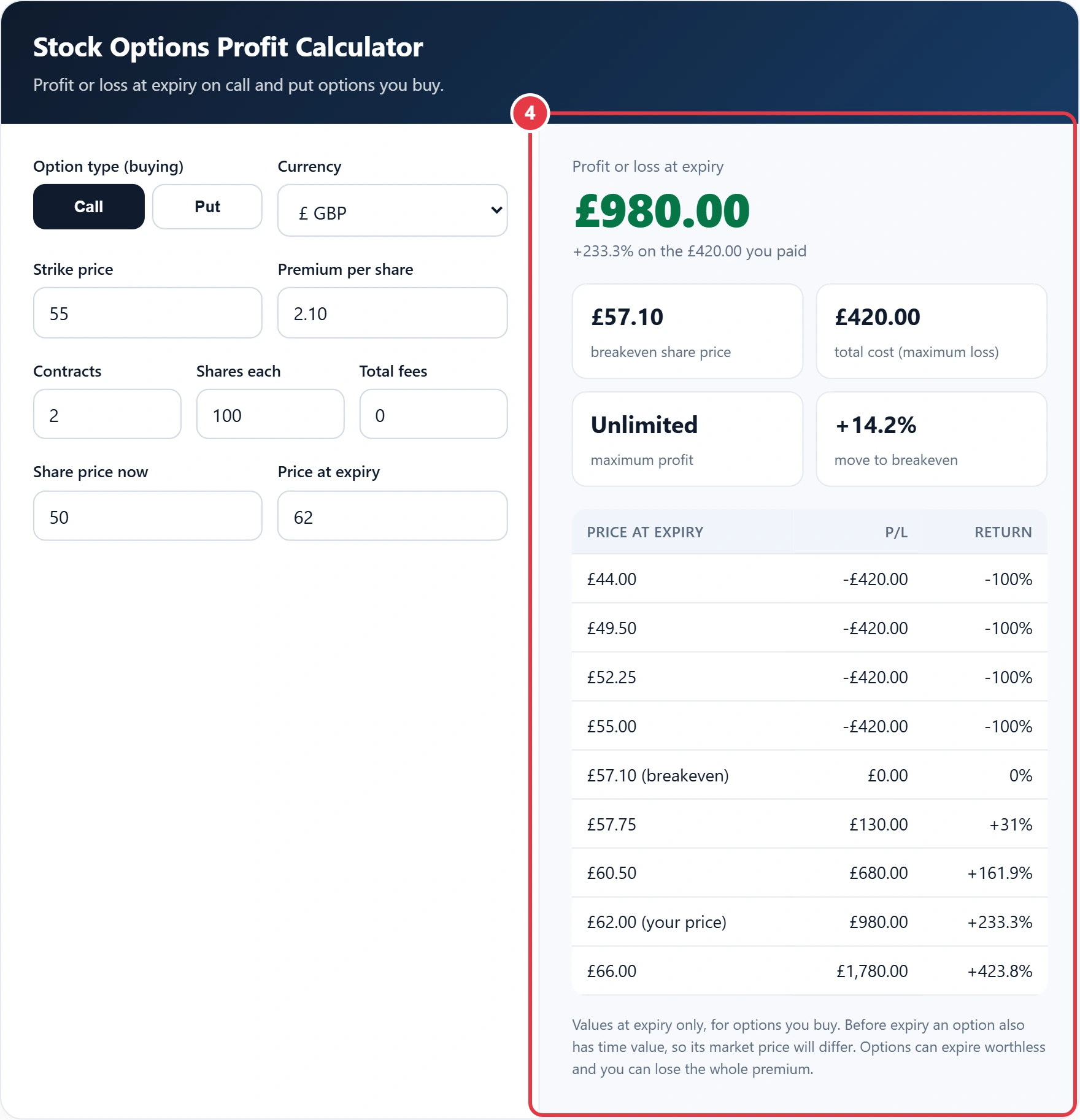
| Price at expiry | P/L | Return |
|---|
Values at expiry only, for options you buy. Before expiry an option also has time value, so its market price will differ. Options can expire worthless and you can lose the whole premium.
Buying an option is a bet with a known cost and a deadline, so it pays to see the whole range of outcomes before you click buy. This stock options profit calculator works out what a bought call or put is worth on expiry day, the share price you need to break even, and a small payoff table that shows how the result changes as the price moves.
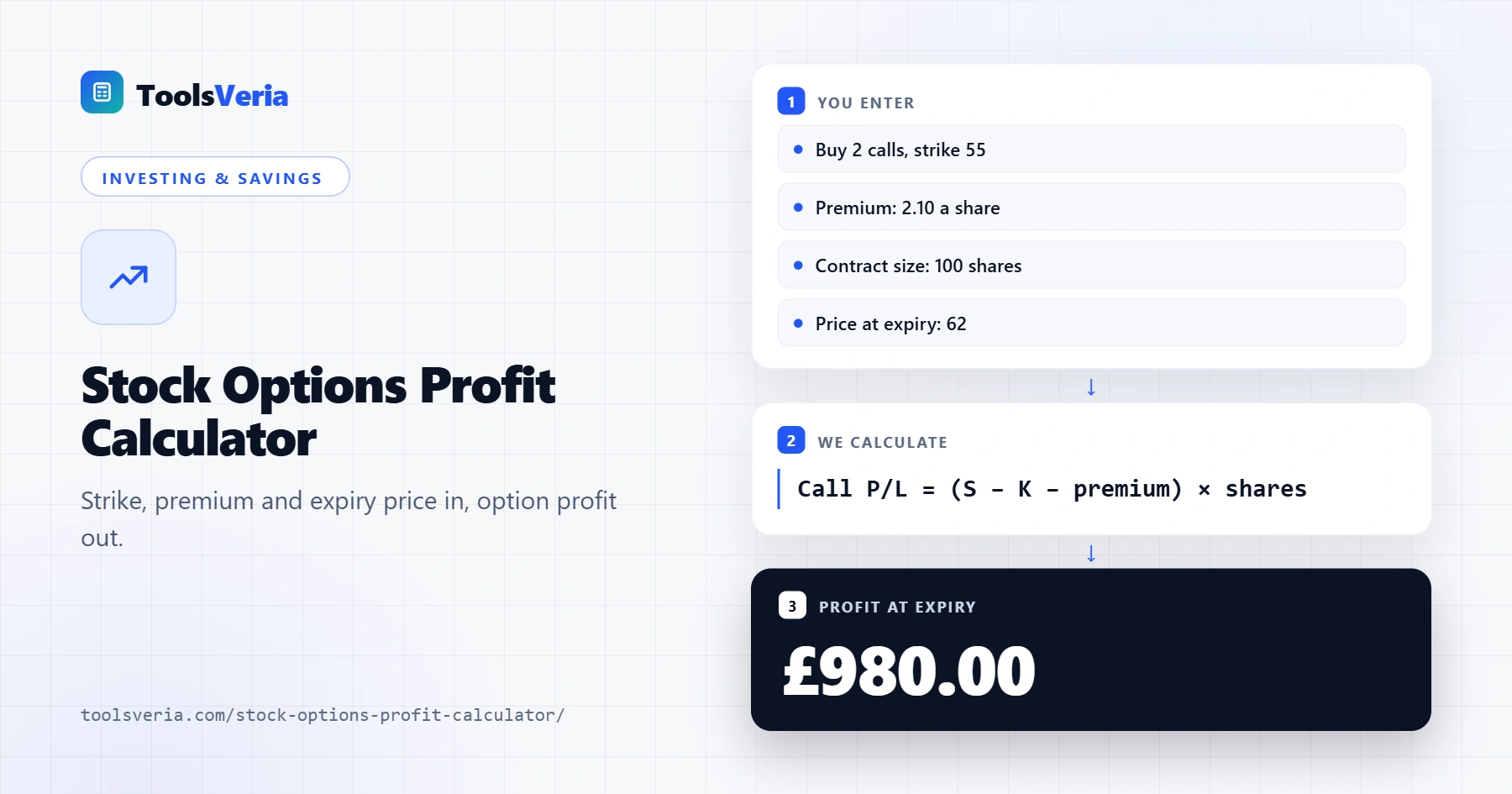
Quick answer: A stock options profit calculator values a bought call at expiry as the amount the share price sits above the strike, minus the premium, multiplied by the shares covered. Two $55 call contracts bought at $2.10 a share cost $420 and break even at $57.10. If the shares finish at $62, the profit is $980.
In This Guide
How Is Option Profit Calculated?
A call gives you the right to buy shares at the strike price, so at expiry it is worth the amount the share price sits above the strike, or nothing. A put gives you the right to sell at the strike, so it is worth the amount the price sits below the strike. Your profit is that value, minus the premium you paid, multiplied by the number of shares the contracts cover.
Here is how it plays out for Marcus. He expects a chip maker trading at $50 to rally after results, so he buys 2 call contracts with a $55 strike for a premium of $2.10 a share. Each contract covers 100 shares, so his outlay is 2.10 × 200 = $420. His breakeven at expiry is 55 + 2.10 = $57.10. If the shares finish at $62, each option is worth $7, giving (7 − 2.10) × 200 = $980 profit. If they finish at $54, the calls expire worthless and he loses the $420.
How to Use the Stock Options Profit Calculator
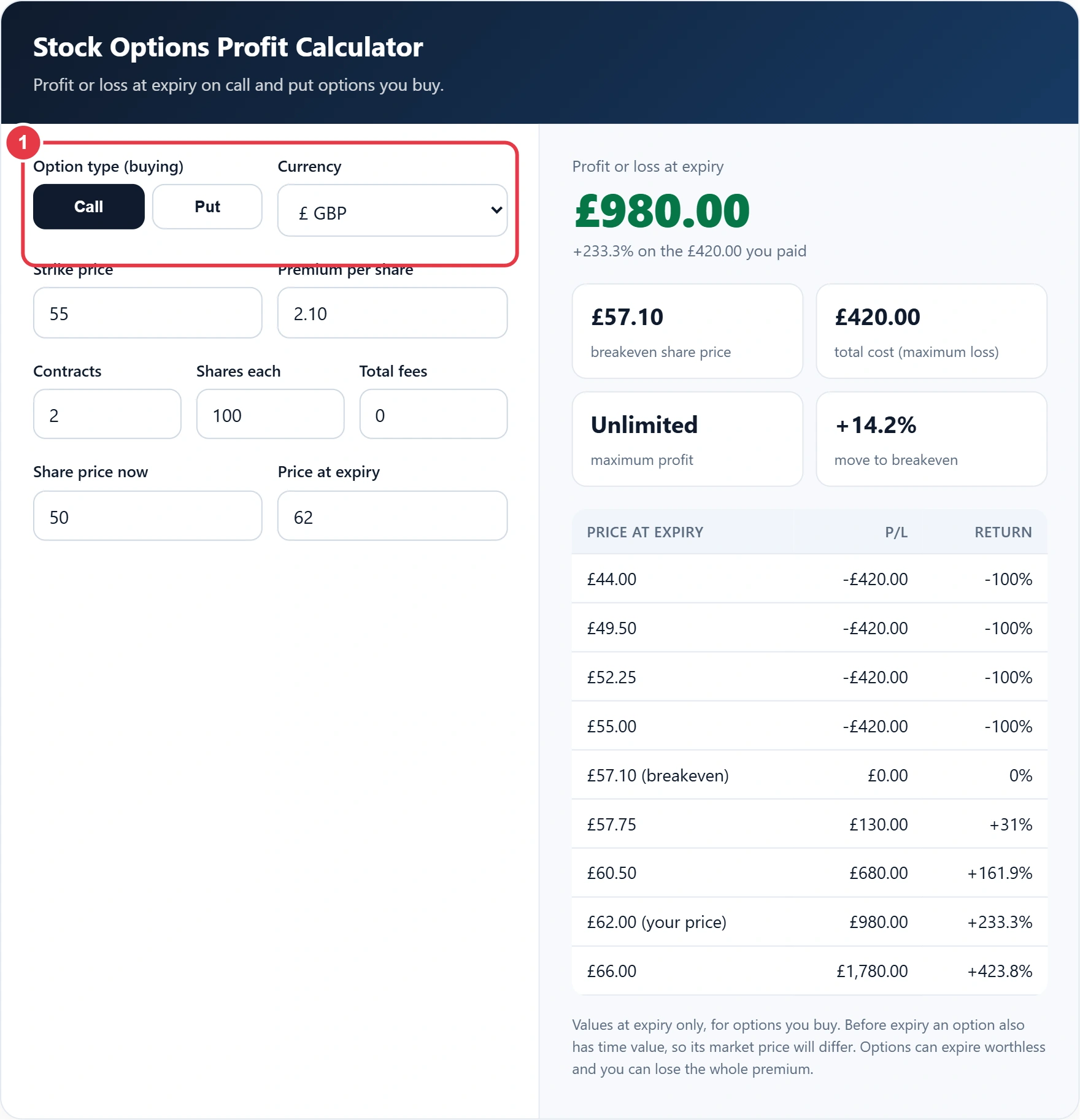
Step 1: Choose a Call or a Put
Pick Call if you expect the share price to rise, or Put if you expect it to fall, then choose the currency your broker quotes in.
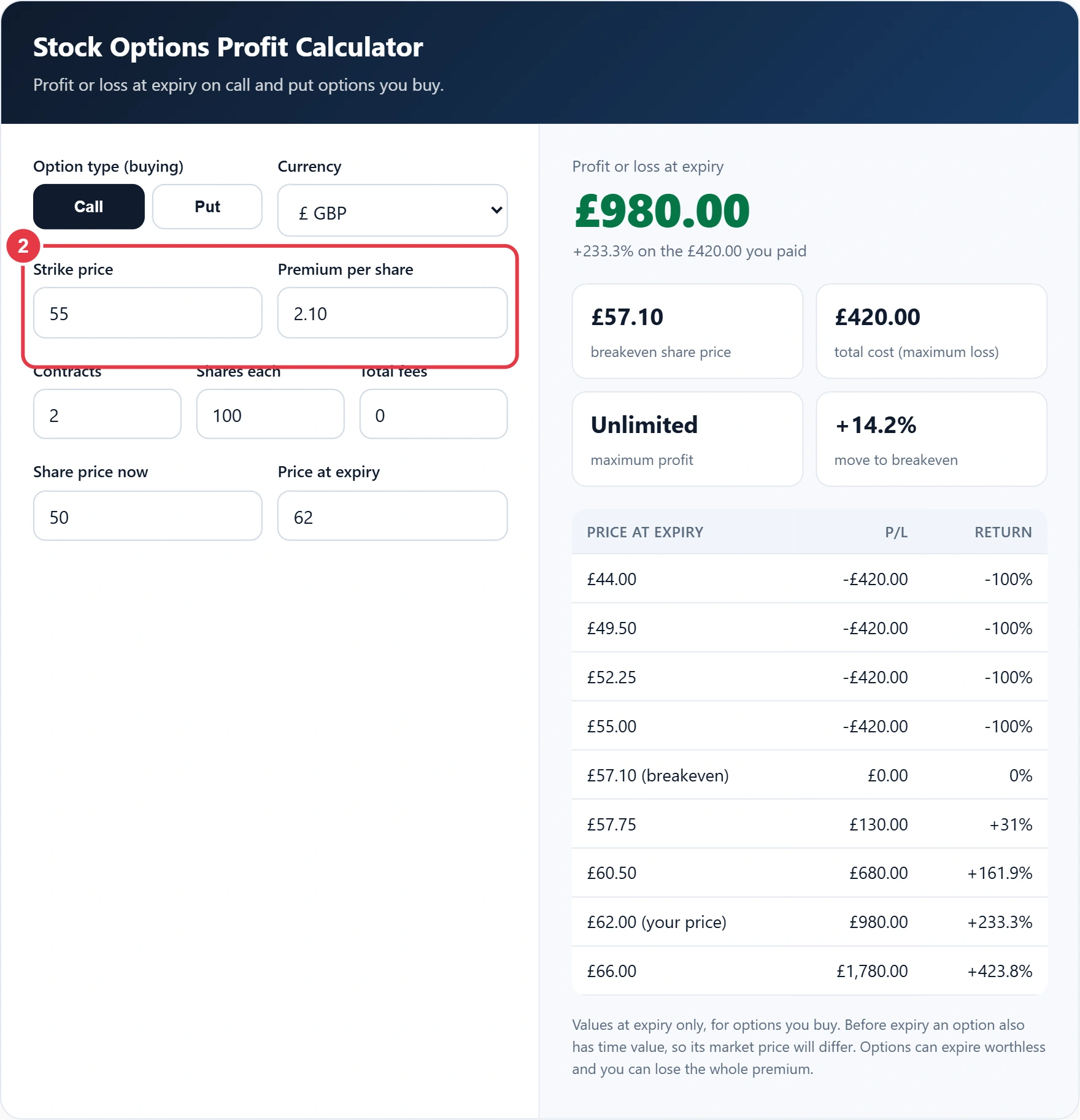
Step 2: Enter the Strike and Premium
Type the strike price and the premium per share from the option chain. Brokers quote premium per share, not per contract, so a quote of 2.10 on a 100 share contract costs 210 in total. The Investor.gov glossary entry on options is a clear refresher if the terms are new to you.
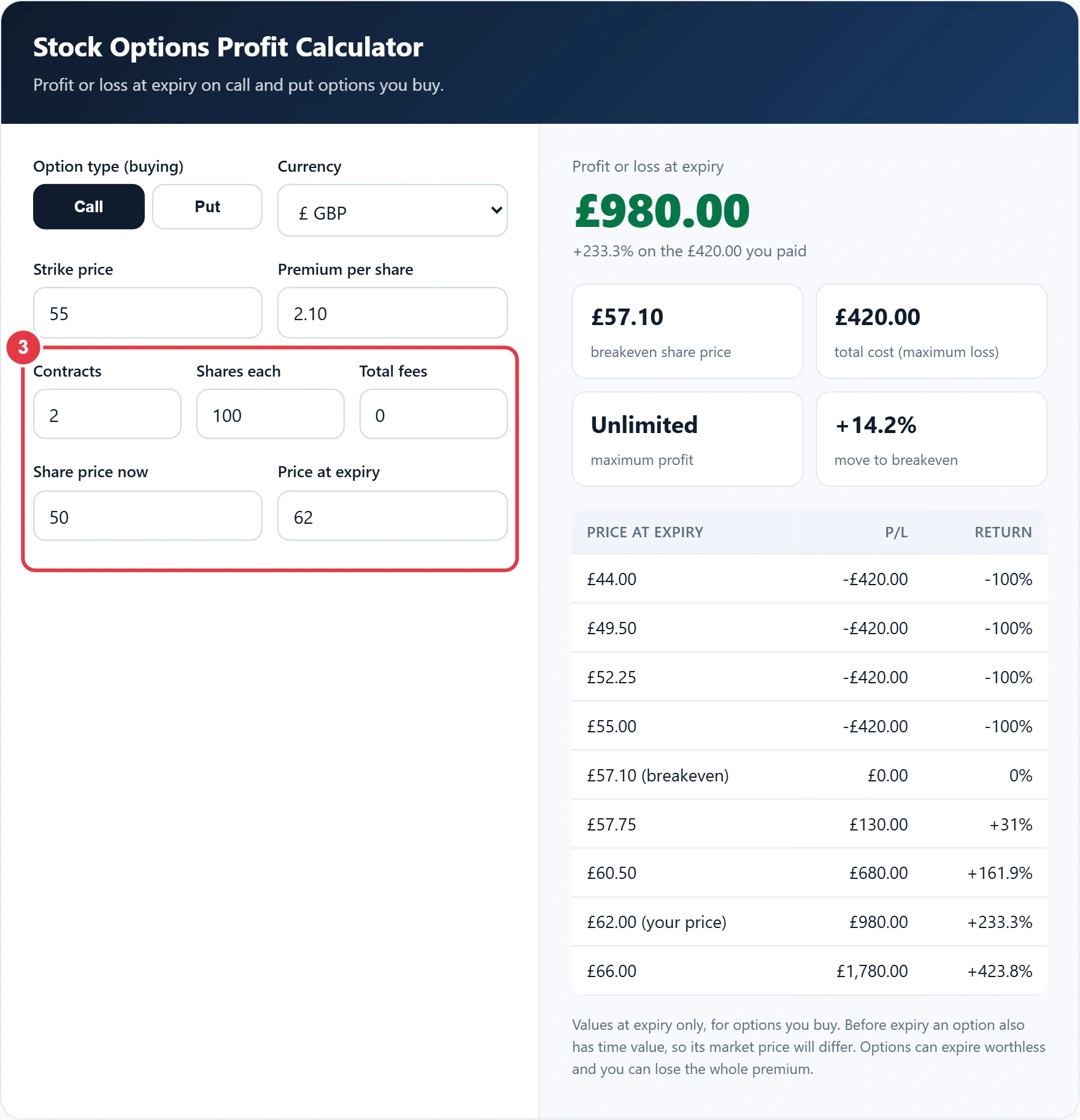
Step 3: Set Contracts, Size and Prices
Enter how many contracts you are buying and the shares per contract, which is 100 for standard US equity options. Add any commission, the share price today and the price you expect at expiry. To see how big a move that expiry price represents, the percentage increase calculator gives the exact change between the two prices.
Step 4: Read the Payoff
The panel shows your profit or loss, return on premium, breakeven, maximum loss and maximum profit. The table lists outcomes around the strike, with your breakeven and chosen price marked.
What Does the Payoff Table Not Show?
- Before expiry, an option also carries time value, so you can often sell it for more than the table suggests. That time value shrinks every day.
- Implied volatility changes the premium. Buying just before results often means paying for a big move that may not come.
- Writing (selling) options has a very different risk profile and is not covered here.
A large percentage return on a small premium can look attractive, but most short dated options bought out of the money expire worthless. For a deeper read on how calls and puts are priced, the Wikipedia article on options covers intrinsic and time value in detail. If you would rather own the shares outright, the profit margin calculator shows the percentage gain on a straight buy and sell, which makes a fair comparison with the return on an option.
Stock Options Profit Terms Explained
These terms explain the contract features and pricing ideas behind the stock options profit calculator so you can judge a trade's risk before buying.
- Call option
- A contract giving the buyer the right, but not the obligation, to buy the underlying shares at the strike price on or before expiry. Buyers profit when the share price climbs far enough above the strike to cover the premium.
- Put option
- A contract giving the buyer the right, without any obligation, to sell the underlying shares at the strike price. It gains value as the share price falls and is used either to speculate on a decline or to hedge an existing holding.
- Strike price
- The fixed price at which an option holder may buy or sell the underlying shares. Its distance from the current share price largely decides how expensive the option is and how likely it is to finish with any value.
- Option premium
- The price paid to buy an option, quoted per share and multiplied by the shares each contract covers. For a buyer it is the maximum possible loss, because an unprofitable option can simply be left to expire.
- Intrinsic value
- The amount by which an option is in the money, meaning how far the share price sits beyond the strike in the holder's favour. At expiry an option is worth only this, since its time value has gone.
- Time value
- The part of an option's price above its intrinsic value, reflecting the chance that the share price moves favourably before expiry. It shrinks as the expiry date approaches, which is why values calculated at expiry leave it out.
</>Embed this calculator on your website
Add the free Stock Options Profit Calculator to your own site or blog. Copy the code below and paste it into an HTML block. It resizes itself and works on phones.
How we checked this tool: the Tools Veria Editorial Team built this tool by hand, checked it against the official rules or published standards where they apply, and tested it against worked examples. Results are estimates for planning, not personal financial or tax advice. Read our editorial policy and disclaimer, or report an error.
Frequently Asked Questions
How do I calculate the breakeven on a call option?
Add the premium per share to the strike price. A 55 strike call bought for 2.10 breaks even at 57.10 at expiry.
How do I calculate the breakeven on a put option?
Subtract the premium per share from the strike price. A 50 strike put bought for 1.80 breaks even at 48.20 at expiry.
Why multiply by 100?
A standard US equity option contract covers 100 shares, so a premium quoted at 2.10 costs 210 per contract. Other markets can use different sizes, which is why the field is editable.
What is the most I can lose when buying options?
When you buy a call or a put, the most you can lose is the premium you paid plus any fees. That happens if the option expires worthless.
Does this calculator show profit before expiry?
No. It shows the value at expiry only. Before then, the option price also depends on time left and volatility, which a pricing model such as Black-Scholes estimates.
Are options available to UK retail investors?
Some UK brokers offer US listed options to clients who pass an appropriateness check. They are complex products, and you can lose all of the money you put in.