Create fictional UK addresses with realistic postcodes for testing and design work.
Every address is made up. House numbers and street names are random, towns are real and postcodes follow the correct format for that area but are not checked against Royal Mail data. Use them only to test forms, software and layouts, never for fraud, to register accounts or to receive goods.
For testing only. These are not real delivery addresses.
Testing a checkout, a sign up form or a CRM import is much easier with realistic data. This UK address generator creates fictional addresses that look and behave like real ones: a house number, a made up street, a real town, its county and a postcode in the correct format for that area. Postcodes follow the structure explained in this overview of postcodes in the United Kingdom, so they pass normal format checks without pointing at anyone's home.
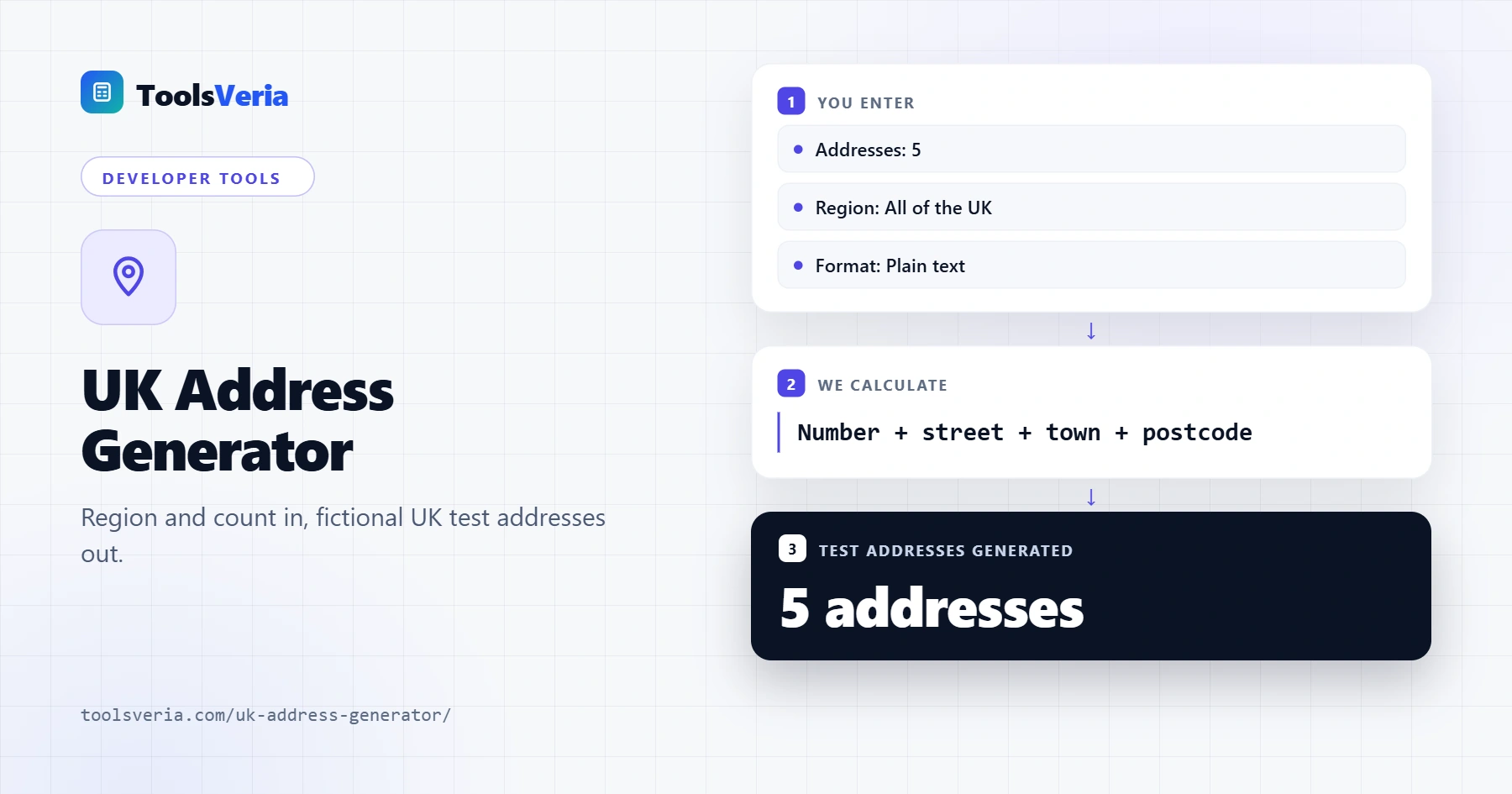
Quick answer: A UK address generator builds fictional test addresses from a house number, a made up street, a real town and a postcode with a genuine outward code, such as M14 for Manchester. The inward code is a digit plus two letters that never include C, I, K, M, O or V, so formats pass normal checks.
In This Guide
What Is a Fake UK Address Generator?
It is a test data tool. Developers, testers and designers use fake addresses to fill forms, check validation rules, try out label layouts and populate demo databases. Using a real person's address for this is poor practice under data protection rules, so fictional data is the safer choice.
Each address is built in a fixed way. The street name joins a random first part, such as Oak, Mill or Station, with an ending such as Road, Lane or Close. The town is picked from a list of real UK towns and cities, and the postcode starts with a genuine outward code for that place, for example M14 for Manchester or LS6 for Leeds. The inward code is a random digit followed by two letters from the set Royal Mail uses, which leaves out C, I, K, M, O and V. The full postcode is not checked against Royal Mail data, so it may not exist.
How Do You Use the UK Address Generator?
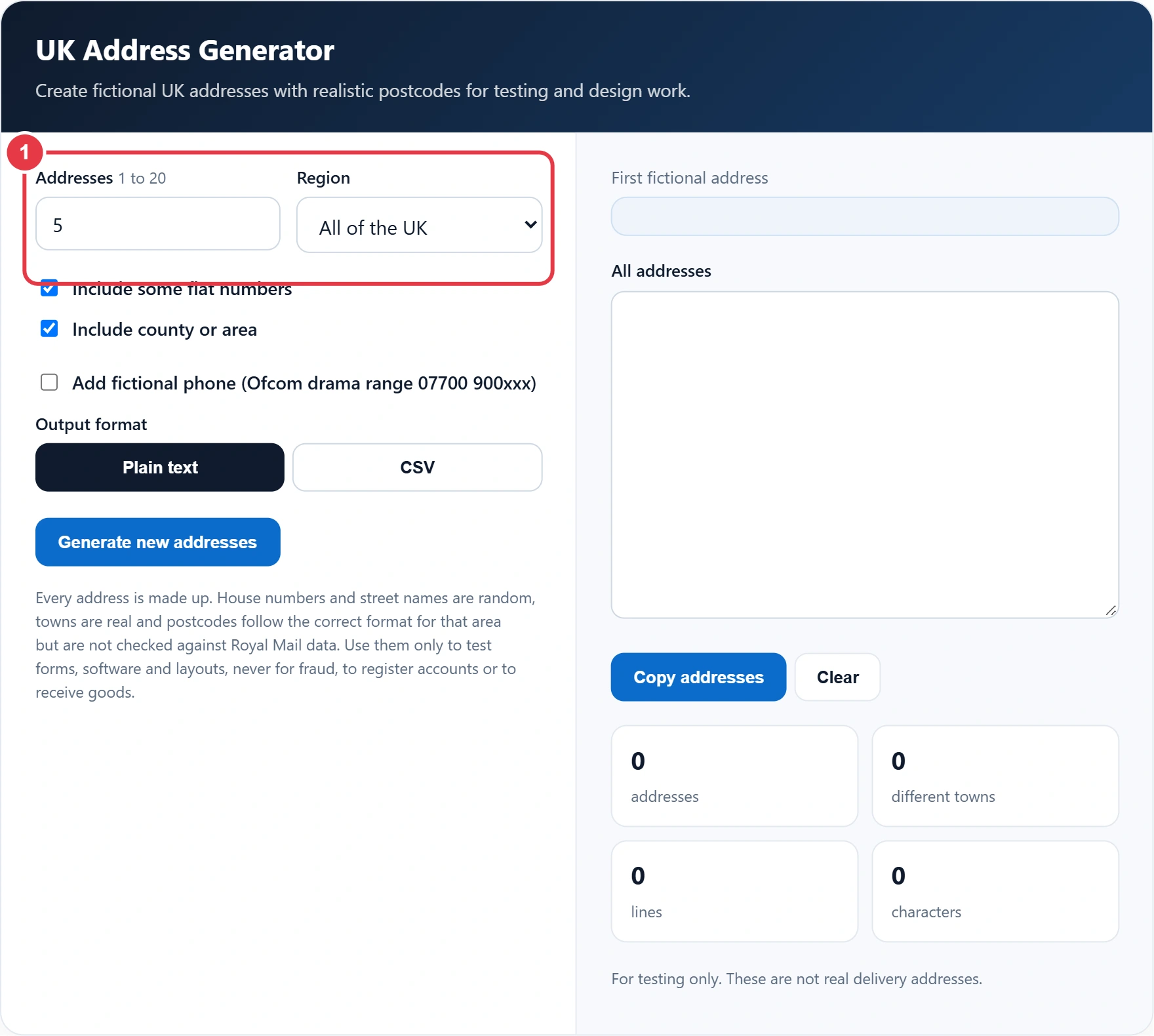
Step 1: Choose How Many and Where
Enter a number from 1 to 20 and choose a region: all of the UK, England, London only, Scotland, Wales or Northern Ireland. Enter a number from 1 to 20 and choose a region: all of the UK, England, London only, Scotland, Wales or Northern Ireland.
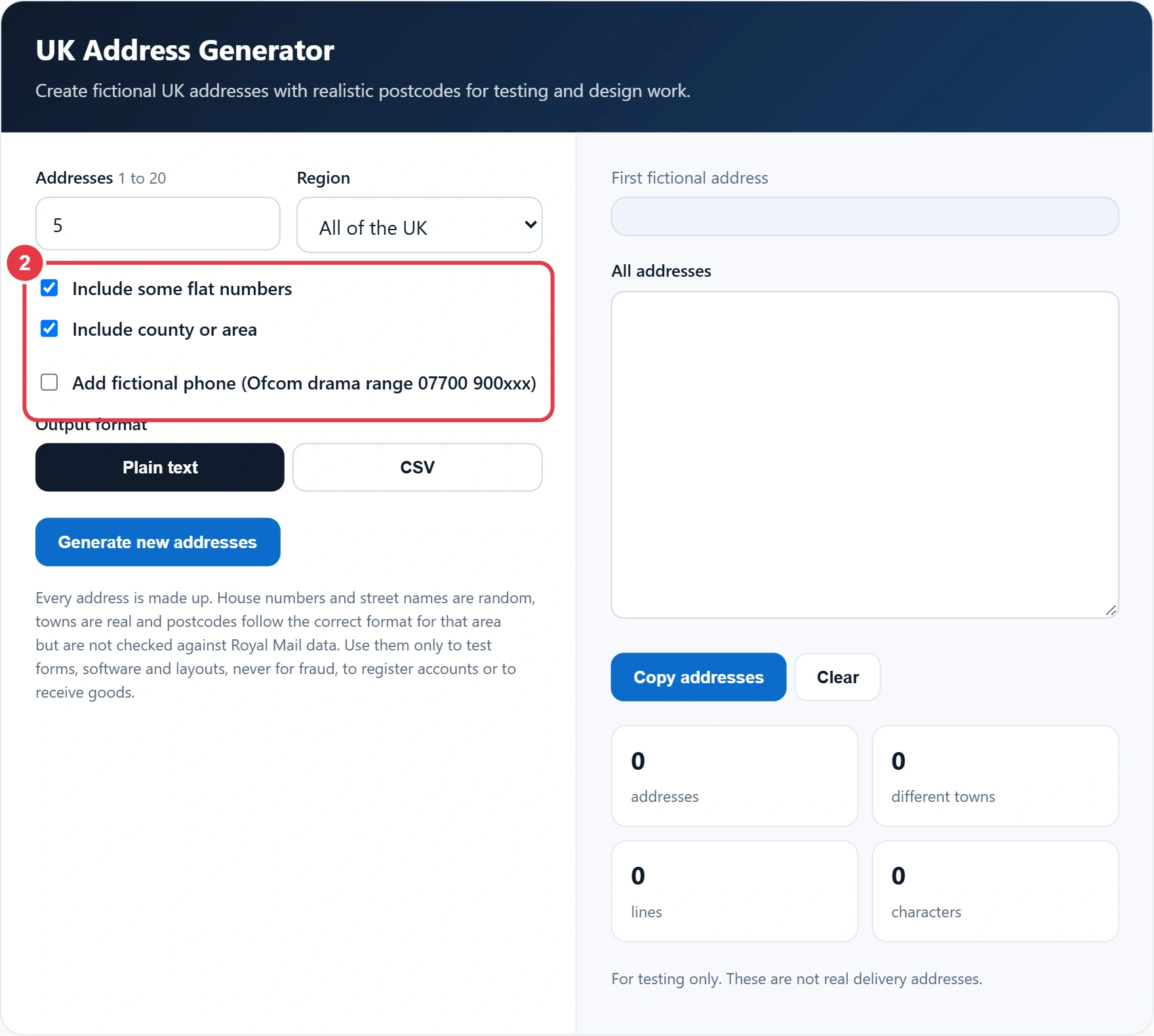
Step 2: Pick the Extra Details
Tick the boxes to add occasional flat numbers, the county or area, and a fictional mobile number from the range set aside for TV and radio drama.
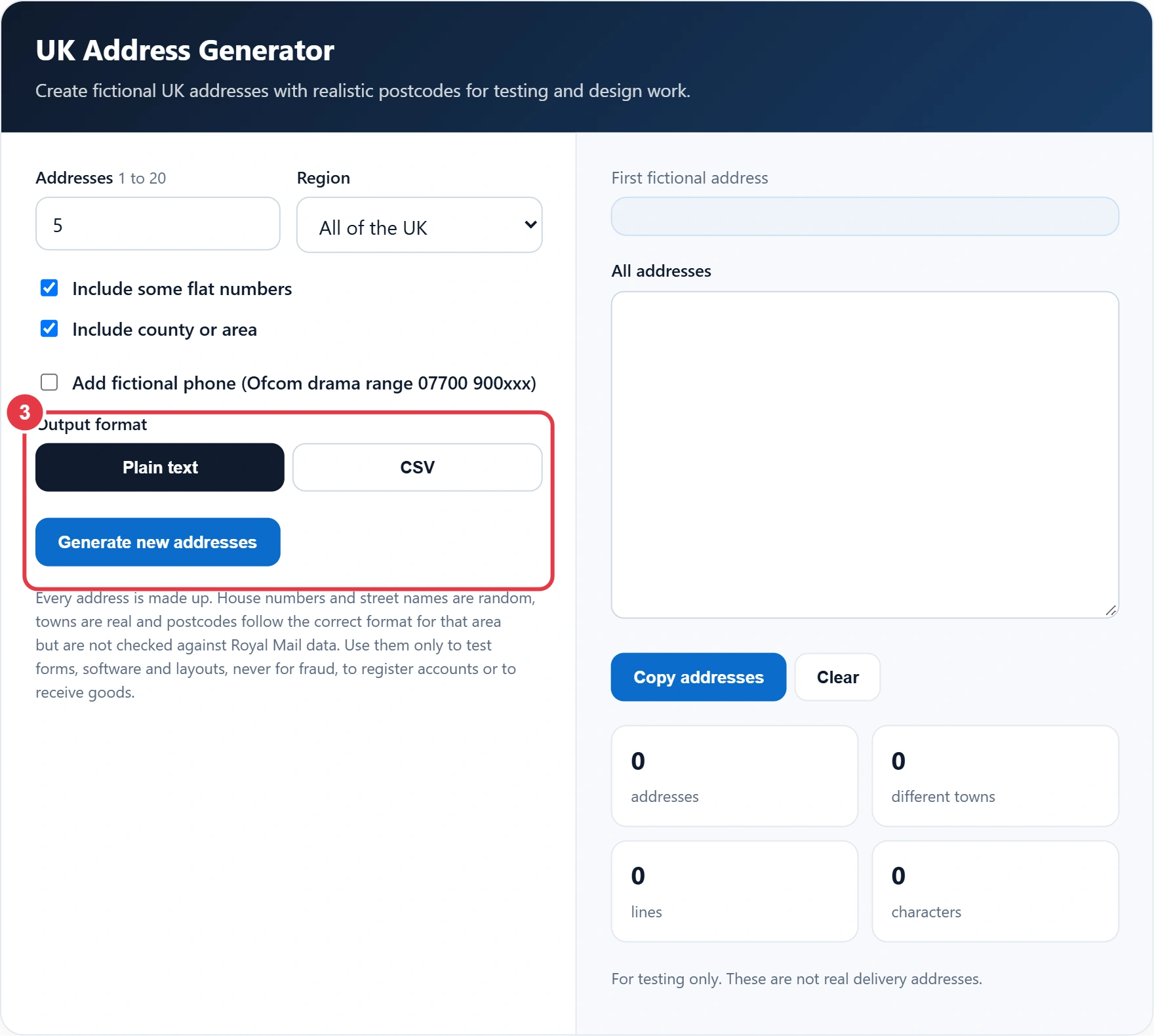
Step 3: Choose a Format and Generate
Plain text gives one address block per entry. CSV gives a header row and one address per line, ready to import into a spreadsheet or test database. If each test record also needs a unique ID, the UUID generator creates as many as you need in one go. Press Generate for a fresh set.
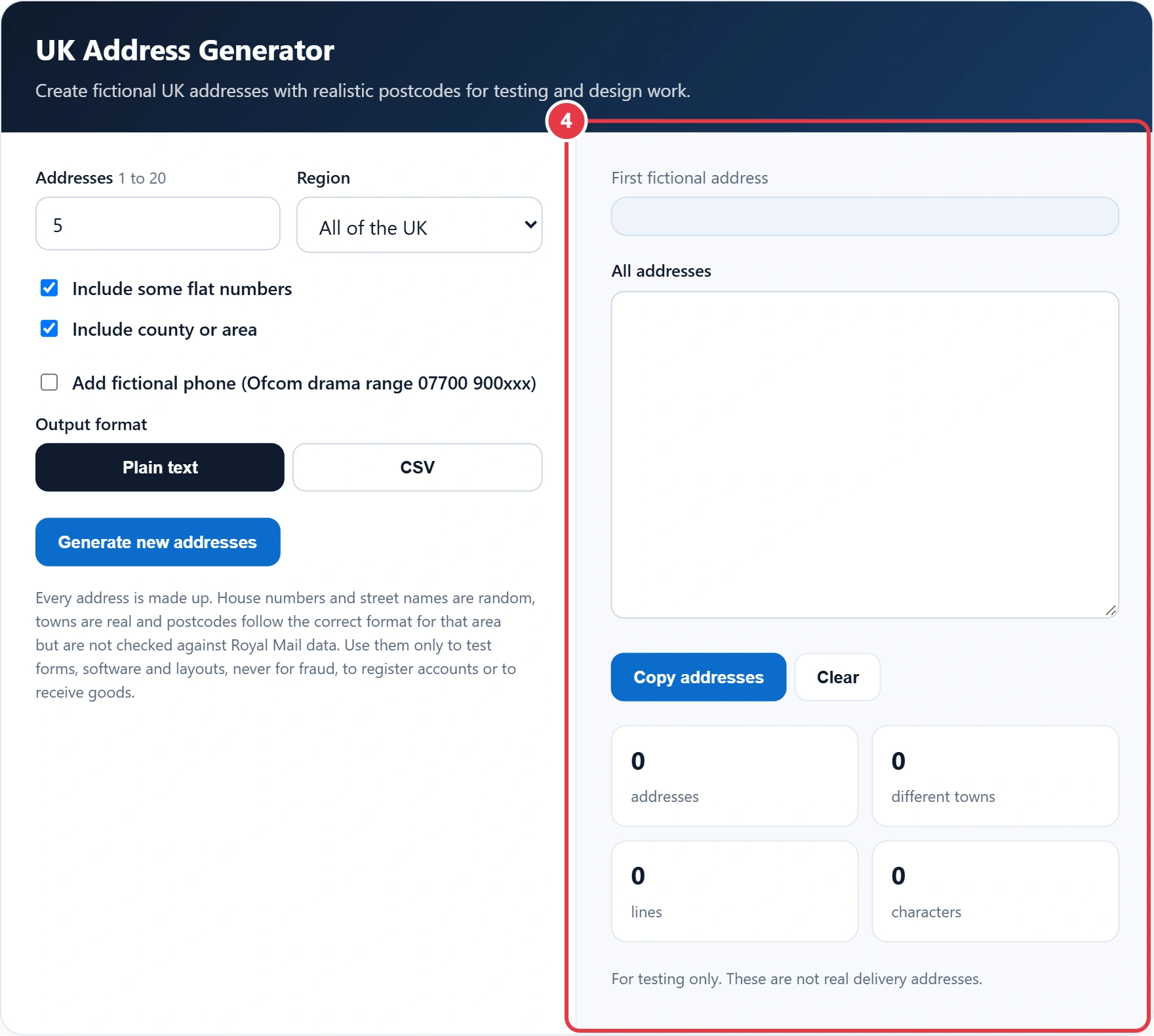
Step 4: Copy Your Test Addresses
The first address is shown on its own for a quick check. Press Copy addresses to copy the full list, and if your other test data is in JSON, the JSON to CSV converter turns it into a sheet that sits alongside these addresses. Use the stats to confirm the count.
Which UK Postcode Areas Does the Address Generator Use?
| Town | Postcode area | Example format |
|---|---|---|
| London | E, N, SE, SW, W, NW | SE15 4QT |
| Manchester | M | M14 6HL |
| Birmingham | B | B15 2RS |
| Leeds | LS | LS6 3BN |
| Glasgow | G | G12 8PA |
| Cardiff | CF | CF24 4HQ |
| Belfast | BT | BT9 5AB |
The UK address generator uses postcode areas for London (E, N, SE, SW, W, NW), Manchester (M), Birmingham (B), Leeds (LS), Glasgow (G), Cardiff (CF) and Belfast (BT). The optional phone numbers come from 07700 900000 to 07700 900999, a block Ofcom keeps for drama so that numbers shown on screen never reach a real person. You can read more about these reserved ranges in this guide to fictitious telephone numbers. Please use this tool for testing only. Fake addresses must never be used to deceive a business, open accounts or receive goods.
Key UK Address Generator Terms Explained
These definitions explain the postcode structure and test data ideas behind the UK address generator, helping you create realistic records without touching real people's details.
- UK postcode
- An alphanumeric code used by Royal Mail to sort post to a small group of addresses. It has two parts separated by a space, and its format can be validated even when a particular combination is not assigned to any property.
- Outward code
- The first half of a postcode, made of the postcode area letters and the district number. It identifies the town or district a letter is sent to first, which is why it must match the town in a realistic test address.
- Inward code
- The second half of a postcode, always a single digit for the sector followed by two letters for the unit. It narrows delivery to a street or part of a street, and some letters are excluded to avoid misreading.
- Test data
- Invented records used to try out software, forms and imports without exposing information about real people. Good test data follows the same formats as live data so validation rules, layouts and database fields are properly exercised.
- Drama number range
- A block of telephone numbers that Ofcom reserves for use in films, television and radio so that fictional numbers never ring a real person. Generated phone numbers in the 07700 900xxx range are safe for the same reason.
- CSV format
- Comma separated values, a plain text format where each line is one record and commas divide its fields. A header row names the columns, so spreadsheets and databases can import the addresses directly.
</>Embed this calculator on your website
Add the free UK Address Generator to your own site or blog. Copy the code below and paste it into an HTML block. It resizes itself and works on phones.
How we checked this tool: the Tools Veria Editorial Team built this tool by hand, checked it against the official rules or published standards where they apply, and tested it against worked examples. Results are estimates for planning, not personal financial or tax advice. Read our editorial policy and disclaimer, or report an error.
Frequently Asked Questions
Are these real UK addresses?
No. The towns are real, but the house numbers and street names are made up and the postcodes are random codes in the correct format for that area.
Can I use a fake UK address to sign up for services?
No. These addresses are only for testing forms, software and designs. Using them to mislead a business or receive goods is not acceptable.
Will the postcodes pass validation?
They follow the standard UK postcode format, so they pass format checks. They may fail a lookup against Royal Mail address data because they are not real.
What phone numbers does the tool use?
It uses 07700 900000 to 07700 900999, a mobile range Ofcom reserves for drama, so the numbers cannot ring a real person.
Can I export the addresses to a spreadsheet?
Yes. Choose CSV, copy the result and paste it into a .csv file or straight into a spreadsheet.
Is anything sent to a server?
No. Addresses are generated in your browser and nothing you choose is stored or sent anywhere.