HMRC approved mileage rates for business travel in 2026/27.
HMRC approved rates from 6 April 2026: cars and vans 55p a mile for the first 10,000 business miles and 25p after, motorcycles 24p, bicycles 20p, passengers 5p. Commuting to a permanent workplace does not count as business travel.
Using your own car for work? This mileage allowance calculator works out the tax free amount HMRC allows for your business miles in 2026/27, including passenger payments. The rates come from HMRC's approved mileage allowance payment rules, and the results show whether you can claim tax relief because your employer pays less, or owe tax because they pay more.
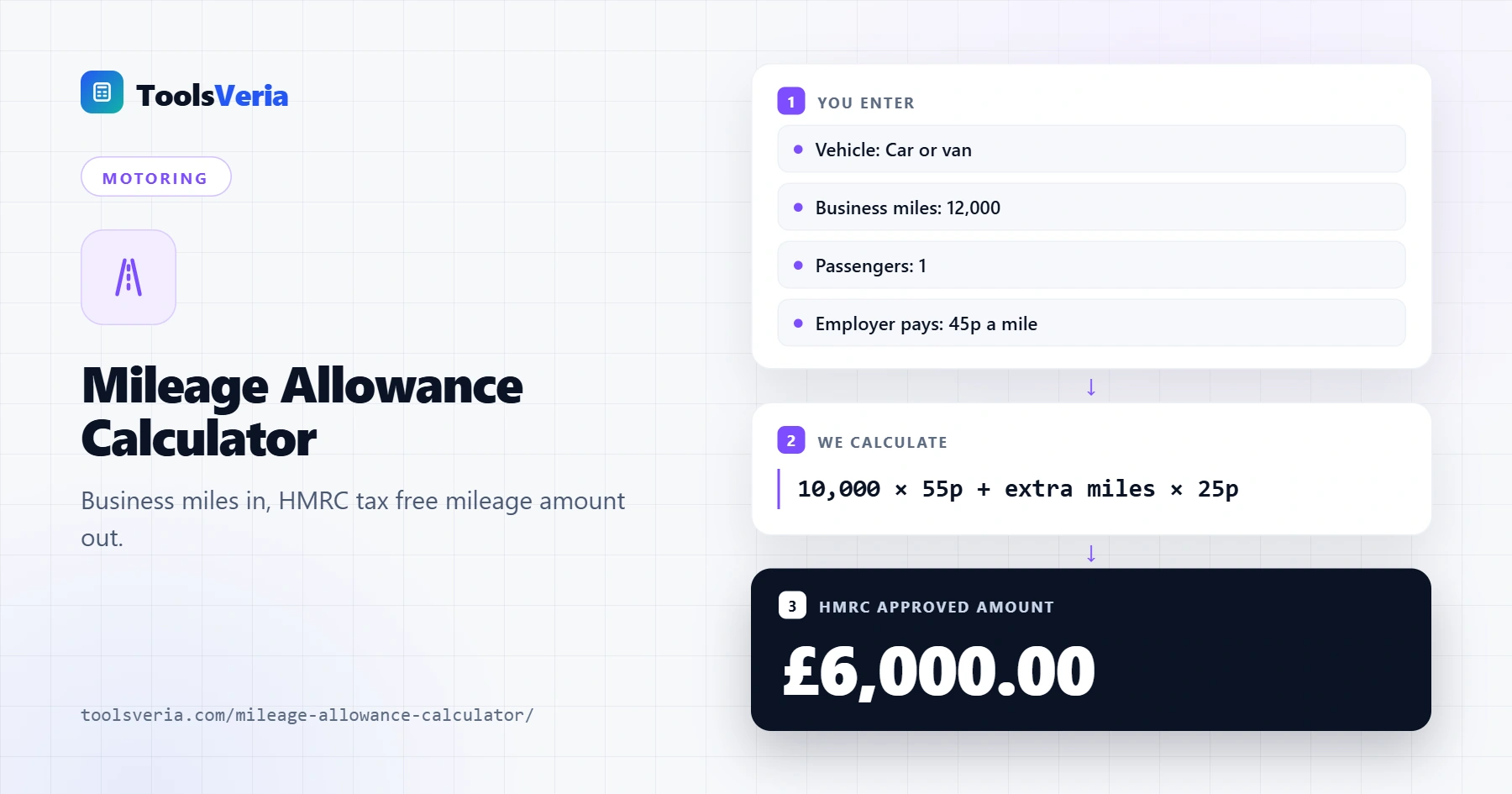
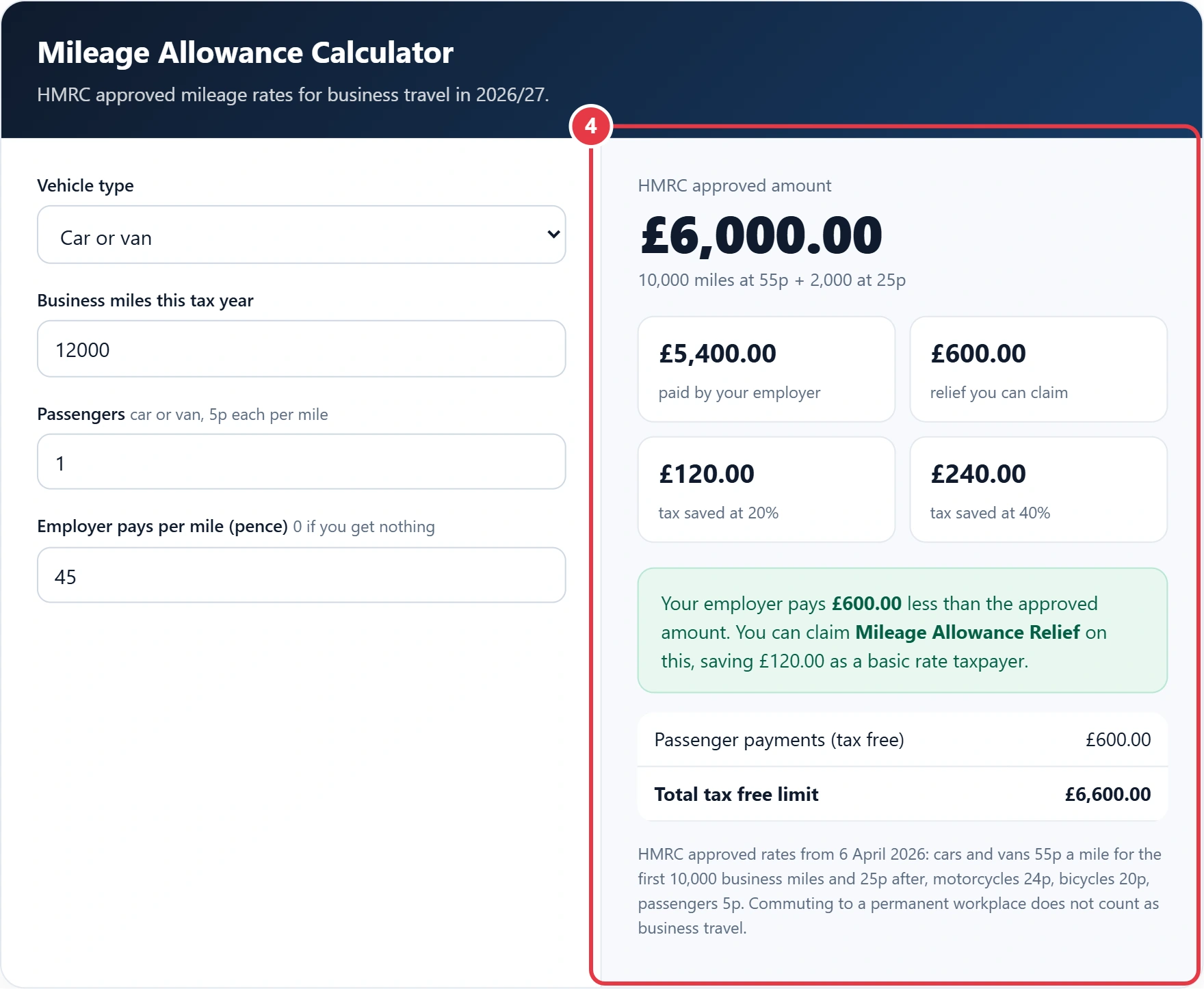
Quick answer: A mileage allowance calculator applies HMRC's 2026/27 approved rates: 55p a mile for the first 10,000 business miles in a car or van, then 25p a mile. So 12,000 miles gives £5,500 + £500 = £6,000, and if your employer pays only 45p you can claim relief on the £600 gap.
In This Guide
What Is the HMRC Mileage Allowance?
Approved Mileage Allowance Payments (AMAPs) are the most an employer can pay you per business mile without it counting as taxable income. From 6 April 2026 the car and van rate rose from 45p to 55p a mile for the first 10,000 business miles in a tax year, with 25p a mile after that. Motorcycles are 24p and bicycles 20p.
For a car, the formula is (first 10,000 miles × 55p) + (remaining miles × 25p). So 12,000 miles gives £5,500 + £500 = £6,000. If your employer pays only 45p, you receive £5,400 and can claim Mileage Allowance Relief on the £600 gap. That saves £120 at 20% tax.
How Do You Use the Mileage Allowance Calculator?
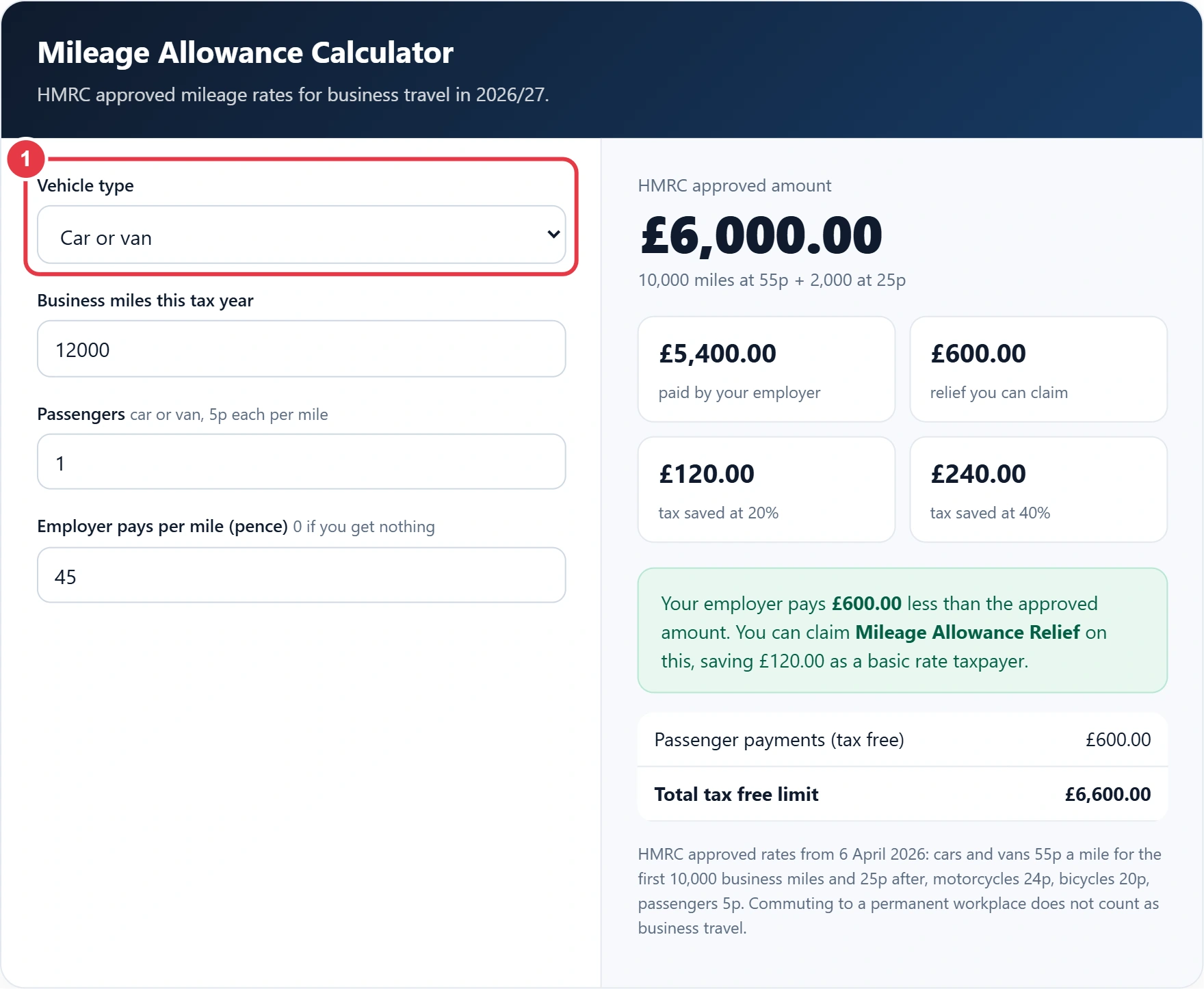
Step 1: Choose Your Vehicle
You select car or van, motorcycle or bicycle, and cars and vans share the same approved rate whatever the fuel, including electric. Select car or van, motorcycle or bicycle. To compare the rate with your real running costs, the MPG calculator works out your actual fuel economy and cost per mile. Cars and vans share the same approved rate, and the type of fuel makes no difference, including electric.
Step 2: Enter Your Miles and Passengers
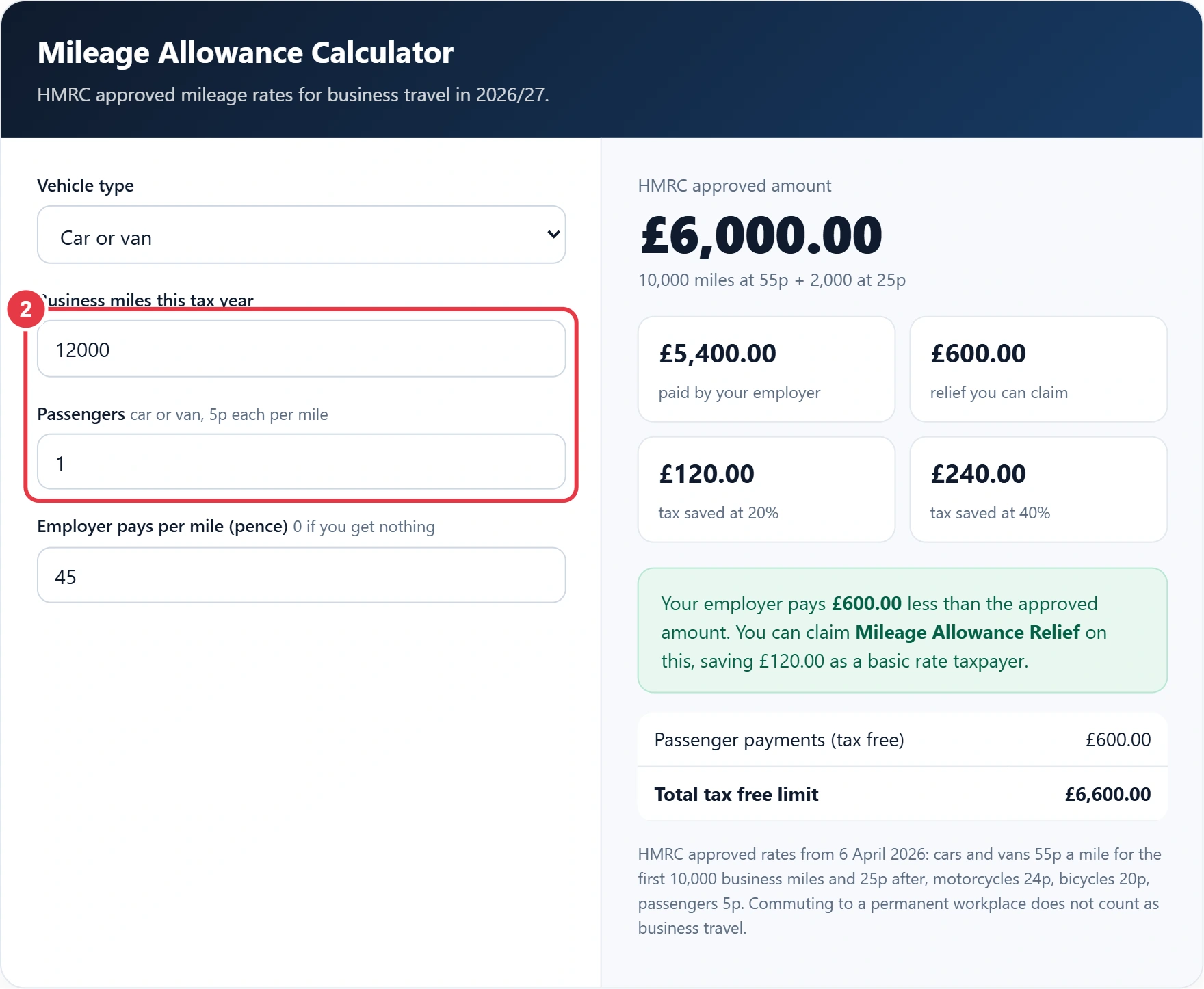
Add your total business miles for the tax year. For a car or van, enter how many colleagues travel with you on business trips. The calculator assumes they come on every business mile.
Step 3: Enter What Your Employer Pays
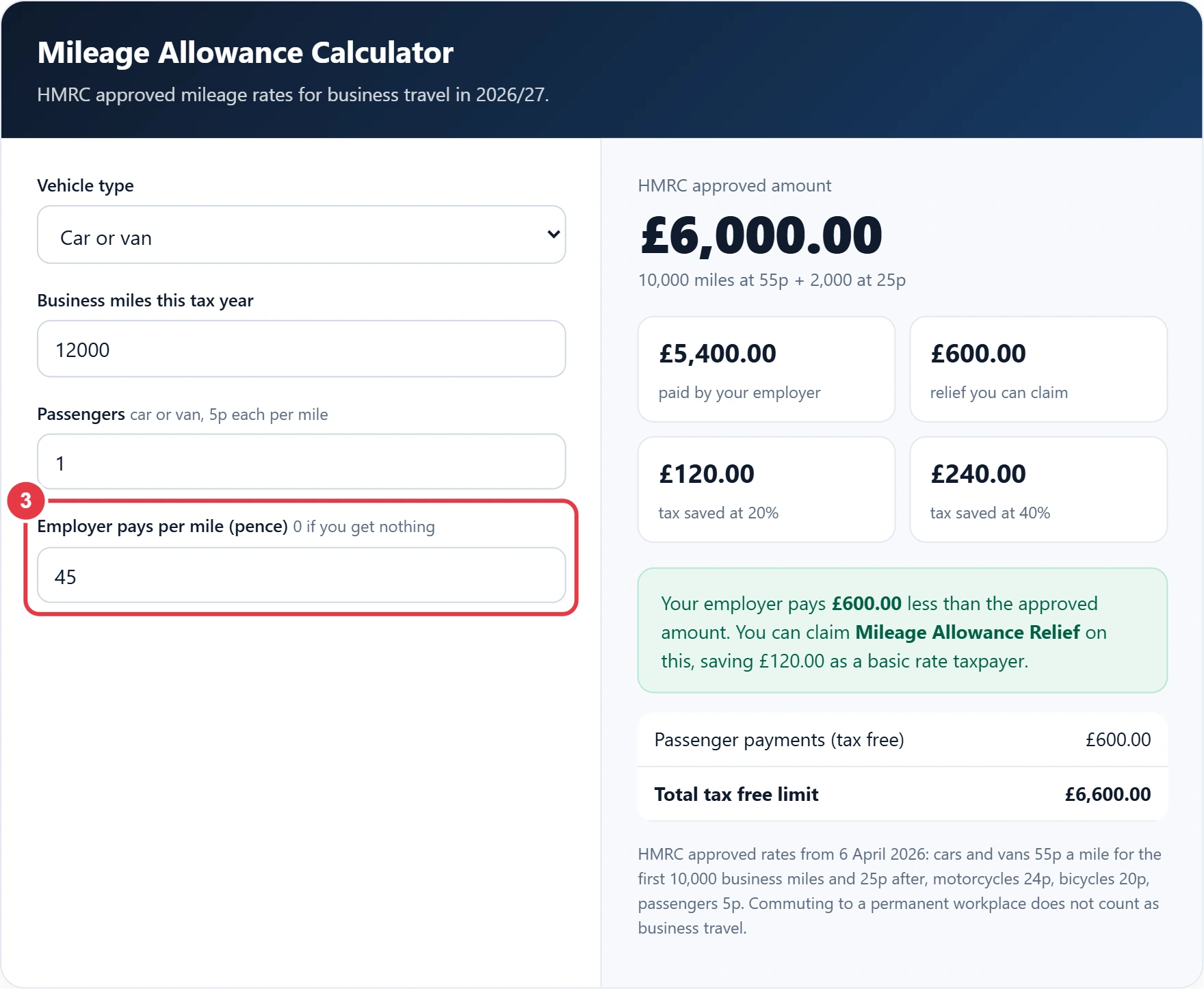
Type the pence per mile your employer pays you. If you get no mileage payments, enter 0 and you can claim relief on the full approved amount.
Step 4: Read Your Results
You will see the approved amount, what your employer paid, any relief to claim or taxable excess, and the tax saving at 20% and 40%. Sole traders can use the same rates as a simplified expense, and the self employed tax calculator shows how business expenses like these reduce your Income Tax and National Insurance.
What Are the HMRC Mileage Rates for 2026/27?
| Vehicle | First 10,000 miles | Over 10,000 miles |
|---|---|---|
| Cars and vans | 55p (was 45p) | 25p |
| Motorcycles | 24p | 24p |
| Bicycles | 20p | 20p |
| Each passenger | 5p | 5p |
For 2026/27, HMRC mileage rates are 55p a mile for cars and vans for the first 10,000 miles and 25p after, 24p for motorcycles, 20p for bicycles and 5p per passenger. Passenger payments are tax free up to 5p a mile, but you cannot claim relief if your employer does not pay them. To claim Mileage Allowance Relief, keep a log of dates, journeys and miles, then claim tax relief for vehicles you use for work online or through Self Assessment.
Courts use their own mileage rates for jurors, and the jury service loss of earnings calculator applies them alongside the daily earnings limits.
Mileage Allowance Terms You Should Know
These HMRC terms explain how business travel is reimbursed and taxed, so you can use the mileage allowance calculator to claim relief or check employer payments.
- Approved Mileage Allowance Payments
- The maximum per mile amounts an employer can pay staff for using their own vehicle on business journeys without the payment being taxed. The rates vary by vehicle type and, for cars and vans, drop once annual business mileage passes 10,000.
- Mileage Allowance Relief
- Tax relief an employee can claim from HMRC when their employer pays less than the approved amount for business miles, or nothing at all. Relief is given on the shortfall at the employee's own Income Tax rate.
- Business travel
- Journeys made as part of your job, such as visits to clients or to a temporary workplace. Ordinary commuting between home and a permanent workplace is excluded, so those miles cannot be included in any mileage claim.
- Passenger payment
- An extra amount an employer may pay per mile for each colleague carried on a business journey. It is tax free up to the approved rate, but an employee cannot claim relief when the employer chooses not to pay it.
- Simplified expenses
- An optional HMRC method that lets sole traders and partnerships claim a flat rate per business mile instead of recording actual vehicle running costs. Once chosen for a vehicle, the same method must be used for as long as it is used in the business.
- Taxable excess
- The amount by which an employer's mileage payments exceed the approved rates for the miles driven. This surplus counts as earnings and is subject to Income Tax, so it must be reported rather than kept tax free.
</>Embed this calculator on your website
Add the free Mileage Allowance Calculator to your own site or blog. Copy the code below and paste it into an HTML block. It resizes itself and works on phones.
How we checked this tool: the Tools Veria Editorial Team built this tool by hand, checked it against the official rules or published standards where they apply, and tested it against worked examples. Results are estimates for planning, not personal financial or tax advice. Read our editorial policy and disclaimer, or report an error.
Frequently Asked Questions
What is the HMRC mileage rate for 2026/27?
Cars and vans get 55p a mile for the first 10,000 business miles and 25p after that. Motorcycles get 24p and bicycles 20p.
When did the mileage rate go up from 45p to 55p?
The approved rate for cars and vans rose from 45p to 55p a mile from the start of the 2026/27 tax year on 6 April 2026.
What is Mileage Allowance Relief?
It is tax relief on the gap between the HMRC approved amount and what your employer pays. You get relief at your highest rate of income tax.
Can I claim mileage for driving to work?
No. Travel between home and your permanent workplace is commuting and does not count. Trips to temporary workplaces or clients usually do.
Does the 55p rate apply to electric cars?
Yes. The approved mileage rate is the same for petrol, diesel, hybrid and electric cars.
Is the 10,000 mile limit per job or per year?
It is per tax year, across all business miles you drive for the same employment.