Theoretical value of European call and put options, with the full set of Greeks.
Time is measured as days ÷ 365. Rates and volatility are example inputs, not market data.
| Greek | Call | Put |
|---|
d1 and d2
Before you pay a premium for an option, it helps to know what the contract is worth on paper. This Black Scholes calculator gives you the theoretical value of a European call and put, plus the five Greeks that show how that value will move. The model behind it won Myron Scholes and Robert Merton the 1997 Nobel prize in economics, and it is still the starting point most traders use when they compare quotes.
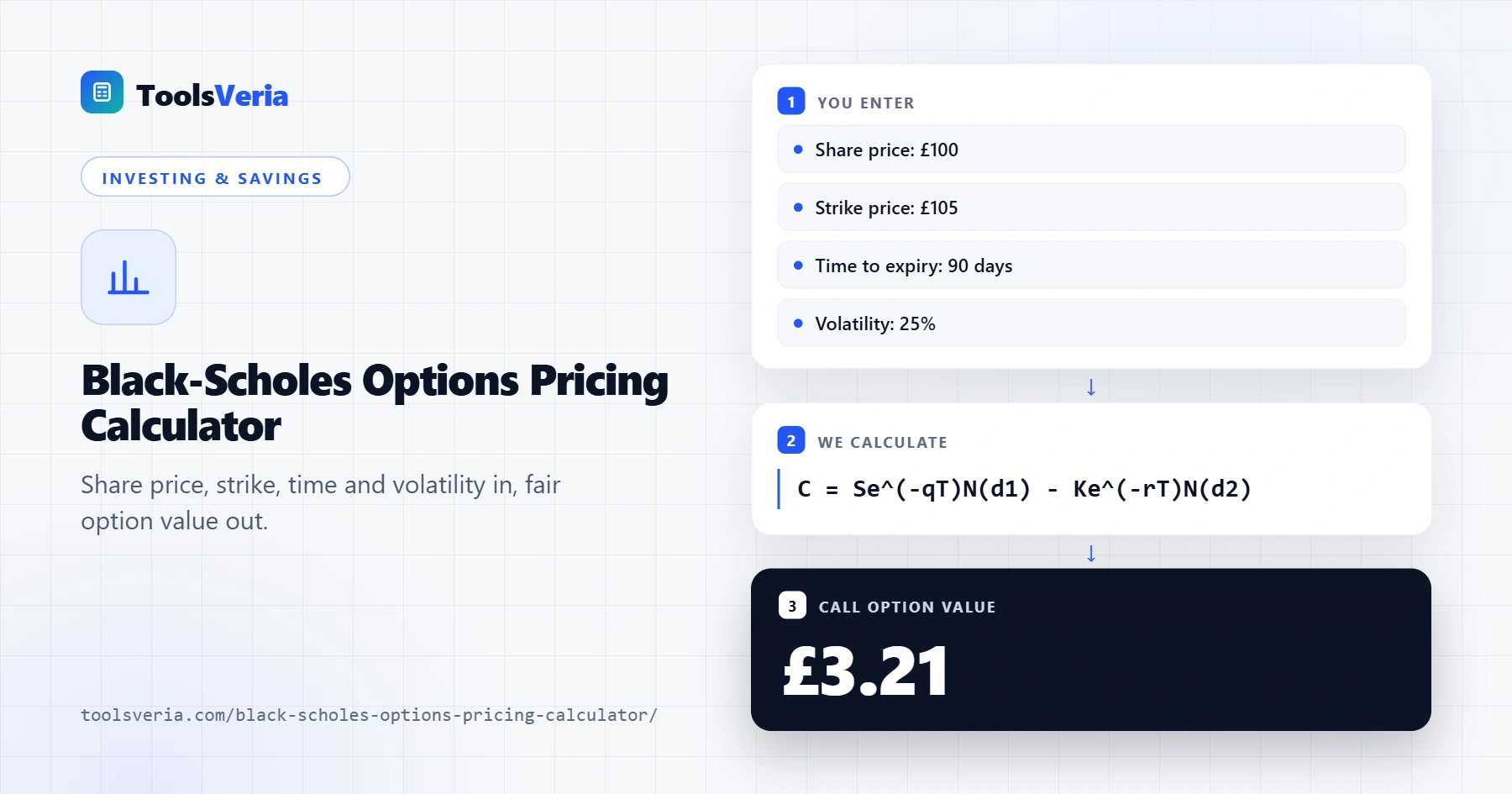
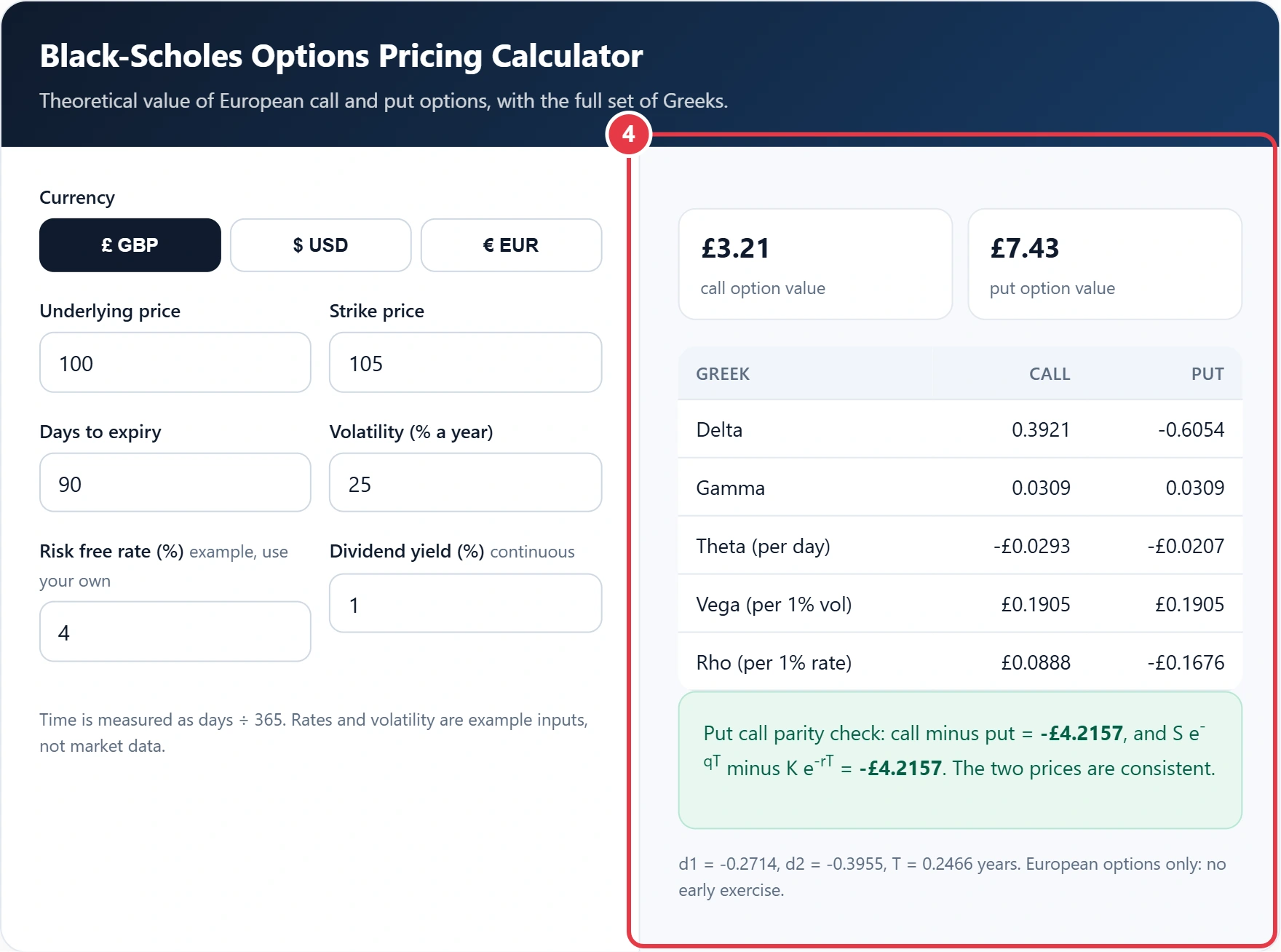
Quick answer: A Black Scholes calculator prices a European option from the share price, strike, time to expiry, volatility, interest rate and dividend yield. For a three month option on a £100 share with a £105 strike, 25% volatility, a 4% rate and a 1% dividend yield, the call is worth £3.21 and the put £7.43.
In This Guide
What Is the Black-Scholes Model?
Black-Scholes treats the share price as a random walk with a constant level of volatility. From that assumption it works out the cost of a portfolio that would copy the option exactly, which gives a single fair price. Two helper values do most of the work: d1 = [ln(S/K) + (r − q + σ²/2)T] ÷ σ√T and d2 = d1 − σ√T. The call is then S e-qT N(d1) − K e-rT N(d2), where N is the standard normal probability.
The q term is a continuous dividend yield. Dividends pull the share price down when they are paid, so a higher yield makes calls cheaper and puts dearer. The model only fits European options, which can be exercised at expiry and not before.
How to Use the Black Scholes Calculator
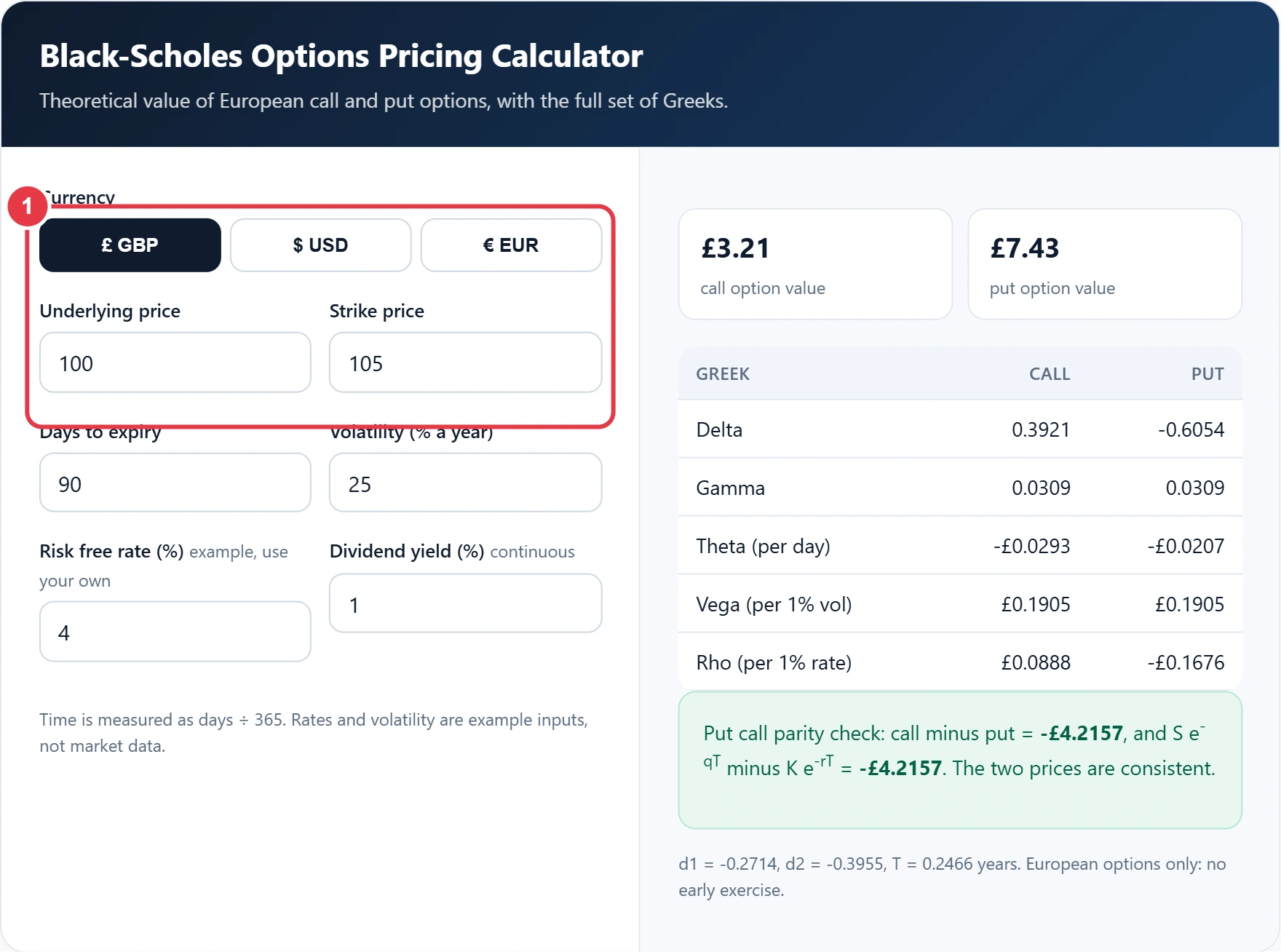
Step 1: Enter the Price and Strike
Pick your currency, then type the current price of the share or index and the strike price written into the option contract.
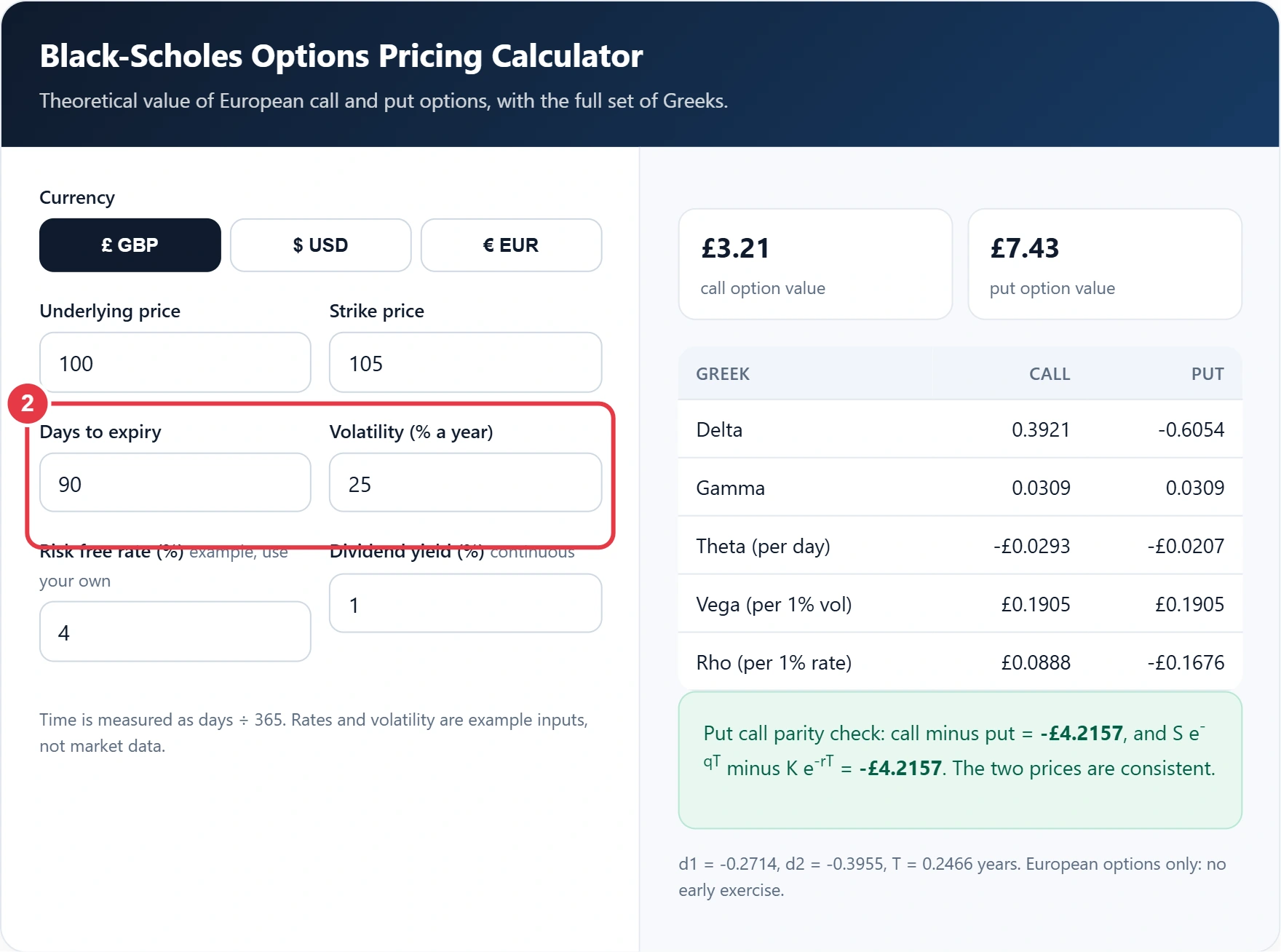
Step 2: Set Time and Volatility
Enter the calendar days left until expiry and the annual volatility as a percentage. Implied volatility from your broker's option chain usually gives a more useful answer than past volatility.
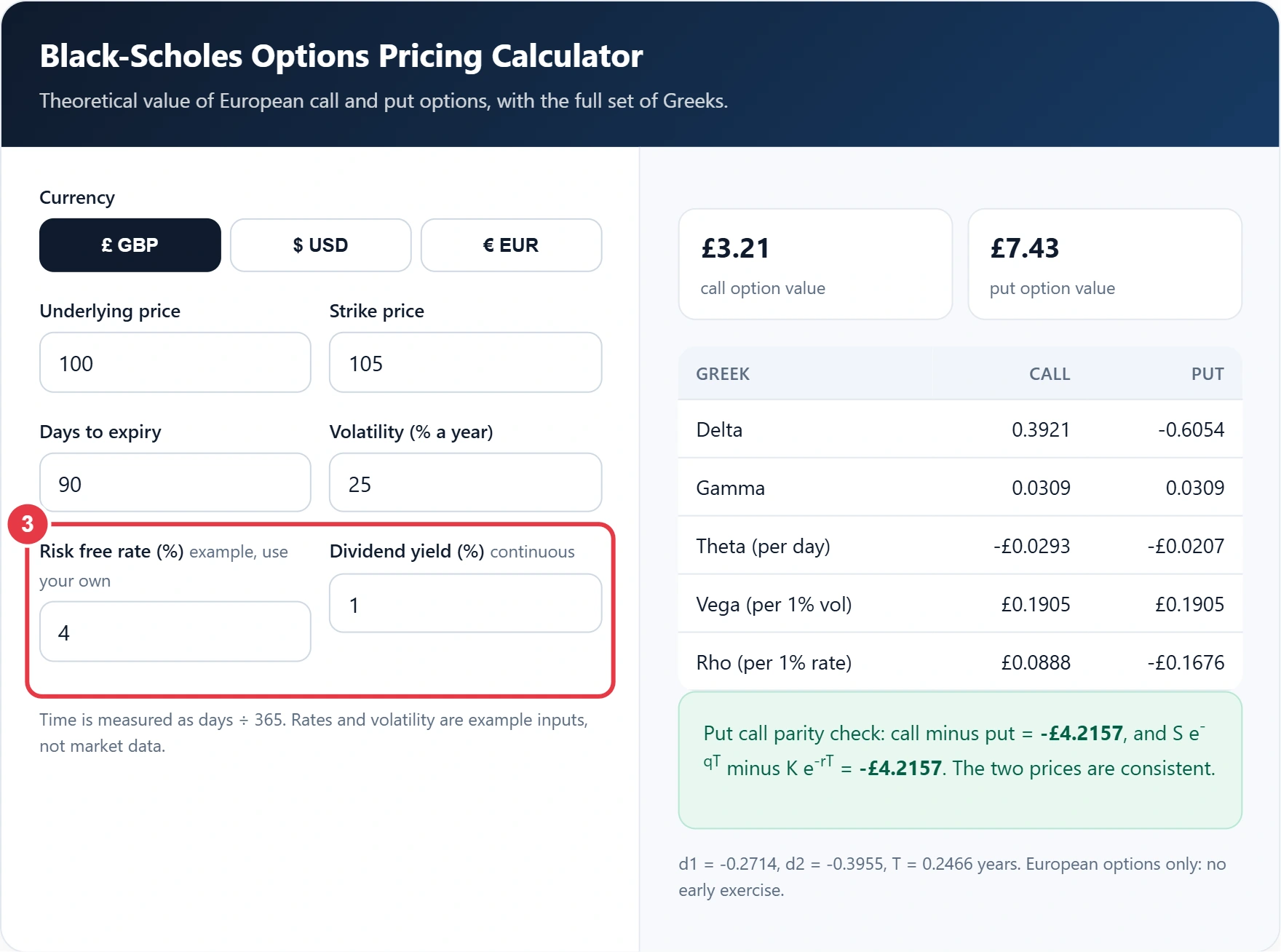
Step 3: Add the Rate and Dividend Yield
Use a risk free rate that matches the option's life, such as a short dated government bill yield, and the expected dividend yield. To check how a yield compares with the cash you would actually receive, our dividend tax calculator shows what is left after tax on UK dividends.
Step 4: Read the Values and Greeks
You get both option values, a table of Greeks and a put call parity check that confirms the call and put agree with each other. Theta is shown per calendar day, while vega and rho show the change for a one point move in volatility or rates.
A Worked Example With the Greeks
Tom is looking at a three month call on a share trading at £100, with a £105 strike, 25% volatility, a 4% rate and a 1% dividend yield. The calculator values the call at £3.21 and the put at £7.43. If the share rises to £110 by expiry, the percentage increase calculator shows that his £3.21 premium growing into £5.00 of intrinsic value is a 56% gain, before any trading costs.
| Greek | Call | What it tells Tom |
|---|---|---|
| Delta | 0.3921 | The call gains about 39p for each £1 rise in the share |
| Gamma | 0.0309 | Delta rises by about 0.03 for each £1 move |
| Theta | -£0.0293 | Time decay costs about 3p a day |
| Vega | £0.1905 | Each extra point of volatility adds about 19p |
| Rho | £0.0888 | A one point rate rise adds about 9p |
These sensitivities change as the price and time move, so treat them as a snapshot. The overview of the option Greeks covers the higher order measures, and real quotes will differ because markets price in volatility skew, early exercise and trading costs.
Black-Scholes Options Pricing Terms Explained
These terms explain the inputs and outputs of the Black-Scholes options pricing calculator, helping you judge whether a quoted option premium looks fair.
- European option
- A contract giving the right, but not the obligation, to buy or sell an asset at a set price only on the expiry date. The Black-Scholes formula values this type exactly, while early exercise features need other models.
- Strike price
- The fixed price at which the holder may buy the asset with a call or sell it with a put. The relationship between strike and the current price determines whether the option has intrinsic value today.
- Implied volatility
- The volatility figure that, entered into the model, reproduces an option's market price. It reflects expected future price swings and usually gives a more realistic valuation input than volatility measured from past prices.
- Risk-free rate
- The return on a near riskless investment over the option's life, typically a short dated government bill yield. A higher rate raises call values and lowers put values because it changes the present cost of paying the strike.
- Option Greeks
- Sensitivities that show how an option's value responds to changes in its inputs: delta for price, gamma for delta, theta for time, vega for volatility and rho for interest rates. They guide hedging and risk management.
- Put-call parity
- The relationship linking European call and put prices with the same strike and expiry to the underlying price and the discounted strike. If it fails, an arbitrage would exist, so it serves as a consistency check on the results.
</>Embed this calculator on your website
Add the free Black-Scholes Calculator to your own site or blog. Copy the code below and paste it into an HTML block. It resizes itself and works on phones.
How we checked this tool: the Tools Veria Editorial Team built this tool by hand, checked it against the official rules or published standards where they apply, and tested it against worked examples. Results are estimates for planning, not personal financial or tax advice. Read our editorial policy and disclaimer, or report an error.
Frequently Asked Questions
Can I use Black-Scholes for American options?
Only as a rough guide. American options can be exercised early, which adds value to puts and to calls on dividend paying shares, so a binomial model is better for those.
Which volatility figure should I enter?
Use the implied volatility shown on your broker's option chain if you want to compare with market prices. Historical volatility tells you how the share has moved, not what the market expects.
Why is theta negative for both the call and the put?
Both options lose time value as expiry gets closer, so theta is usually negative. Deep in the money puts can be an exception when interest rates are high.
What does put call parity prove?
It confirms that call minus put equals the discounted share price minus the discounted strike. If those two figures match, the call and put prices are consistent with each other.
How do I convert a discrete dividend into a yield?
Divide the dividends expected before expiry by the share price, then scale to a yearly figure. A £2 dividend over a year on a £100 share is roughly a 2% yield.
Why does my broker's price differ from the calculator?
Market prices include supply and demand, the bid offer spread and volatility that varies by strike. The model gives a fair value under its assumptions, not a live quote.