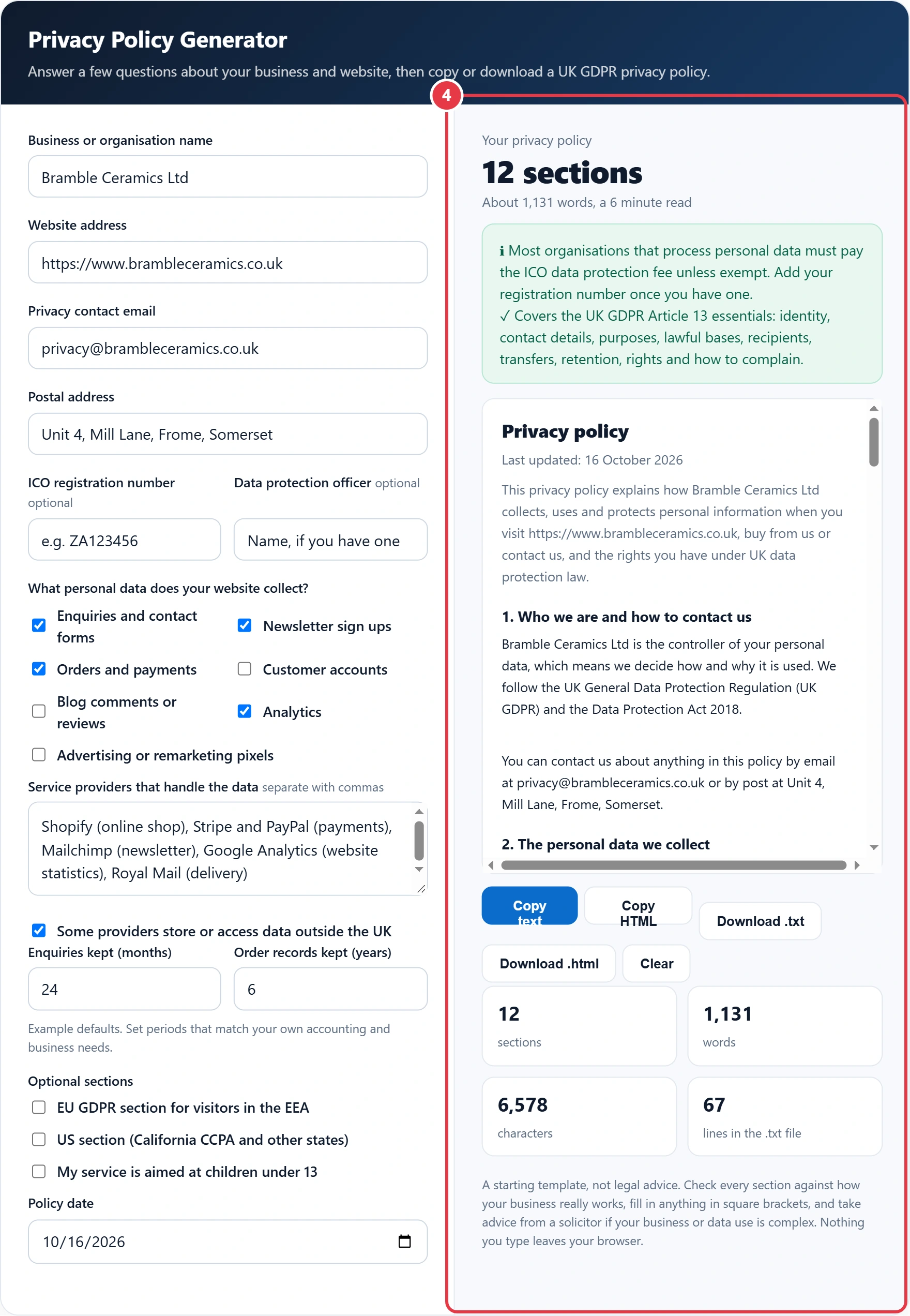
Answer a few questions about your business and website, then copy or download a UK GDPR privacy policy.
Example defaults. Set periods that match your own accounting and business needs.
A starting template, not legal advice. Check every section against how your business really works, fill in anything in square brackets, and take advice from a solicitor if your business or data use is complex. Nothing you type leaves your browser.
This privacy policy generator writes a free, UK first privacy policy for small businesses, sole traders, charities and bloggers whose websites collect personal data, based on UK GDPR and the Data Protection Act 2018 as they apply in 2026. It follows the ICO list of privacy information you must give people, builds each section from your answers, and lets you copy or download the result straight away, with no sign up.
Quick answer: a UK privacy policy must say who you are, what personal data you collect, why, your lawful basis, who receives it, any transfers abroad, how long you keep it, people's rights and how to complain to the ICO. The privacy policy generator above writes all of these from your answers in about two minutes.
In This Guide
What Is a Privacy Policy Generator?
A privacy policy generator is a tool that turns answers about your business and the data your website collects into a ready to publish privacy notice. The logic is simple: your answers plus the Article 13 checklist give one plain English section for each item the law requires, so nothing essential is left out.
The UK GDPR calls this the right to be informed. People must get the information when you collect their data, in clear language they can find easily. A policy copied from another site rarely matches your own providers, purposes or retention periods, and that mismatch is exactly what a complaint to the ICO tends to expose. Generating it from your own answers keeps it accurate.
How to Use the Privacy Policy Generator
Step 1: Add Your Business Details
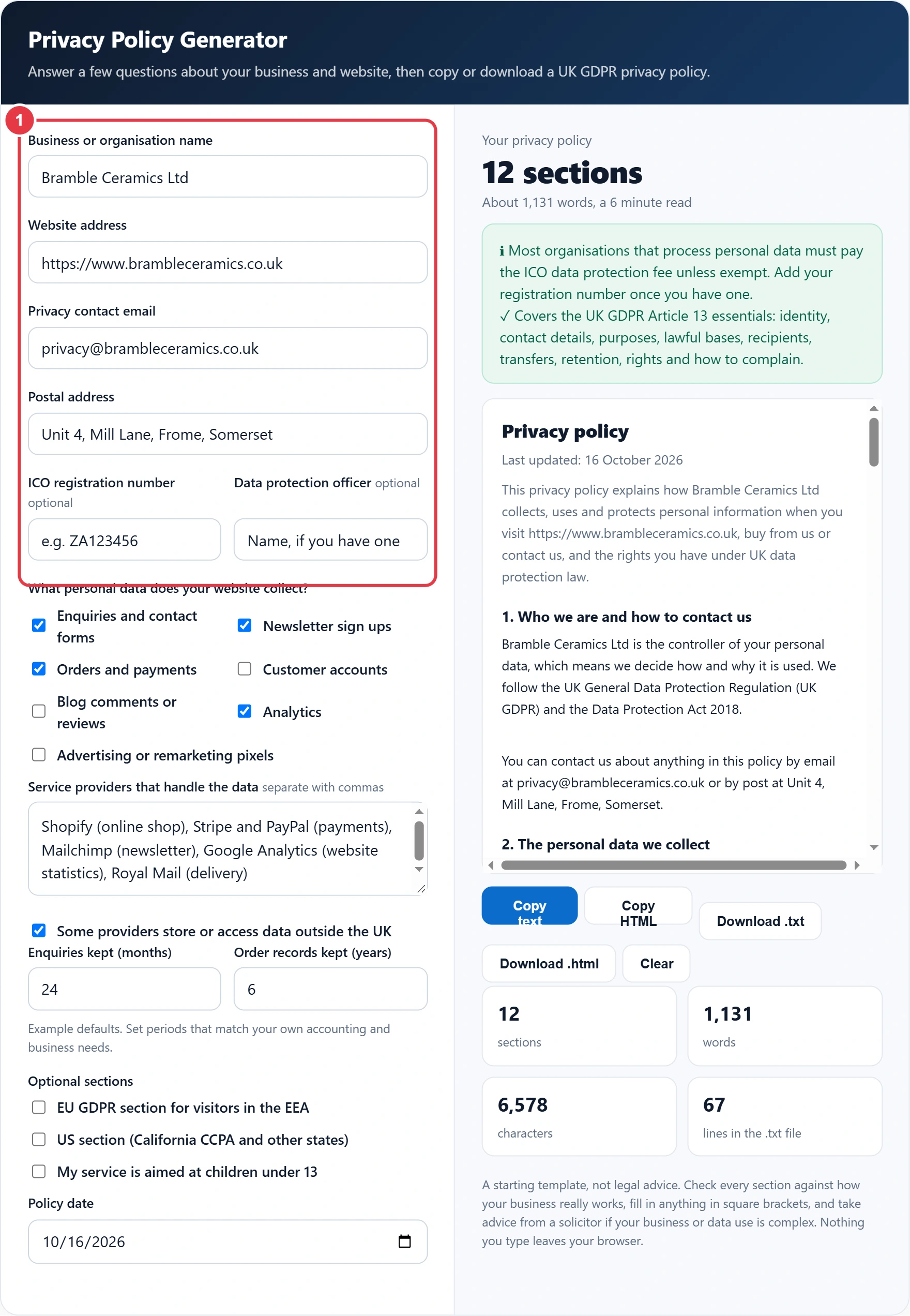
Enter your business name, website, a privacy contact email and a postal address. Add your ICO registration number if you pay the data protection fee, and a data protection officer only if you have formally appointed one.
Step 2: Tick the Data You Collect
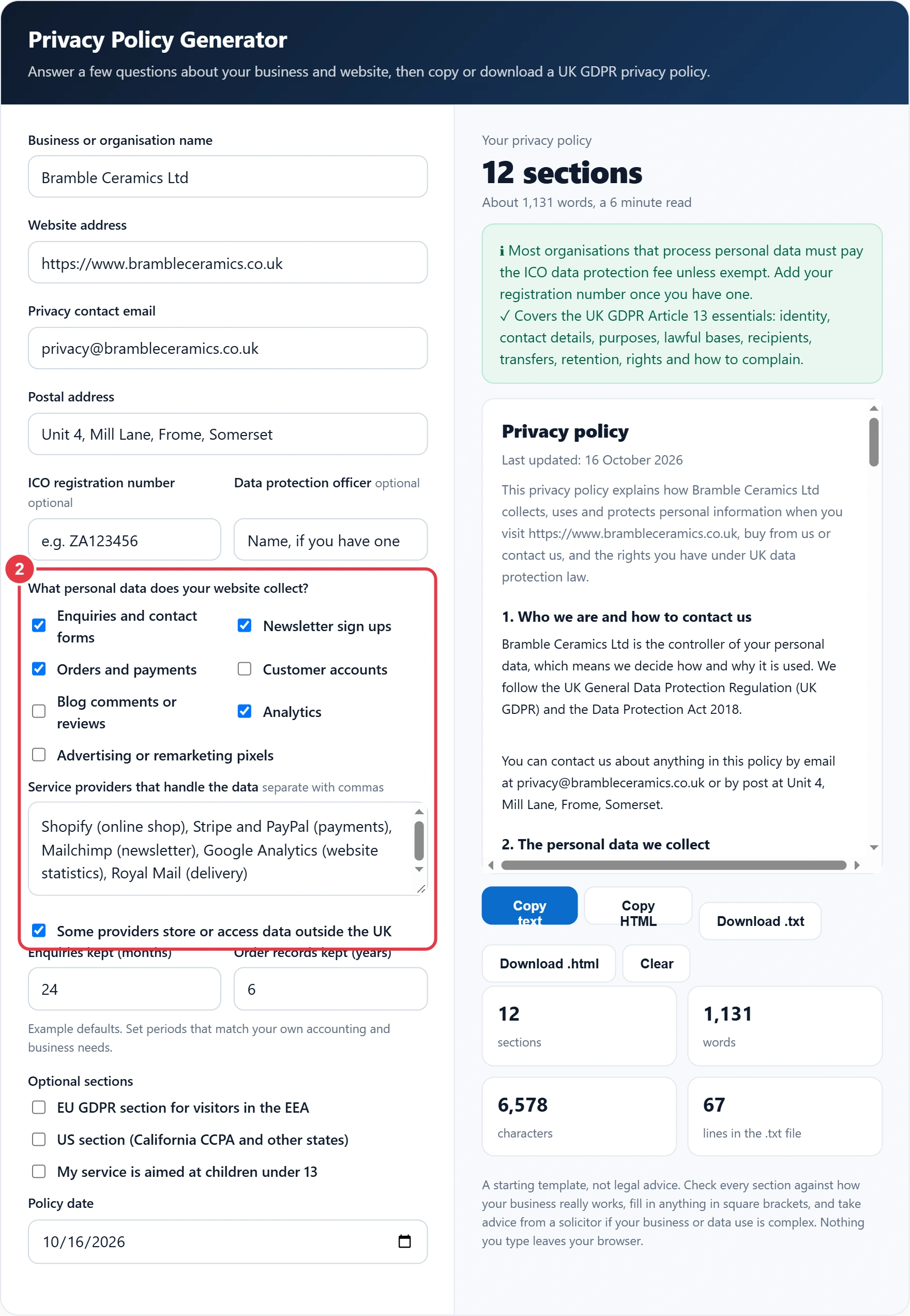
Tick every way your site gathers personal data: contact forms, newsletter sign ups, orders, accounts, comments, analytics and advertising pixels. Then list the providers that handle it, such as your shop platform, payment processor and email tool. If you send customers receipts made with the online receipt generator, the names and addresses on them count as order data too.
Step 3: Set Retention and Optional Sections
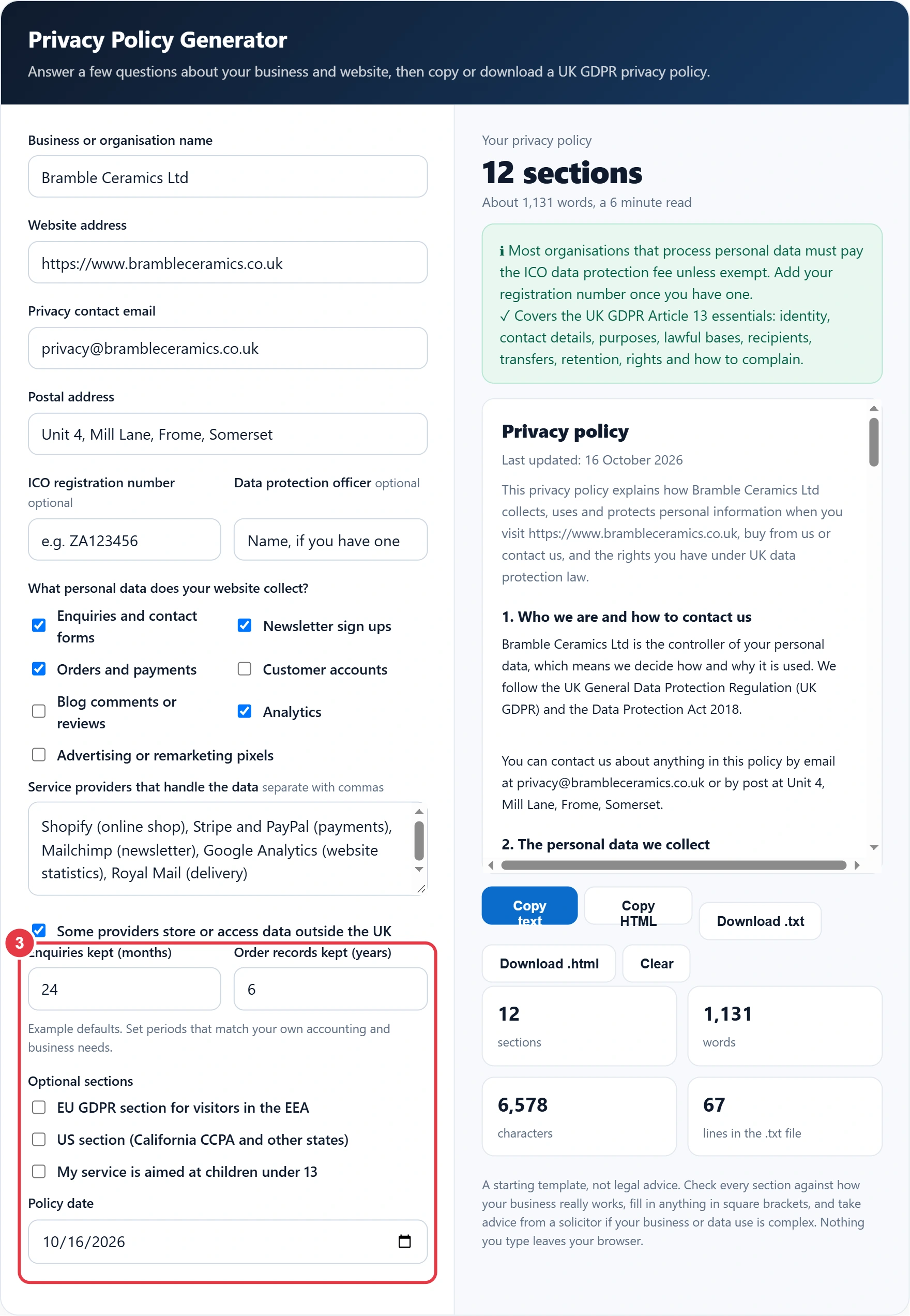
Set how long you keep enquiries and order records. The defaults are labelled examples, so match them to your own accounting and business needs. Switch on the EU section if you target customers in the EEA, the US section if you sell to American consumers, and the children option only if your service is aimed at under 13s.
Step 4: Review, Copy or Download
Read the preview, fix any warning, and fill in anything in square brackets. Press Copy HTML to paste the policy into a WordPress or Shopify page, or download a .txt or .html file. Publish it at a simple address such as /privacy-policy/ and link it from your footer and every form.
Do I Need a Privacy Policy on My Website in the UK?
Yes, if your website collects any personal data, and almost every site does: a contact form, a newsletter box, comments, online orders or analytics that log IP addresses all count. Size is no exemption, so a sole trader with a one page site needs one as much as a large retailer.
Here is a worked example. Hannah runs Bramble Ceramics, a two person pottery business in Frome. Her Shopify site takes about 60 orders a month, has 1,400 newsletter subscribers and uses Google Analytics. She ticks enquiries, newsletter, orders and analytics, lists five providers, keeps enquiries for 24 months and order records for 6 years. The privacy policy generator produces 12 sections and about 1,130 words, a six minute read. Its notes remind her to add her ICO registration number, and after one read through she publishes it at /privacy-policy/ and links it from her footer and checkout.
What Must a UK Privacy Policy Include?
It must include the items listed in Article 13 of the UK GDPR when you collect data from people directly, plus the source of the data under Article 14 when you get it from someone else. The table maps each section of the generated policy to the rule behind it.
| Policy section | What it tells people | Where the rule comes from |
|---|---|---|
| Who we are and how to contact us | Your identity, contact details and any DPO | UK GDPR Article 13(1)(a) and (b) |
| Data we collect and how we use it | Purposes and the lawful basis for each | Article 13(1)(c) and (d), Article 6 |
| Who we share it with | Recipients or categories of recipients | Article 13(1)(e) |
| Transfers outside the UK | Countries and the safeguard used | Article 13(1)(f) |
| How long we keep it | Retention period or how it is decided | Article 13(2)(a) |
| Your rights and how to complain | Rights, consent withdrawal, ICO complaint | Article 13(2)(b) to (d) |
| Cookies | What is stored on devices and why | PECR regulation 6 |
You can read each requirement in the official text of UK GDPR Article 13 on legislation.gov.uk, which is the version that applies in the UK after the changes made by later Acts.
What Changed for Privacy Policies in 2026?
The main change is the Data (Use and Access) Act 2025, whose data protection provisions were all in force by 19 June 2026. Two parts affect a typical website policy. First, the ICO expects you to make complaints easy, acknowledge them within 30 days and respond without undue delay, so the generated policy says exactly that. Second, cookie rules now allow some statistics and settings cookies without consent, provided you explain them and offer a simple, free way to object, as set out in the ICO's storage and access technologies guidance finalised in April 2026.
Advertising and tracking pixels still need consent first. If your analytics tool also feeds advertising, treat it as needing consent too.
Common Privacy Policy Mistakes to Avoid
- Copying another site's policy: it describes their providers and purposes, not yours, and may break their copyright.
- Saying you never share data: if you use Mailchimp, Stripe or Google Analytics, you share data with processors and must say so.
- No retention periods: "as long as necessary" on its own is too vague. Give a period or explain how you decide it.
- EU only wording: UK sites should name the UK GDPR, the ICO and UK transfer safeguards rather than EU bodies.
- Forgetting to update it: adding a new chat widget, CRM or pixel means the policy needs a new line.
Testing new forms with real customer details is another quiet risk. Use made up test data from the UK address generator instead, so real personal data never sits in a staging site. Figures checked October 2026 against ICO guidance and legislation.gov.uk.
Privacy Policy Generator Terms You Should Know
These data protection terms explain the sections the privacy policy generator writes, helping you check that each one reflects how your business really handles personal data.
- UK GDPR
- The retained UK version of the EU General Data Protection Regulation, read alongside the Data Protection Act 2018. It sets out the principles, individual rights and organisational duties that every privacy notice published by a UK business must reflect.
- Lawful basis
- A legal ground listed in UK GDPR, such as consent, contract, legal obligation or legitimate interests, that must support each use of personal data. A privacy notice has to state which basis covers every purpose for which data is processed.
- Data controller
- The organisation that decides why and how personal data is processed and therefore carries primary responsibility for compliance. A small business collecting enquiries through its own website is normally the controller for that information.
- Data processor
- A third party that handles personal data on a controller's behalf and only under its instructions, such as a payment, email marketing or hosting provider. A privacy notice should name these recipients or describe the categories they fall into.
- Information Commissioner's Office
- The independent UK regulator for data protection, which enforces UK GDPR, publishes guidance and deals with complaints from the public. Every privacy notice must tell people that they have the right to complain to it.
</>Embed this calculator on your website
Add the free Privacy Policy Generator to your own site or blog. Copy the code below and paste it into an HTML block. It resizes itself and works on phones.
How we checked this tool: the Tools Veria Editorial Team built this tool by hand, checked it against the official rules or published standards where they apply, and tested it against worked examples. Results are estimates for planning, not personal financial or tax advice. Read our editorial policy and disclaimer, or report an error.
Frequently Asked Questions
Does a sole trader need a privacy policy?
Yes. A sole trader whose website collects names, emails, orders or analytics data must tell people how that data is used under UK GDPR. Being small does not remove the duty, so a short, accurate privacy policy is still needed.
Is a free privacy policy generator good enough?
A free privacy policy generator gives a solid starting template that covers the items UK GDPR requires. You must still check it matches how your business really works, fill in any placeholders and take legal advice if you handle sensitive or large amounts of data.
Can I copy another website's privacy policy?
No. Another site's policy describes its own providers, purposes and retention periods, so it will be inaccurate for you, and the wording may be protected by copyright. Generate your own and edit it to match your real data use.
Do I need to pay the ICO data protection fee?
Most organisations that process personal data must pay an annual data protection fee to the ICO unless an exemption applies. The ICO website has a short self assessment that tells you whether you need to pay and which tier applies.
How often should I update my privacy policy?
Review it at least once a year and every time you change how you use personal data, such as adding a new email tool, payment provider or tracking pixel. Change the date at the top and tell people about significant changes.
What is the difference between a privacy policy and a cookie policy?
A privacy policy explains all the personal data you collect and people's rights under UK GDPR. A cookie policy covers only cookies and similar technologies under PECR, listing each one, its purpose and duration. Most UK websites need both.