Compare the objective and real gain methods and see the municipal plusvalía due on a 2026 sale.
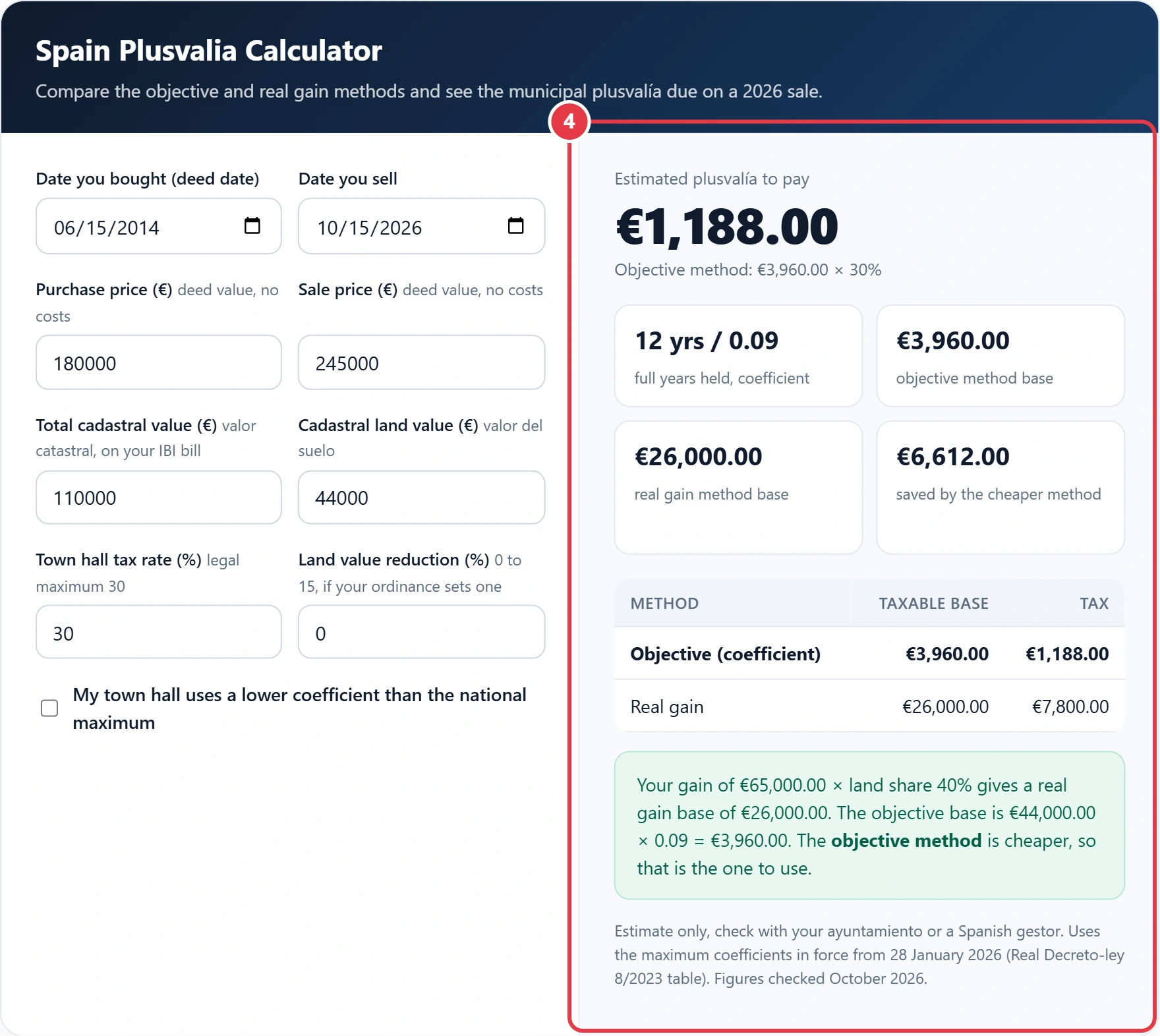
| Method | Taxable base | Tax |
|---|
Estimate only, check with your ayuntamiento or a Spanish gestor. Uses the maximum coefficients in force from 28 January 2026 (Real Decreto-ley 8/2023 table). Figures checked October 2026.
This plusvalia calculator works out the Spanish municipal plusvalía tax (IIVTNU) that a seller owes on a property sale in 2026, using both legal methods side by side so British and other foreign owners can see which one is cheaper. It uses the national maximum coefficients in force since 28 January 2026, applies your town hall rate and flags when a sale at a loss means nothing is due. Figures checked October 2026.
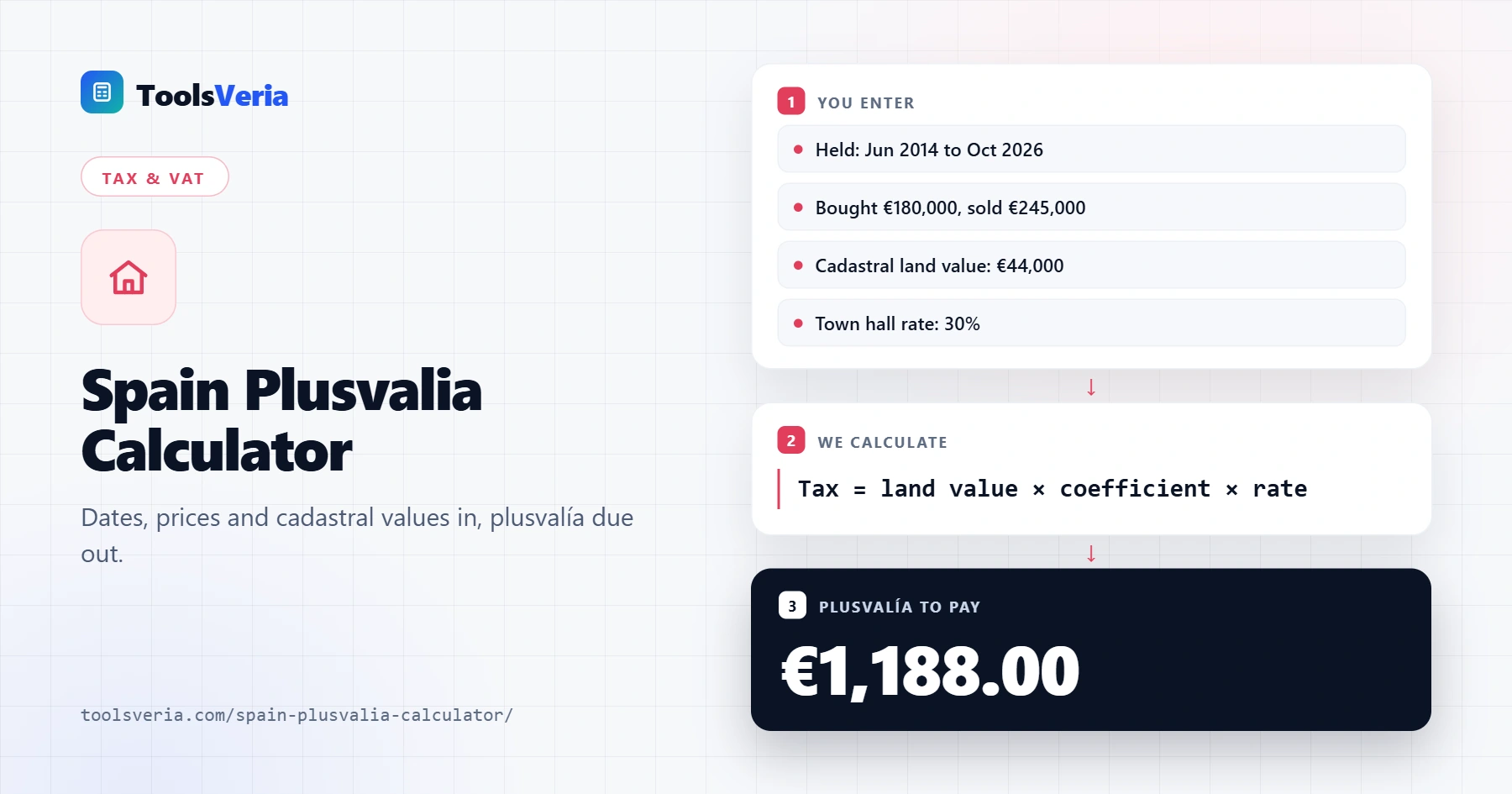
Quick answer: Plusvalía equals the cadastral land value × the coefficient for your years of ownership × your town hall rate (up to 30%), unless your real gain on the land is lower. A plusvalia calculator on €44,000 land held 12 years gives €44,000 × 0.09 × 30% = €1,188.
In This Guide
What Is Spanish Plusvalía Tax?
Plusvalía municipal is a local tax charged by the Spanish town hall (ayuntamiento) on the increase in value of urban land when a property is sold, gifted or inherited. It is separate from Spanish capital gains tax on the whole property, and it only looks at the land under your home, not the building.
Since Real Decreto-ley 26/2021 you can choose between two methods. The objective method multiplies the cadastral land value (valor del suelo on your IBI bill) by a coefficient set for the number of full years you owned the property. The real gain method takes your sale price minus your purchase price, both as stated in the deeds and without costs or taxes, and applies the share of the cadastral value that relates to land. The town hall rate is then applied to whichever base is lower, and if there is no gain at all, no tax is due.
How to Use the Spain Plusvalia Calculator
Step 1: Enter the Purchase and Sale Dates
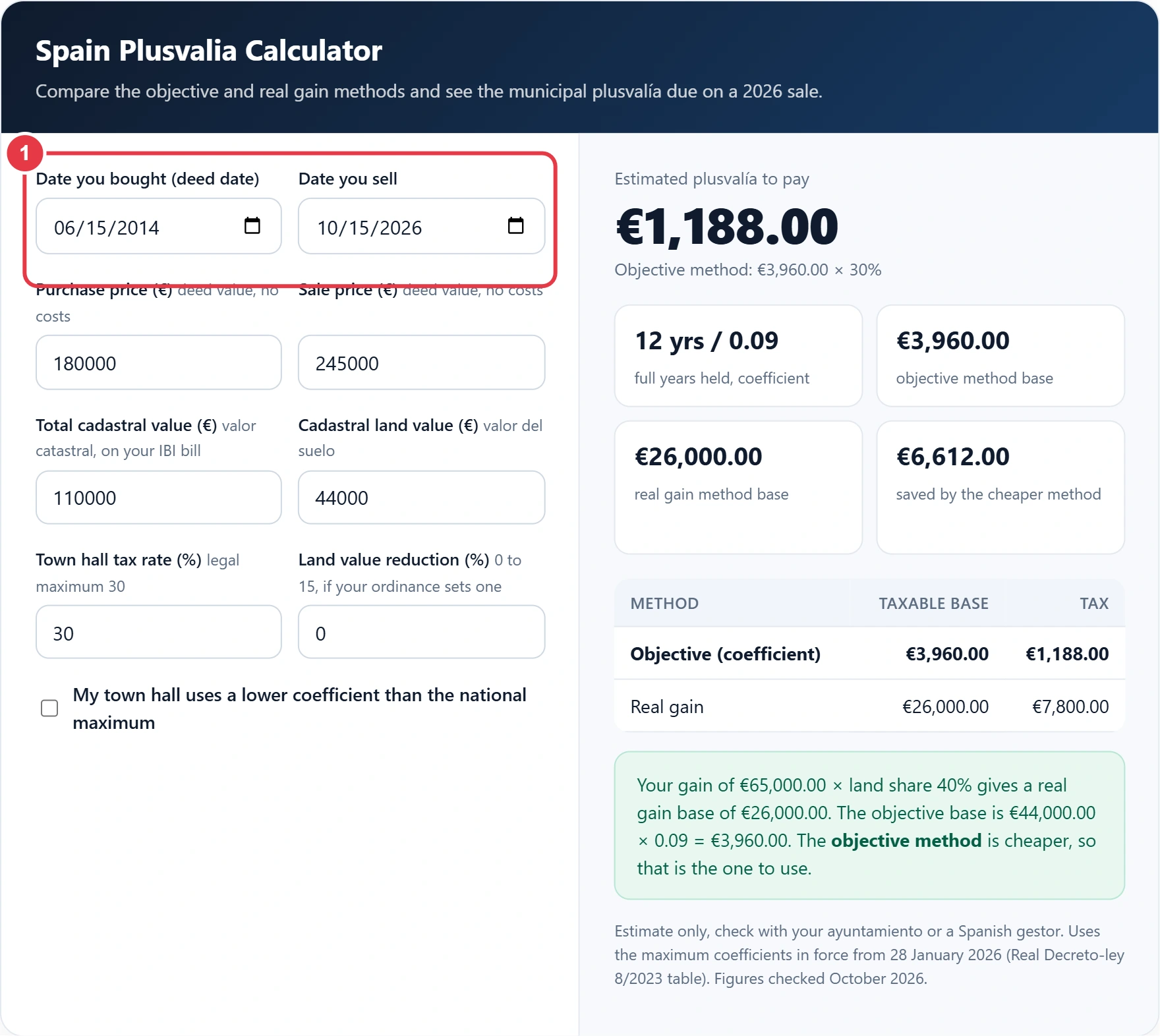
Use the date on your purchase deed (escritura) and the planned completion date. Only full years count, so owning from 15 June 2014 to 15 October 2026 is 12 years. If you need to check the exact gap between two dates, the days between dates calculator gives it in days, months and years. Under one year, the calculator prorates the coefficient by full months.
Step 2: Add Deed Prices and Cadastral Values
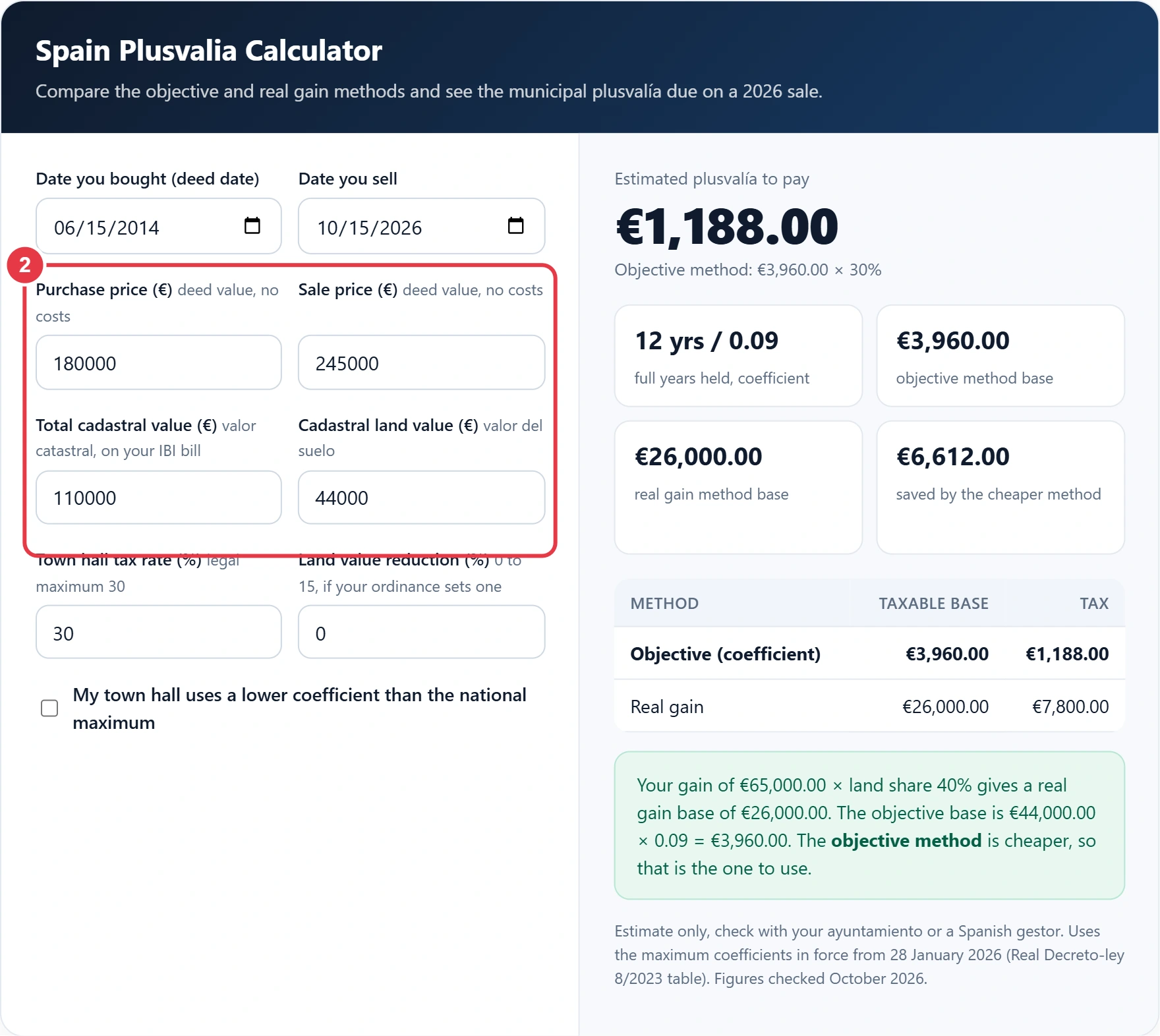
Enter the prices shown in both deeds, leaving out notary fees, agency fees and transfer taxes, because the law says those costs cannot be counted. Then copy the total cadastral value and the land value (valor del suelo) from your latest IBI receipt. The ratio between the two sets the land share used in the real gain method.
Step 3: Set Your Town Hall Rate
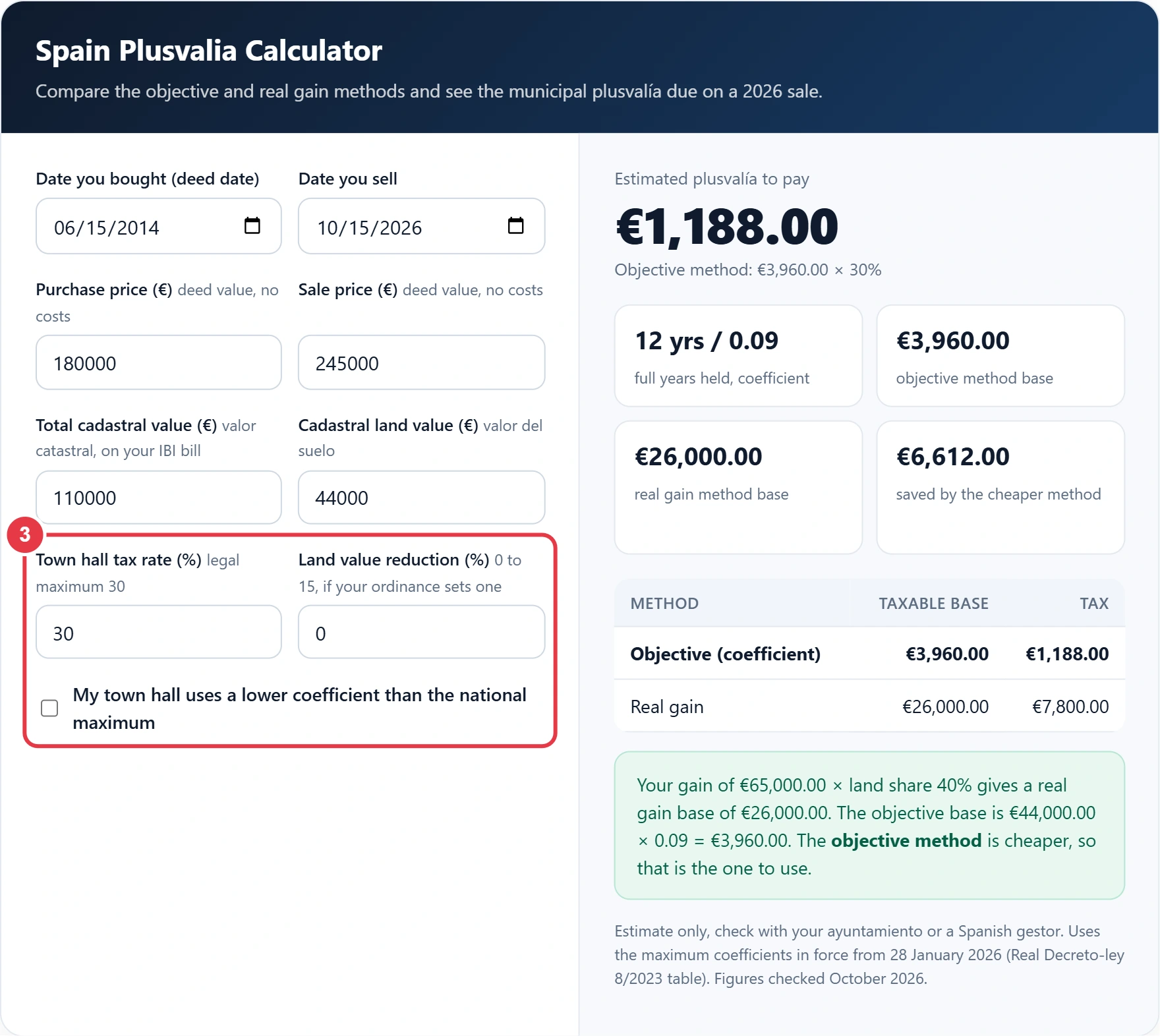
Each ayuntamiento sets its own rate in its plusvalía ordinance, up to a legal maximum of 30%, and some reduce the cadastral land value by up to 15% after a new valuation. The calculator starts at 30% so you see the worst case. If your ordinance uses a coefficient below the national maximum, tick the box and type it in.
Step 4: Read Your Result
The headline shows the plusvalía due under the cheaper method. The stats give the years and coefficient used, both taxable bases and how much the better method saves, and the table shows the tax under each method so you can see the comparison for yourself.
How Is Plusvalía Calculated in 2026?
In 2026 plusvalía is calculated with the coefficients from Real Decreto-ley 8/2023, ranging from 0.09 for 12 to 15 years of ownership up to 0.40 for 20 years or more. A newer table in Real Decreto-ley 16/2025 applied only briefly, because Congress refused to validate it on 27 January 2026 and the earlier maximums returned the next day.
| Full years owned | Maximum coefficient | Full years owned | Maximum coefficient |
|---|---|---|---|
| Under 1 (by months) | 0.15 | 11 | 0.10 |
| 1 | 0.15 | 12 | 0.09 |
| 2 | 0.14 | 13 | 0.09 |
| 3 | 0.14 | 14 | 0.09 |
| 4 | 0.16 | 15 | 0.09 |
| 5 | 0.18 | 16 | 0.10 |
| 6 | 0.19 | 17 | 0.13 |
| 7 | 0.20 | 18 | 0.17 |
| 8 | 0.19 | 19 | 0.23 |
| 9 | 0.15 | 20 or more | 0.40 |
| 10 | 0.12 |
These are maximums. A town hall may set lower coefficients in its ordinance but never higher ones, so always check the local text before you sign. The formula in plain words: objective base = cadastral land value × coefficient; real base = (sale price minus purchase price) × land share; tax = the lower base × the town hall rate.
How Much Plusvalía Will I Pay When I Sell?
If you have held a Spanish home for 10 to 16 years, the objective method costs between 2.7% and 3.6% of the cadastral land value at a 30% rate, because the coefficients are lowest in that range. Short holds and holds of 20 years or more cost more under the objective method, which is when the real gain method often wins.
Worked example: Helen, a retired teacher from Leeds, bought an apartment in Torrevieja on 15 June 2014 for €180,000 and sells it on 15 October 2026 for €245,000. Her IBI bill shows a total cadastral value of €110,000, of which €44,000 is land, so land is 40% of the value. Her real gain on the land is €65,000 × 40% = €26,000. The objective base is €44,000 × 0.09 = €3,960, which is lower, so at a 30% rate she owes €1,188. Using the Spain plusvalia calculator before completion lets her agree with the buyer how much to hold back at the notary.
| Scenario | Coefficient | Objective base | Real gain base | Tax at 30% |
|---|---|---|---|---|
| Helen: 12 years, €65,000 gain, €44,000 land | 0.09 | €3,960 | €26,000 | €1,188 |
| 1 year, €25,000 gain, €30,000 land of €75,000 | 0.15 | €4,500 | €10,000 | €1,350 |
| 20 years, €10,000 gain, €60,000 land of €120,000 | 0.40 | €24,000 | €5,000 | €1,500 |
| Sold for less than the purchase price | Any | Not used | €0 | €0 |
The third row shows why the comparison matters: after 20 years the objective method would cost €7,200, but the real gain method cuts the bill to €1,500. A good plusvalia calculator should always show both figures, not just one.
Do I Pay Plusvalía If I Sell at a Loss?
No. If the sale price in your deed is equal to or lower than the purchase price, there has been no increase in value and the transfer is not subject to the tax. You must still file the plusvalía declaration and attach both deeds as proof. Where a value checked by the tax authority is higher than the deed price, the higher figure is used for this test.
When Is Plusvalía Paid and Who Pays It?
In a sale the seller normally pays, and the declaration is due within 30 working days of the transfer. On an inheritance the heirs pay within six months of the death, which can be extended to one year, and on a gift the person receiving it pays. Many town halls also offer reliefs of up to 95% on inheritances between close relatives, so check the ordinance if you inherited. The overview of taxation in Spain sets out how local, regional and national property taxes fit together.
If you live in the UK, you may also have to report the sale to HMRC, and the GOV.UK guide to being taxed twice on foreign income explains how Foreign Tax Credit Relief works when Spain has already taxed a gain, so ask an adviser how plusvalía fits your own return. To see how much your property has risen in percentage terms, the percentage increase calculator turns the two deed prices into a growth figure you can compare with local market data.
</>Embed this calculator on your website
Add the free Spain Plusvalia Calculator to your own site or blog. Copy the code below and paste it into an HTML block. It resizes itself and works on phones.
How we checked this tool: the Tools Veria Editorial Team built this tool by hand, checked it against the official rules or published standards where they apply, and tested it against worked examples. Results are estimates for planning, not personal financial or tax advice. Read our editorial policy and disclaimer, or report an error.
Frequently Asked Questions
How is plusvalía calculated in Spain?
Plusvalía is the cadastral land value multiplied by the coefficient for your full years of ownership, then by the town hall rate of up to 30%. If your real gain on the land is lower, that real gain is taxed instead, so you always pay on the smaller base.
What is the plusvalía coefficient for 20 years?
The maximum coefficient for 20 years or more of ownership is 0.40 in 2026, under the Real Decreto-ley 8/2023 table that returned on 28 January 2026. On €60,000 of cadastral land value that gives an objective base of €24,000 before the town hall rate.
Is plusvalía paid if I sell at a loss?
No. If your sale deed price is the same as or lower than your purchase deed price, there is no increase in value and no plusvalía is due. You still have to file the declaration with the town hall and attach both deeds to prove the loss.
Who pays plusvalía, buyer or seller?
In a normal sale the seller pays plusvalía, because the seller is the one who makes the gain. On an inheritance the heirs pay it, and on a gift the person receiving the property pays. A contract can share the cost, so read your private purchase contract.
How long do I have to pay plusvalía?
For a sale you have 30 working days from the date of the deed to file and pay. For an inheritance the deadline is six months from the date of death, which the town hall can extend to one year if you apply within the first six months.
Can expenses be deducted from the real gain?
No. The real gain method uses only the prices stated in the purchase and sale deeds, or a higher value checked by the tax authority. Notary fees, agency commission, transfer tax and improvement costs cannot be added, so the real gain is often higher than buyers expect.