Chloe’s pregnancy test came back positive in April, and the first thing she wanted to know was when the baby might arrive. Learning how to calculate due date estimates by hand takes only the first day of her last period and a calendar, and it gives her a date to plan around until her midwife and dating scan confirm it.
This guide is for anyone who is newly pregnant, trying to conceive or supporting a partner. It explains the standard 280 day method, Naegele’s rule and why it sometimes disagrees by a day or two, how to adjust for longer or shorter cycles, how IVF dates work, and why the ultrasound date usually wins. These are estimates for planning, not medical advice, and your midwife or doctor will confirm your dates.
Quick answer: To calculate a due date, add 280 days (40 weeks) to the first day of your last menstrual period. The NHS uses this method before the dating scan. A last period starting on 14 March 2026 gives an estimated due date of 19 December 2026. If your cycle is longer than 28 days, add the extra days.
In This Guide
Why is a due date counted from your last period?
A due date is counted from the first day of your last menstrual period because that date is usually known, while the exact day of conception almost never is. Pregnancy is therefore said to last about 40 weeks, even though the baby has been developing for roughly 38 of them. The NHS due date guidance uses this same starting point.
The method assumes a 28 day cycle with ovulation around day 14. That is why, in the first two weeks of “pregnancy” by this count, you are not actually pregnant yet. It sounds odd, but it gives every midwife, GP and hospital the same fixed reference point.

How to calculate due date from your last period
To calculate your due date from your last period, find the first day of bleeding and count forward 280 days. Chloe’s last period started on Saturday 14 March 2026. Counting 280 days on lands on Saturday 19 December 2026, which is her estimated due date. Because 280 is exactly 40 weeks, the due date always falls on the same weekday as the start of the last period.
Counting 280 days by hand is fiddly, so most people use a calculator or a pregnancy wheel. Our days between dates calculator is a handy way to check any count, and the due date calculator does the whole job from one date.
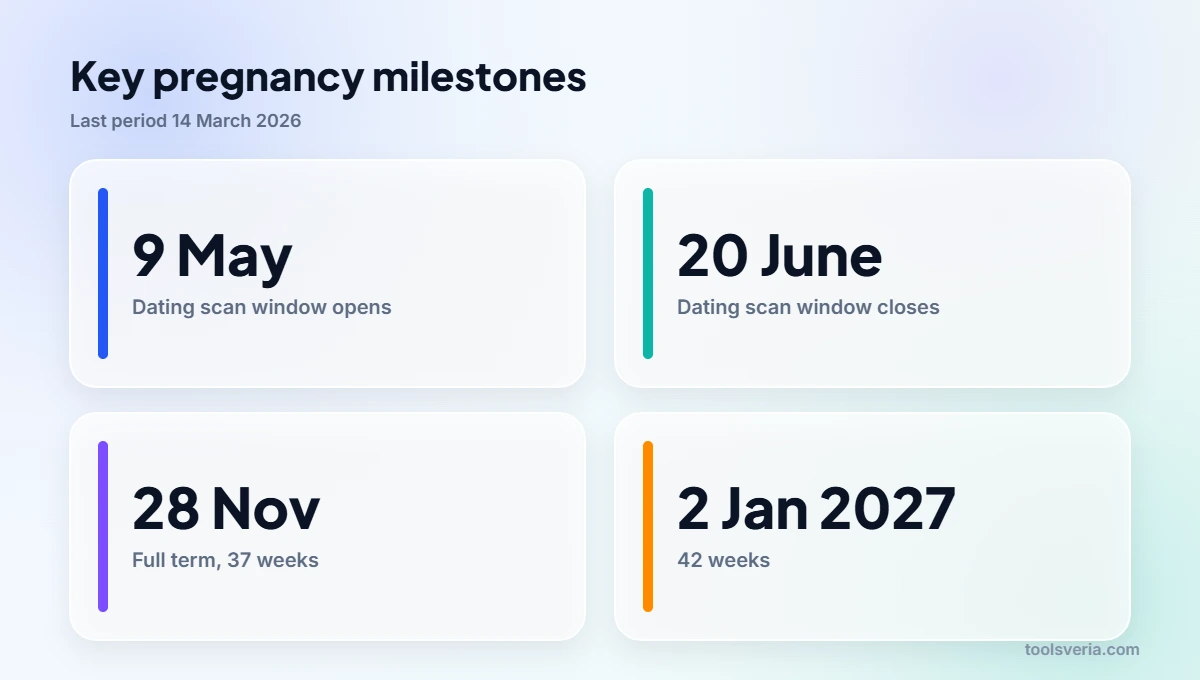
With a due date in hand, the other milestones follow. Full term begins at 37 weeks, which for Chloe is 28 November 2026, and 42 weeks falls on 2 January 2027. Most babies are born somewhere in that five week window rather than on the due date itself.

What is Naegele’s rule and is it accurate?
Naegele’s rule is a shortcut that avoids counting days: take the first day of the last period, add 7 days, subtract 3 months and add 1 year. It is named after the German obstetrician Franz Naegele, who described it in the early nineteenth century.
For Chloe, 14 March plus 7 days is 21 March. Subtracting 3 months gives 21 December, and moving to the following year gives 21 December 2026. That is two days later than the exact 280 day count of 19 December, because the months between March and December do not add up to a neat number of days. The rule assumes an average month length, so it can drift by a day or two either way.
Neither answer is more “true” than the other; both are estimates. The difference simply shows why a calculator counting exact days is the better starting point, and why the scan date usually replaces both.
How do you adjust for a longer or shorter cycle?
To adjust for cycle length, add one day to the due date for every day your cycle is longer than 28 days, or subtract one day for every day it is shorter. Ovulation tends to happen about 14 days before the next period, so a longer cycle pushes ovulation, and therefore conception, later.
| Average cycle length | Adjustment | Due date for a last period on 14 March 2026 |
|---|---|---|
| 24 days | Subtract 4 days | 15 December 2026 |
| 26 days | Subtract 2 days | 17 December 2026 |
| 28 days | No change | 19 December 2026 |
| 30 days | Add 2 days | 21 December 2026 |
| 32 days | Add 4 days | 23 December 2026 |
| 35 days | Add 7 days | 26 December 2026 |
If your cycles are irregular, the adjustment becomes guesswork, and an early scan is the more reliable way to date the pregnancy. If you tracked ovulation while trying to conceive, our guide on how to calculate ovulation explains the link between cycle length and fertile days.
Calculating a due date from conception or IVF
If you know the date of conception, add 266 days (38 weeks) instead of 280. Chloe’s likely conception date, around 28 March 2026, plus 266 days lands on 19 December 2026, matching the period based date because her cycle is a typical 28 days.
IVF gives the most precise dates of all, because the embryo’s age is known. Clinics commonly add 261 days to the date of a day 5 blastocyst transfer, or 263 days to a day 3 transfer. Priya had a day 5 transfer on 20 June 2026, so her estimated due date is 8 March 2027. With a day 3 transfer on the same date it would be 10 March 2027. Your fertility clinic will give you its own figure, which takes priority.
Why might the dating scan change your due date?
The dating scan can change your due date because measuring the baby directly is more accurate than assuming when ovulation happened. In England the NHS offers this first scan between 8 and 14 weeks, as described on its 12 week scan page. The sonographer measures the baby from crown to rump and works out the gestational age from that length.
For Chloe, that window runs from 9 May to 20 June 2026. If her baby measures a few days smaller or larger than expected, the scan date replaces the period date in her notes. From then on, every appointment, test and the timing of any induction discussion is based on the scan date, so use it in any calculator you try afterwards.
Your due date also matters outside the hospital. In the UK it sets the earliest date you can start maternity leave and statutory pay, and the maternity pay calculator uses it to work out when payments begin. Contact your midwife or GP promptly if you have bleeding, severe pain or any worry, whatever your dates say.
Key points
- Add 280 days to the first day of the last period: 14 March 2026 gives 19 December 2026.
- Naegele’s rule (add 7 days, subtract 3 months, add 1 year) can differ by a day or two.
- Add or subtract one day for each day your cycle differs from 28 days.
- From a day 5 IVF transfer, add 261 days; from a day 3 transfer, add 263 days.
- The NHS dating scan at 8 to 14 weeks usually sets the date used from then on.
Key Due Date Terms Explained
These terms are used by midwives, scan reports and calculators whenever you work out how to calculate due date estimates for a pregnancy.
- Last menstrual period
- The first day of bleeding in the final period before pregnancy, used as day one of the 40 week count. A last period on 14 March 2026 gives a due date of 19 December 2026.
- Estimated due date
- The date 280 days after the last menstrual period, or 266 days after conception, when a pregnancy reaches 40 weeks. It is a planning estimate, and most births fall between 37 and 42 weeks.
- Naegele’s rule
- A calendar shortcut that adds 7 days to the last period, subtracts 3 months and adds 1 year. Because months vary in length, it can differ from an exact 280 day count by a day or two.
- Gestational age
- How far along a pregnancy is, counted in weeks and days from the last menstrual period rather than from conception. Chloe was 31 weeks and 6 days on 23 October 2026.
- Crown rump length
- The ultrasound measurement from the top of the baby’s head to its bottom, taken at the NHS dating scan between 8 and 14 weeks to confirm or change the due date.
Frequently Asked Questions
I cannot remember when my last period started. What can I do?
Tell your midwife or GP, who can arrange the dating scan to set your due date from the baby’s measurements. Until then, any estimate based on a guessed period date may be several days or weeks out.
My scan date is five days earlier than my period date. Which is right?
Use the scan date. Measuring the baby between 8 and 14 weeks is more reliable than assuming ovulation on day 14, so the NHS normally records the scan date and bases all later appointments and checks on it.
How many weeks pregnant am I on a given date?
Count the days from the first day of your last period and divide by 7. Chloe, with a last period on 14 March 2026, was 31 weeks and 6 days pregnant on 23 October 2026.
Does a 35 day cycle really move my due date by a week?
Roughly, yes. A 35 day cycle suggests ovulation around day 21 rather than day 14, so conception and the due date shift about 7 days later. For a last period on 14 March 2026, that gives 26 December instead of 19 December.
Why does Naegele’s rule give a different date from my app?
Apps usually count exactly 280 days, while Naegele’s rule shifts by calendar months, which vary in length. For a 14 March start the rule gives 21 December and an exact count gives 19 December. Both are estimates.
Is a baby born at 38 weeks early?
No. A pregnancy is considered full term from 37 weeks, so a birth at 38 weeks is within the normal range. Babies born before 37 weeks are classed as premature, and your midwife will discuss any extra care needed.
Chloe now has an estimated due date of 19 December 2026, a scan window from 9 May to 20 June, and a clear idea of how that date might change. Knowing how to calculate due date estimates helps with planning, but your midwife and the dating scan have the final word. Figures checked October 2026.