A due date calculator using your last period, conception date, IVF transfer or dating scan.
| Milestone | Week | Date |
|---|
An estimate for healthy pregnancies, not medical advice. Your midwife or doctor will confirm your due date at the dating scan. Contact them urgently about bleeding, severe pain or reduced baby movements.
This free due date calculator estimates when your baby is likely to arrive and how many weeks pregnant you are today, for parents to be in the UK, US, Europe and elsewhere. It works from the first day of your last period, a known conception date, an IVF transfer date or a dating scan result, and it follows the same 40 week method as the NHS due date calculator. It then adds your scan windows, full term date and other milestones in one table.
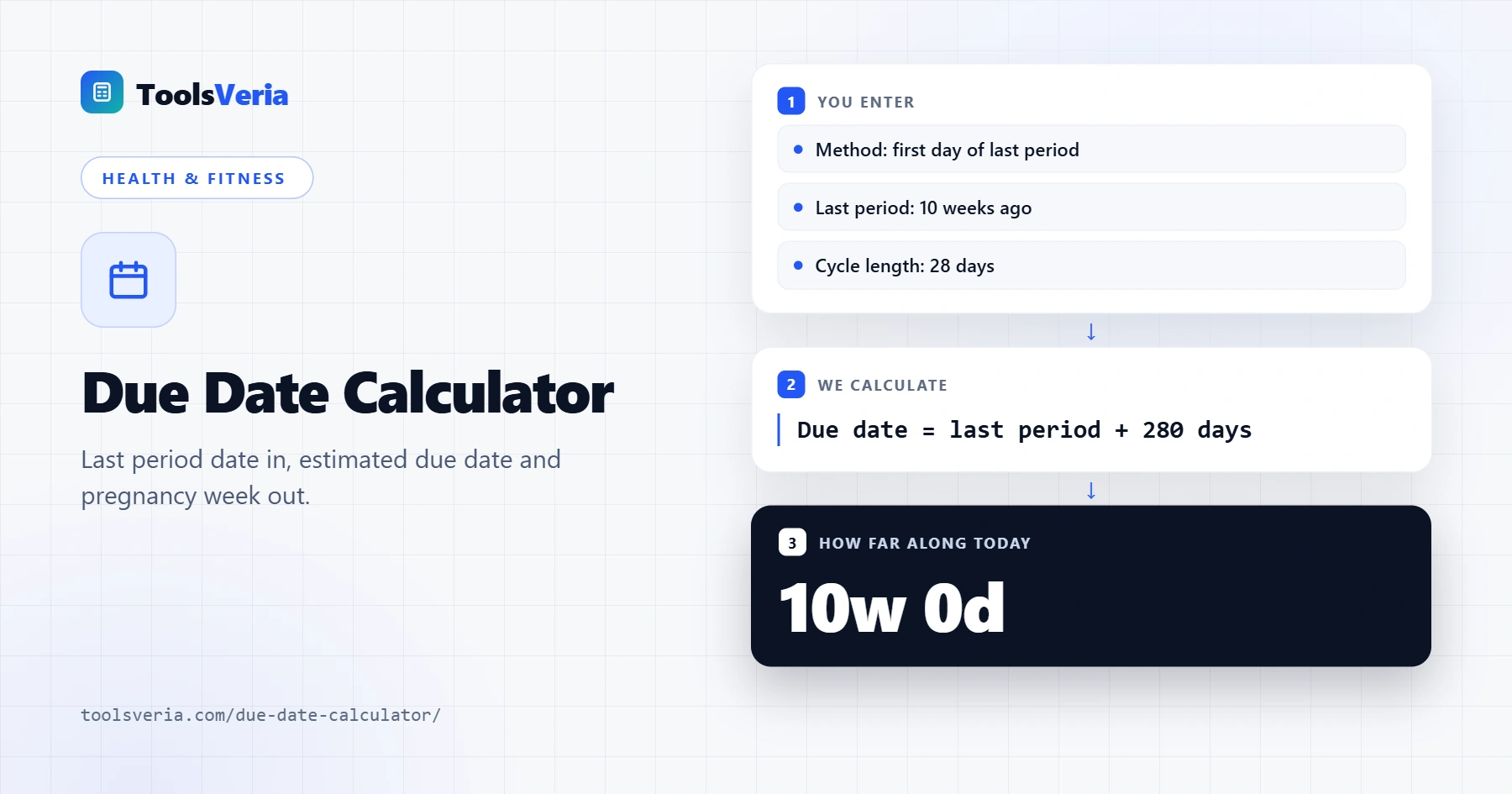
Quick answer: Your estimated due date is 280 days, or 40 weeks, after the first day of your last period, adjusted by the number of days your cycle is longer or shorter than 28. A due date calculator adds 266 days to a conception date. Most babies arrive between 37 and 42 weeks.
In This Guide
What Is a Due Date Calculator?
A due date calculator is a tool that predicts the day a pregnancy reaches 40 weeks, known as the estimated due date (EDD). Pregnancy is counted from the first day of the last period, about two weeks before conception, so at conception you are already counted as 2 weeks pregnant.
The method in plain words is Naegele's rule: last period + 280 days, plus (cycle length minus 28) days. Other starting points use fixed gaps: conception + 266 days, a day 5 IVF transfer + 261 days, a day 3 transfer + 263 days, and a scan date + (280 days minus the age measured at the scan).
How to Use the Due Date Calculator
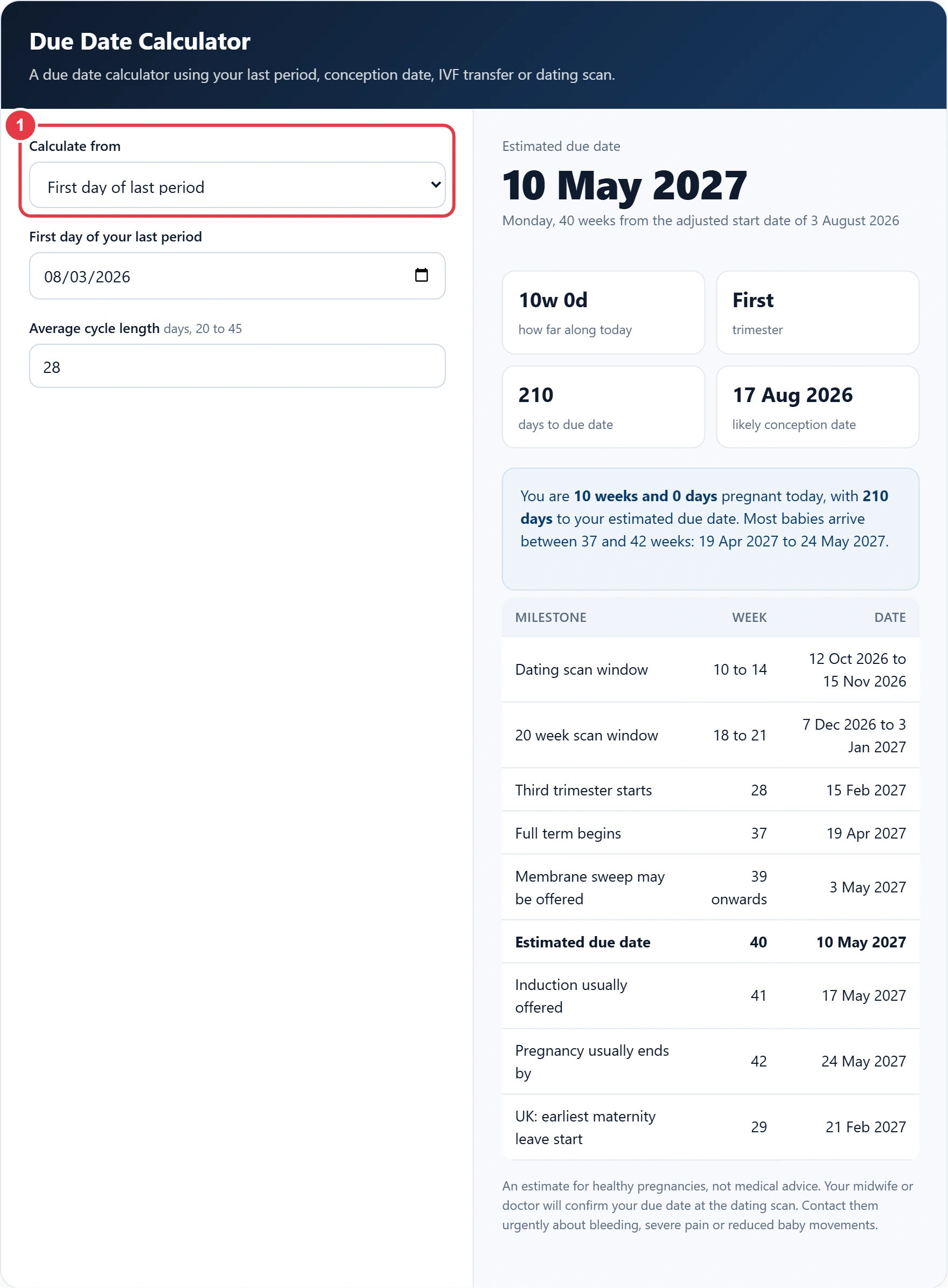
Step 1: Choose Your Method
Pick the starting point you know best. Most people use the first day of their last period. Choose IVF if you had a transfer, or Dating scan if a sonographer has already measured how far along you are.
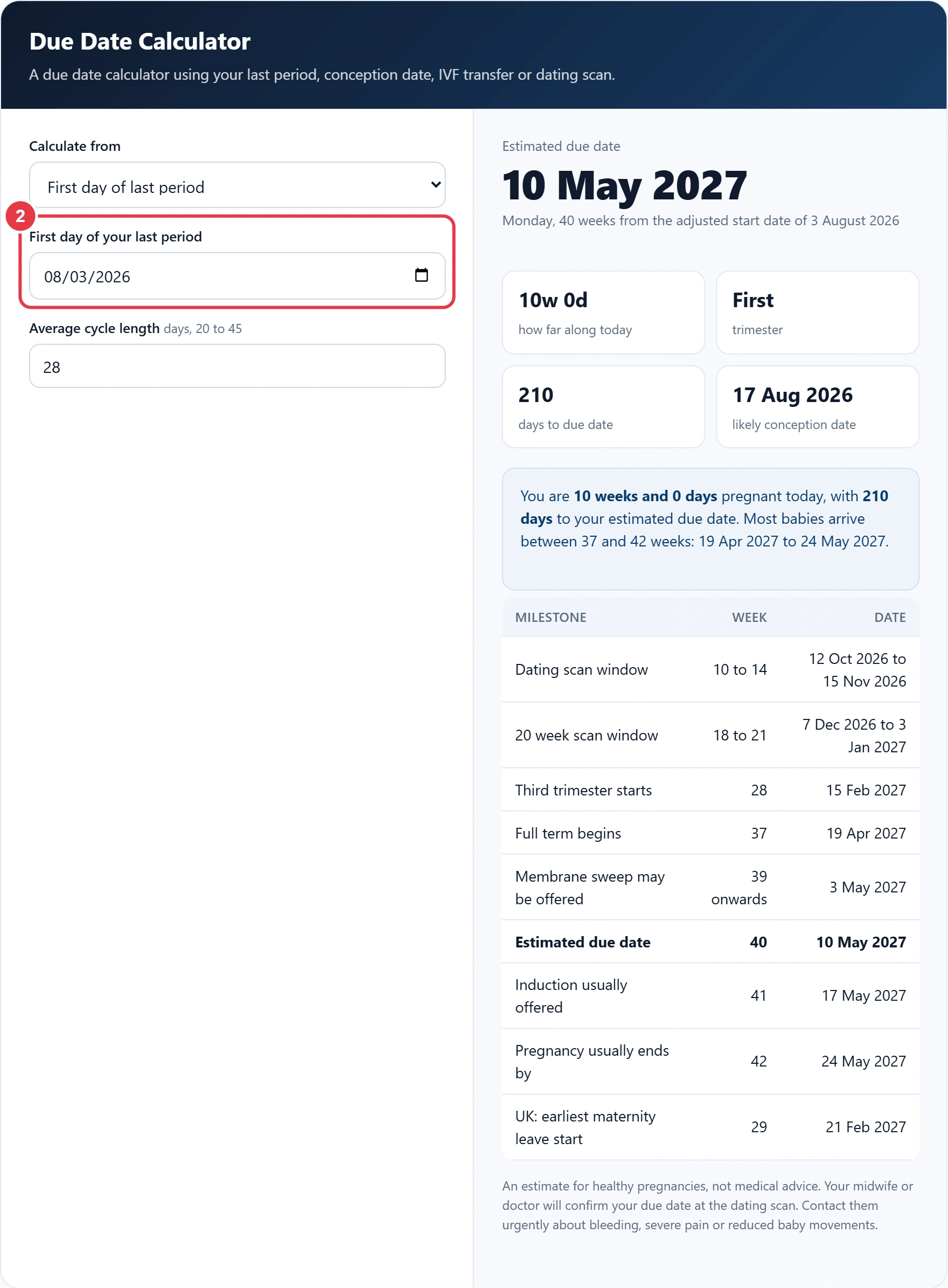
Step 2: Enter the Date
Enter the first day of bleeding of your last period, not the day it ended. For a scan, enter the scan date and the weeks and days the report gave. For IVF, choose a day 3 or day 5 embryo.
Step 3: Adjust Your Cycle Length
If your cycle is usually longer or shorter than 28 days, change it. Ovulation tends to happen about 14 days before the next period, so a 31 day cycle moves the due date 3 days later. The ovulation calculator explains how cycle length shifts the fertile window.

Step 4: Read Your Results
The large date is your estimated due date. The boxes show how far along you are today, your trimester, the days left and the likely conception date, and the table lists the dating scan window, the 20 week scan window, full term, the induction point and the earliest UK maternity leave start date.

How Accurate Is a Pregnancy Due Date Calculator?
A pregnancy due date calculator gives an estimate, and few babies arrive on the exact day. The NHS says pregnancy normally lasts from 37 to 42 weeks, a five week window, so treat your due date as the middle of that range rather than an appointment.
A date from your last period is least reliable when cycles are irregular, when you have recently stopped hormonal contraception or when you are unsure of the date. That is why the NHS dating scan at 10 to 14 weeks is used to confirm or reset the date. Once your scan date is set, use the Dating scan method here to match it.
Due Date by Method
| You know | Rule | Example start | Estimated due date |
|---|---|---|---|
| Last period, 28 day cycle | + 280 days | 1 February 2026 | 8 November 2026 |
| Last period, 31 day cycle | + 283 days | 3 March 2026 | 11 December 2026 |
| Conception date | + 266 days | 15 February 2026 | 8 November 2026 |
| IVF day 5 transfer | + 261 days | 20 February 2026 | 8 November 2026 |
| IVF day 3 transfer | + 263 days | 18 February 2026 | 8 November 2026 |
| Scan at 12 weeks 0 days | + 196 days | 26 April 2026 | 8 November 2026 |
Can My Estimated Due Date Change?
Yes. Your estimated due date can change once, at the dating scan, if the baby's measurements differ from the date your last period suggests. After that scan it normally stays fixed, even if later scans show a larger or smaller baby.
Worked example: Hannah's last period began on 3 March 2026 and her cycles run to 31 days, so the due date calculator gives Friday 11 December 2026. At her dating scan on 20 May 2026 the sonographer measured 10 weeks 6 days, which sets the due date to Thursday 10 December 2026. Her expected week of childbirth starts on Sunday 6 December, so in the UK the earliest date her maternity leave could start is Sunday 20 September 2026. The maternity pay calculator uses that due date to work out her Statutory Maternity Pay, so she can plan the family budget around it.
This tool gives estimates for healthy pregnancies and is not medical advice. Speak to a midwife or GP if you are unsure of your dates, and contact them urgently about bleeding, severe pain or reduced movements. Once the date is set, the pregnancy week by week calculator shows what happens in every week of the months ahead. Checked against NHS guidance in October 2026.
Key Due Date and Pregnancy Terms Explained
These terms explain how a due date calculator measures pregnancy and why your estimated date sits in the middle of a five week window.
- Estimated due date
- The date a pregnancy reaches 40 weeks, also called the EDD. It is 280 days after the first day of the last period in a 28 day cycle, and it can be reset once at the dating scan.
- Gestational age
- How far along a pregnancy is, in weeks and days, counted from the first day of the last period. It runs about two weeks ahead of the baby's actual age from conception.
- Naegele's rule
- The standard method for estimating a due date: add 280 days to the first day of the last period. Adding the difference between your cycle length and 28 days adjusts it for longer or shorter cycles.
- Dating scan
- An ultrasound scan offered at around 10 to 14 weeks in England. It measures the baby to confirm how many weeks pregnant you are and sets the due date used for the rest of your care.
- Full term
- The stage from 37 weeks, when a baby is no longer considered premature. Pregnancy normally ends between 37 and 42 weeks, and induction is usually offered if labour has not started by 41 weeks.
</>Embed this calculator on your website
Add the free Due Date Calculator to your own site or blog. Copy the code below and paste it into an HTML block. It resizes itself and works on phones.
How we checked this tool: the Tools Veria Editorial Team built this tool by hand, checked it against the official rules or published standards where they apply, and tested it against worked examples. Results are estimates for planning, not personal financial or tax advice. Read our editorial policy and disclaimer, or report an error.
Frequently Asked Questions
How many weeks is a full term pregnancy?
A pregnancy is full term from 37 weeks, and most babies are born between 37 and 42 weeks counted from the first day of the last period. The due date itself is 40 weeks. Babies born before 37 weeks are called premature.
Why is pregnancy counted from my last period?
The first day of the last period is a date most people know, while the exact day of conception usually is not. Counting from it adds about two weeks before conception, which is why pregnancy is said to last 40 weeks rather than 38.
What if I do not know the date of my last period?
Speak to a midwife or GP. The dating scan at 10 to 14 weeks measures the baby and gives an accurate due date. Once you have it, choose the Dating scan method in this calculator and enter the weeks and days from your scan report.
How do I work out an IVF due date?
Add 261 days to a day 5 blastocyst transfer date, or 263 days to a day 3 transfer date. Both give the same result as adding 266 days to the egg collection date, because the embryo's age is already known exactly.
What happens if I go past my due date?
Many first babies arrive after the due date. In the NHS, a membrane sweep may be offered after 39 weeks and induction is usually offered if labour has not started by 41 weeks. Your midwife will explain the options and monitoring.
Which trimester am I in?
The commonly used NHS split is weeks 1 to 12 for the first trimester, 13 to 27 for the second and 28 until birth for the third. The calculator shows your trimester today, based on your estimated due date.