Gross profit an average customer brings in over the whole relationship.
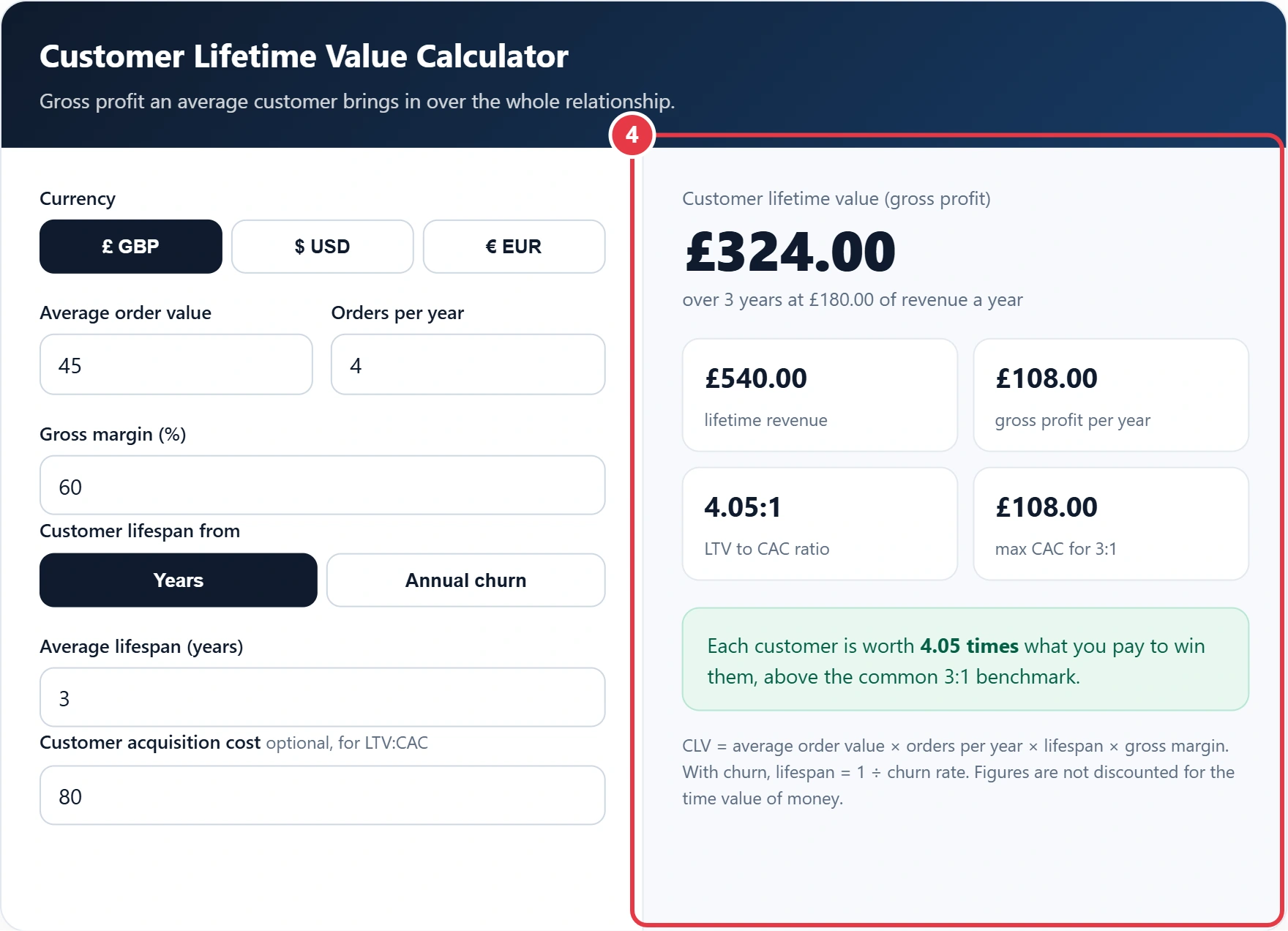
CLV = average order value × orders per year × lifespan × gross margin. With churn, lifespan = 1 ÷ churn rate. Figures are not discounted for the time value of money.
A first order rarely shows what a customer is really worth, because the value builds up over months and years of repeat buying. This customer lifetime value calculator uses the simple, widely taught customer lifetime value approach to turn order size, buying frequency, margin and lifespan into one figure, then sets it against what you pay to win each customer.
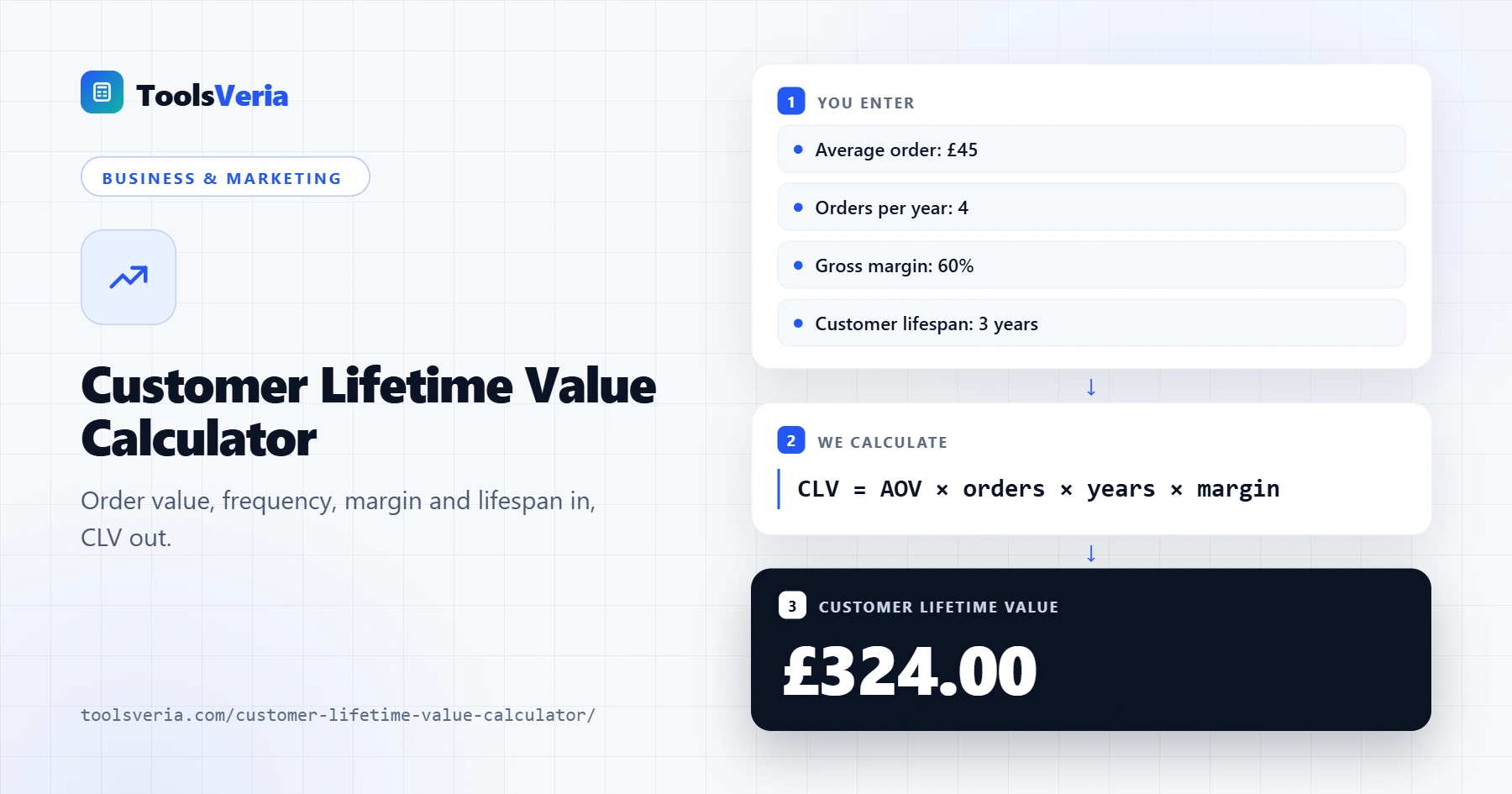
Quick answer: A customer lifetime value calculator multiplies average order value × orders per year × lifespan in years × gross margin. A £45 order bought four times a year at a 60% margin gives £108 of gross profit a year, or £324 over three years. With churn, lifespan is 1 ÷ churn, so 25% means four years.
In This Guide
What Is Customer Lifetime Value?
Customer lifetime value, also called CLV or LTV, is the gross profit an average customer generates from their first purchase to their last. The formula used here is average order value × orders per year × lifespan in years × gross margin. Using margin rather than revenue matters, because a £100 sale with a 20% margin is worth far less to you than one with a 70% margin.
If you do not know how long customers stay, you can use churn instead. A business that loses 25% of its customers each year keeps the average one for 1 ÷ 0.25, which is four years. This is a simple model with no discounting, which is fine for planning but generous for very long lifespans.
How to Use the Customer Lifetime Value Calculator
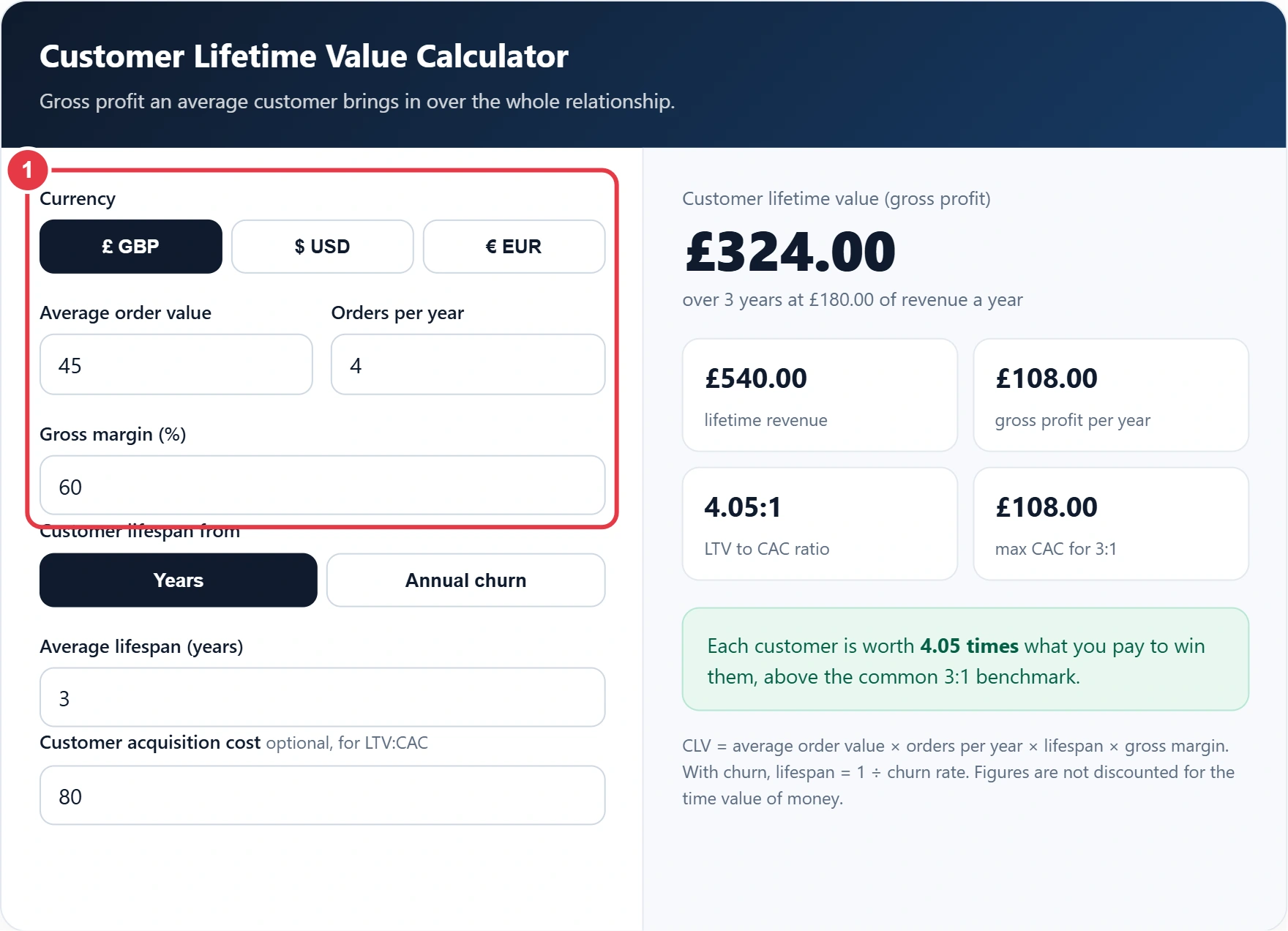
Step 1: Enter Order Value, Frequency and Margin
Pick a currency, then enter your average order value, how often a typical customer buys each year and your gross margin. The average calculator helps if you want to find the mean order value from a list of recent sales first.
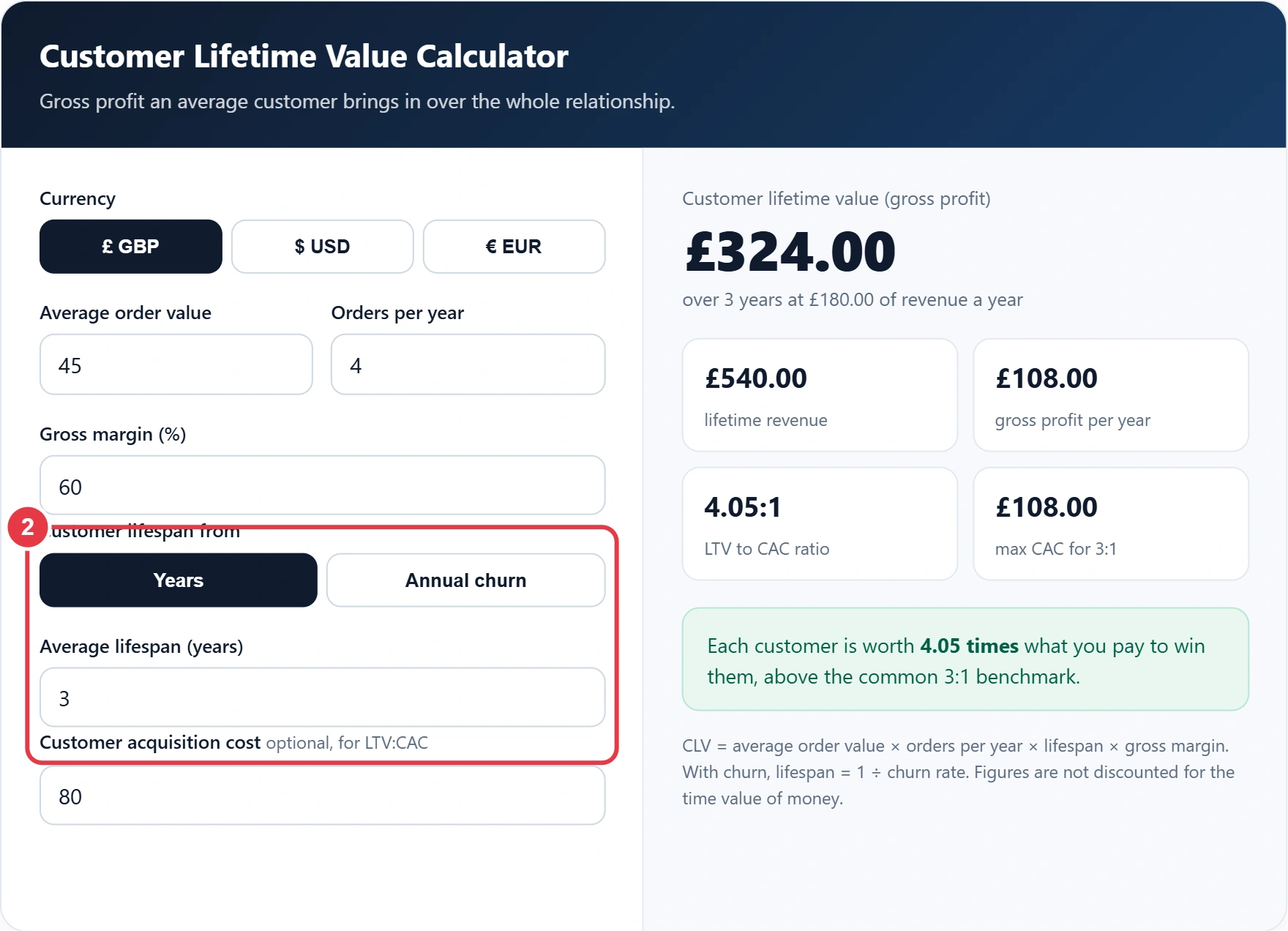
Step 2: Set Lifespan or Churn
Choose Years if you know how long customers usually stay, or Annual churn if you track how many you lose each year. The calculator converts churn into an average lifespan for you.
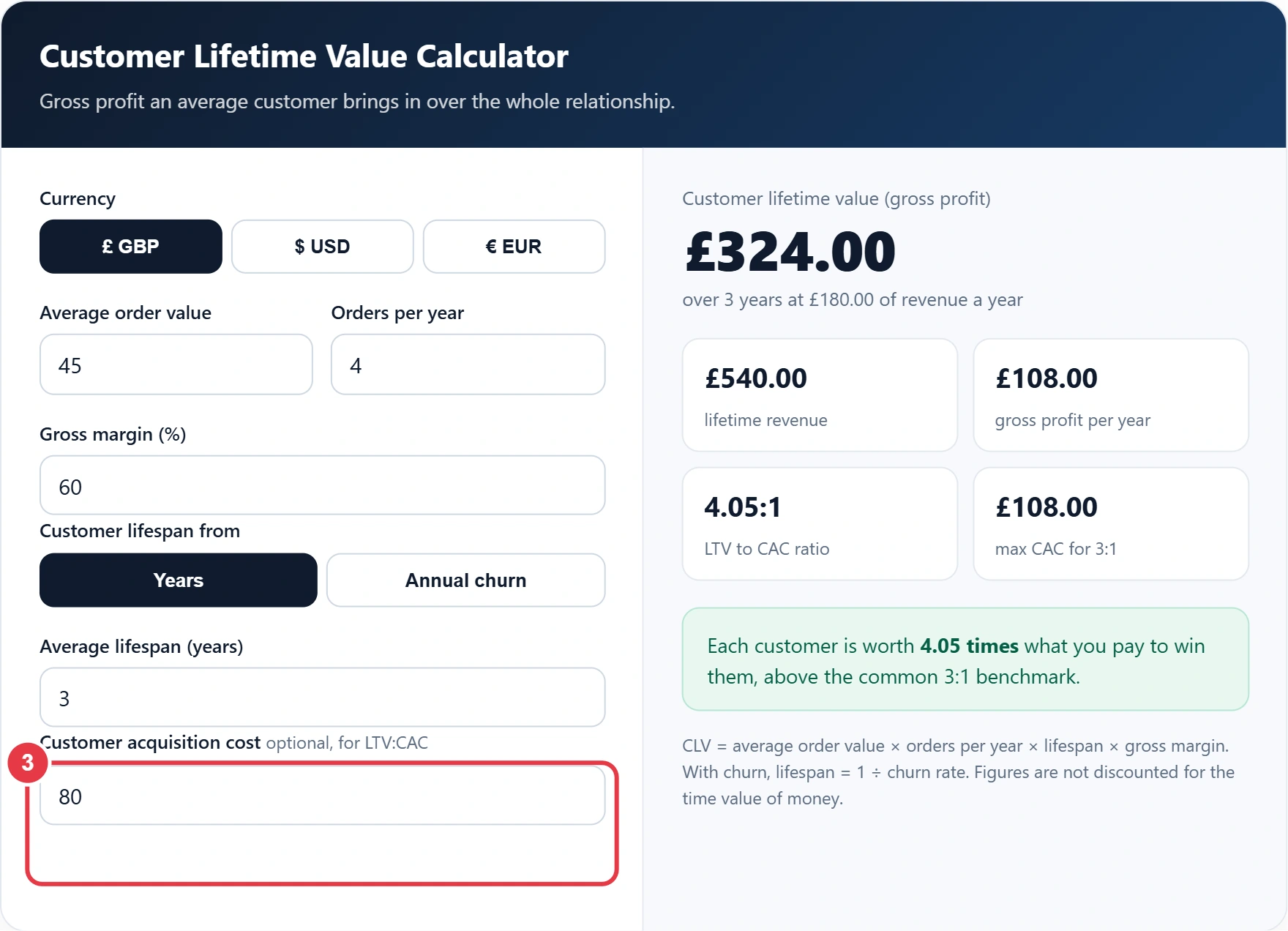
Step 3: Add Acquisition Cost
Enter your average cost to win a new customer. This is optional, but it unlocks the LTV to CAC ratio and the most you could spend to keep a healthy 3:1 balance.
Step 4: Read Your Lifetime Value
The headline figure is lifetime gross profit per customer. You also see lifetime revenue, gross profit per year, the LTV to CAC ratio and the maximum acquisition cost that keeps you at 3:1.
How Churn Changes Lifetime Value
Hannah sells a coffee bean subscription. Her average order is £45, customers order four times a year and her margin is 60%, so each customer brings in £108 of gross profit a year. Over three years that is £324, about four times her £80 acquisition cost. If she raised her prices, the profit margin calculator would show the new margin, but the table shows that keeping customers longer moves the result even more.
| Annual churn | Average lifespan | Lifetime value | LTV to CAC |
|---|---|---|---|
| 50% | 2 years | £216 | 2.70:1 |
| 33.3% | 3 years | £324 | 4.05:1 |
| 25% | 4 years | £432 | 5.40:1 |
| 20% | 5 years | £540 | 6.75:1 |
Cutting churn from 50% to 25% doubles her customer value without a single extra sale. Research summarised in the Harvard Business Review on keeping the right customers makes the same point, so retention work often pays back faster than chasing new buyers.
Key Customer Lifetime Value Terms Explained
These definitions explain the inputs and outputs of the customer lifetime value calculator, helping you set sensible acquisition budgets and retention targets.
- Customer lifetime value
- The total gross profit a business expects from an average customer across the whole relationship. It turns repeat buying into a single figure that can be compared directly with the cost of winning that customer.
- Gross margin
- Revenue minus the direct cost of goods or services sold, expressed as a percentage of revenue. Applying it to lifetime revenue converts sales into the profit actually available to pay for acquisition and overheads.
- Purchase frequency
- The average number of orders a customer places in a set period, usually a year. Raising it through reminders, subscriptions or loyalty schemes increases lifetime value without needing any new customers.
- LTV to CAC ratio
- Lifetime value divided by customer acquisition cost, showing how many times over a customer repays the cost of winning them. A ratio of 3:1 is a commonly used benchmark for healthy, sustainable growth.
- Customer lifespan
- The average length of time a customer keeps buying before they stop. When it is not measured directly, it can be estimated as the reciprocal of the annual churn rate for a steady customer base.
- Time value of money
- The principle that money received today is worth more than the same sum received later, because it can be invested meanwhile. Discounted lifetime value models apply it, while simple models like this one leave it out.
</>Embed this calculator on your website
Add the free Customer Lifetime Value Calculator to your own site or blog. Copy the code below and paste it into an HTML block. It resizes itself and works on phones.
How we checked this tool: the Tools Veria Editorial Team built this tool by hand, checked it against the official rules or published standards where they apply, and tested it against worked examples. Results are estimates for planning, not personal financial or tax advice. Read our editorial policy and disclaimer, or report an error.
Frequently Asked Questions
What is a good LTV to CAC ratio?
A ratio of around 3:1 is a common target. Below 1:1 you lose money on each customer, while far above 5:1 can mean you are underinvesting in growth.
Should CLV use revenue or profit?
Profit gives a truer answer because it shows what you can afford to spend on winning customers. This calculator shows both, with gross profit as the headline figure.
How do I work out lifespan from churn?
Divide 1 by your churn rate as a decimal. Losing 20% of customers a year gives an average lifespan of 1 ÷ 0.2, which is five years.
How often should I recalculate CLV?
Every quarter is sensible for most businesses. Prices, margins and retention change, and an old CLV can lead you to overspend on acquisition.
Does this CLV include discounting?
No. It uses a simple undiscounted model. For lifespans beyond a few years, apply a discount rate to later years to get a more cautious figure.
Can I use CLV for a new business with little data?
Yes, as an estimate. Start with your best guesses, label them clearly and update the figures as real repeat purchase and churn data comes in.